Research associate @uni_muenster. Interested in Social Interaction, Perceived Discrimination, (Mixed) Methods, Participatory Research, Open Science, ...
Come work with me, and let's change the world together one research project at the time.
Looking for a researcher/ statistician and data manager to join my growing and fun team!
https://t.co/cXCGdm5nfO
https://t.co/y5SOYyiH2p
For many behavioral scientists, nothing stings like study results with an unexpectedly small effect. My coauthors—@LinneaGandhi@BenSManning—and I explore the scientific practices and psychological tendencies that drive this phenomenon in our new paper in current directions @PsychScience: https://t.co/USgqJ6WEpJ
As an editor in two international journals, I have learnt four things:
1) that scholars from academically strong countries tend to write as if they were always revolutionizing the field; scholars from peripheral countries, as if they had to ask permission to speak.
In ESM research there are few *validated* items. A problem that is receiving more attention 🧐
There are two papers which illustrate how to use *qualitative methods* to validate ESM context item categories for 1) daily activities and 2) social interaction types. 👥💬
Students conceptualize sense of belonging differently based on socioeconomic status and gender. Daniela Fernández @cambiarcambios presenting her important research @easp2023krk#easp2023krk
I had lots of fun presenting the project idea of the Disidentification workshop of the #EASPSummerSchool2023 tutorized by @IngaJasinskaja Thanks to all my colleagues for these great days!
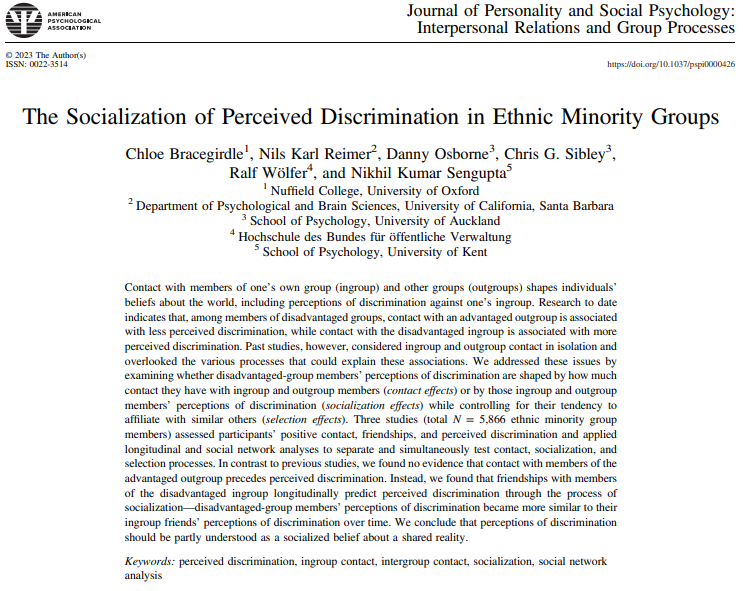
Across three studies we find no evidence of the ironic effect of intergroup contact - instead we find that ingroup contact shapes perceptions of discrimination through socialization. New paper out in JPSP! https://t.co/bH6xTHRFp1 @reimthyme@PsychSengupta@ChrisGSibley
🪃Happy Throwback Thursday TS Fans🪃Celebrate this week by checking out Dr. Molly George’s 2012 article in which they discuss the benefits, challenges and process on teaching about focus group interviewing.
#TS#TeachSoc#Sociologydepartment
https://t.co/EIQnLdrkfU
This paper offers guidance on the benefits of increasing diversity in organizational leadership as well as the means to do so. https://t.co/zdsZYcyXrp
#Psychology@SAGEpsychology
@aydinbayad @ElifthePolPsy @arin_ayanian@IKG_BIE@PolPsyNetDE It was a great conference/session! Definitely left with the thought that these discussions need continuation! If you are planning anything in this direction, please let me know :)
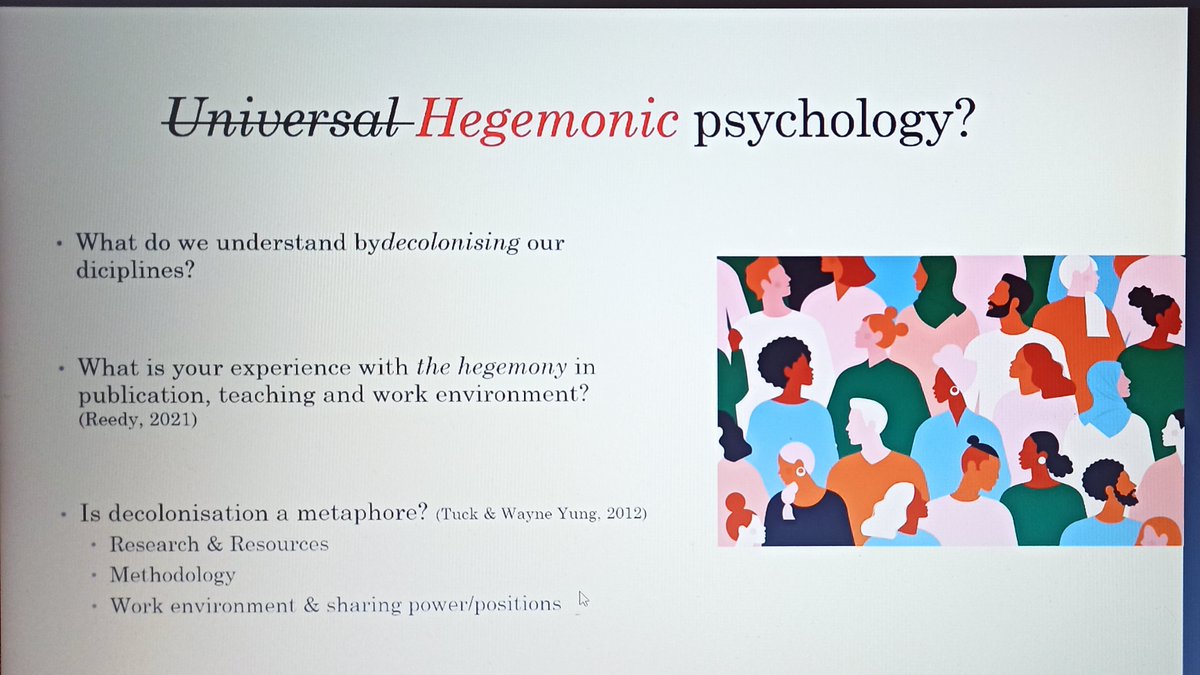
Systems of psychology want more diverse trainees but only if they don’t stand out too much. They want the cloak of diversity without disturbing what’s already been established (white supremacy) — then act surprised when the outsider is ruffling feathers.
People’s cultures impact how they think, feel, and behave in every facet of life. We learn differently. We approach clinical/research differently. We advocate differently. Diversity is the presence of difference. As much as people want “diversity,” systems of power feel uncomfortable with difference.
What has EMA literature taught us about the selection and implementation of common ER strategies of reappraisal, suppression, and rumination? Four most robust findings 1/5
== Preprints: Open guides - effect sizes, confidence intervals, and power. ==
Qinyu Xiao took over guides that I started to guide students in my courses, & did a remarkable job bringing these to become top notch resources.
We would love feedback.
Feel free to use/share.
🧵👇
I am completely astounded by #ChatGPT's capabilities (https://t.co/9IRxjM4Otg). I've been playing around with it to explore possible use cases for psychological research. Here are just a few: 1) Stimuli generation.