I have been following hisposts and I am really addicted to the way he form complex topics with simple words and conclusions. I feel like I can translate better my internal noise into meaning with his words.
Paul Graham wrote a 12,000-word mega essay on how to do great work but the essence of it is a small paragraph near the end:
"Curiosity is the best guide. Your curiosity never lies, and it knows more than you do about what’s worth paying attention to."
This is an incredibly underrated observation.
To really grasp it you have to first ask: what are the alternatives?
You can follow, for example, prestige, or money, or other mimetic forces.
And this typically doesn’t end well.
People find success by following their curiosity.
But then they start drifting away from that.
Suddenly, ambition becomes the driver, or money, or doing something that sounds cool.
And then things start to go downhill.
On a podcast with Shaan Puri, David Perell describes how this happened to him.
He ended up in a writing slump.
I wasn’t feeling it, and I just wasn’t proud of the stuff that I was doing, and I couldn’t get inspired.
His problem was that he had shifted to a frame where everything was based around the idea of him being a “creative force”. In other words, ambition and doing something that sounds cool had become the driver for him.
But when he started he wrote long form pieces that he was really proud of and would get in a great flow.
At this time, his approach was very different.
"I find an idea that was interesting. I would try to figure out that idea for myself, and then I’d figure out for myself, and I’d say, well, then I got to share this with other people. And I never stopped. That’s all I did, and that’s all I focused on."
Once he recognized this and went back to just following his curiosity, the slump instantly disappeared and he started producing great work again.
And Shaan Puri confirms:
"If you don’t know which path to choose, just choose the one that’s most exciting. Just keep following that, and that will lead you to the right place. Excitement is the engine and the rudder, I think, is a really powerful idea. And every time I’ve drifted away from that like you did, I start with that good things happen, and then I’m like, ooh, now, ambition is the driver, or doing something that sounds cool or important or money is the driver. And then all the bad things happen, and I’m like, shit, why aren’t these working? And it’s like, well, because you stopped doing the working formula, which was leading to all these great things, because you thought you needed to do something different."
Another typical example of how this plays out is when people try to use elaborate spreadsheet-point-systems to decide what business idea to pursue.
It’s easy to come up with dozen of criteria that seem important, assign weights to them, and then start ranking business ideas. Unfair advantages, easy to sell, low friction asset production, recurring revenue, no crazy hours, income potential, minimal customer input to get value, how proud will you feel about building your public profile around this, …
The problem with this approach is that you will always be second guessing since you know deep down that all your ratings are completely made up.
You will most likely never start executing or stick to it, since no idea seems perfect if you look at it like this.
And you will waste a ton of time researching that you could also spend executing.
A top-down approach, masterplanning, doesn’t work.
Instead, what does work is a bottom up approach where you just follow your curiosity and only later connect the dots.
As Steve Jobs noted:
“You can’t connect the dots looking forward, you can only connect them looking backwards. So, you have to trust that the dots will somehow connect in your future. You have to trust in something: your gut, destiny, life, karma, whatever. Because believing that the dots will connect down the road will give you the confidence to follow your heart, even when it leads you off the well-worn path.”
I have my own theory how and why this approach works.
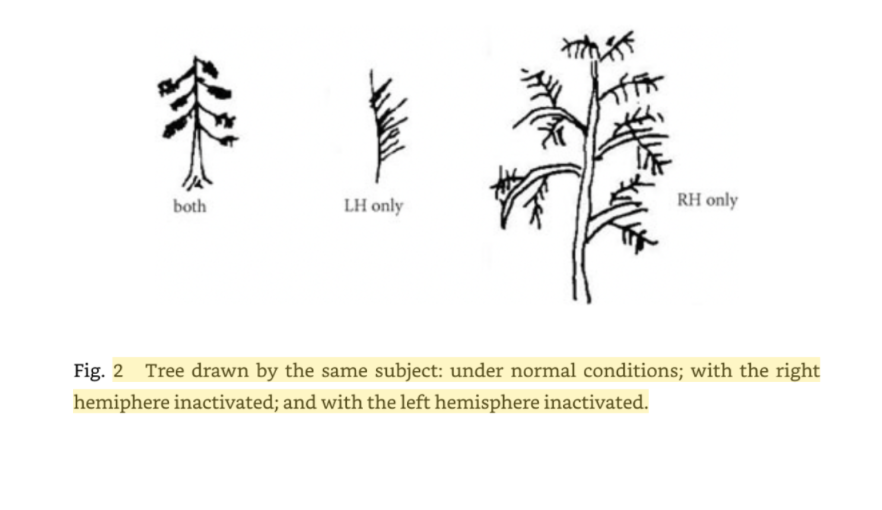
When you’re using spreadsheets or rely on narratives in your head like “this will sound so cool when I tell people about it at the next party”, you’re allowing your left brain take charge.
But your left brain is the Berlusconi of the Brain.
It’s loud, controls the media (that voice in your head), and is largely out of touch with reality.
When you follow your curiosity, you give more power to your right brain.
The right brain is much better connected to the whole around you. It’s fine with ambiguity and doesn’t need fully verbalized trains of thought to pattern match.
The excitement you feel when you follow your curiosity is your body’s way of guiding you in the right direction in a way that doesn’t rely on Berlusconi collaborating.
And that’s why it leads to better outcomes.
It not only steers you in the right direction but also provides the necesary fuel for the journey.
It’s incredibly energizing to follow your curiosity and work on what truly excites you.
If you work on some idea born out of a spreadsheet or left-brain narrative, you will feel low energy and eventually get stuck.
Just think about how hard to is to write an article because you saw that it’s a great SEO opportunity versus writing something because you just want to figure something our for yourself.
“To yell at your creativity, saying, ‘You must earn money for me!’ is sort of like yelling at a cat; it has no idea what you’re talking about, and all you’re doing is scaring it away.” — Liz Gilbert
Not only is the process of creation wildly different but also the output.
Readers can feel how you felt as you wrote something.
And the same is true for any other type of project.
When you follow your curiosity you’re naturally excited about the project.
Your excitement is infectious.
You feel the urge to tell people about it.
Marketing isn’t a chore but a completely natural part of your excitement radiating outward.
The big issue with these ideas is that it’s hard to write about them without sounding a bit woo woo.
It can definitely feel as if the whole universe starts conspiring to help you when you follow your curiosity.
This is where the woo woo ideas come from.
But like I said, what’s really going on is that you give your right brain more power instead of solely relying on your left brain.
The right brain is able to grasp the whole forest not just the trees.
Hence it’s extremely well suited to steer you in the right direction.
But since it doesn’t have access to the media the same way your left brain has, it often feels like magic when these decision play out in your favor.
The universe isn’t conspiring to help you and and excitement isn’t some mystical force.
Instead, excitement is simply information.
It’s your body telling you that you’re on the right track.
That you should keep going.
And the reason why this leads to great outcomes is that excitement is both a great source of energy and tends to point you in the right direction.
So whenever you feel stuck or are unsure what to do, ditch the spreadsheets, ignore what sounds cool, or seems most promising in terms of monetary outcomes.
Just follow your curiosity.
I made an HTML/DOM viewer you can paste into your console to view or debug any website in 3D. Choose from random/gradient/clear colors or whether layers have sides.
You can save it as a bookmarklet so it's 1 click away. It's just a tiny IIFE JS function.
https://t.co/jnbveLYdmN
El prompt usado:
>A frenetic alternative metal song with thundering guitars, a nu metal structure and surprising touches of jazz, complemented by car brake and truck horn sounds
V3 IS HERE 💥 We are excited to introduce our first model capable of producing radio-quality music. v3 allows you to make full, 2 minute songs in seconds and is now available to all users. Try it for free here: https://t.co/E1FhtuO8jS
Thank you to our Pro + Premier members; v3 incorporates your feedback and features several improvements, most notably:
🎧 Better audio quality
🎵 More styles and genres
🎯 Improved prompt adherence, including fewer hallucinations and more graceful endings
Read more on our blog: https://t.co/5IuT0OfuGh
Rick Rubin tells Andrew Huberman how he deals with creative or writer’s block.
He treats his work like a diary entry (and doesn’t worry about internal or external judgment):
➡️ “What's the cause of the block?
The block is usually something that's either personal ("I'm not good enough") or it can be a confidence issue ("I don't have anything to say") or it could be...thinking about someone else ("nobody's going to like what I make").
Do you know what I'm saying?
So, it's either fear of self-judgment or external judgment.
If you're making something with a freedom of "this is something I'm making for myself for now", that is all [you have to do].
It is a diary entry.
Everything I make is a diary entry.
The beauty of a diary entry is that I can write my diary entry and you can't tell me that my diary entry wasn't good enough.
Or that [the diary entry] is not what I experienced. Of course it's what I experienced: I'm writing a personal diary for myself and no one else can judge if it is my experience of my life.
Everything we make can be that: a personal reflection of who we are in that moment of time.
It doesn't have to be the greatest you could ever do.
It doesn't have to have any expectation that it's going to change the world.
It doesn't have to sell a certain number of copies for any reason.
It doesn't have any of those things at all.
It is "I'm making this thing for me and I want to do it to the best of my ability and to where I feel good about it".
[The work] is honest of where I'm at and if you're living in this world of just being honest to where you're at, there's nothing blocking you.
There are no blocks.
The blocks are all based on dealing with a different force or a different perception that is made up.” ⬅️
📚I Jornadas Por una educación sin miedos
✔️Prevención del acoso escolar y uso de las nuevas tecnologías.
▶️Síguelo en directo #educacionsinmiedos
https://t.co/fmGk1bf35u
I'm a big proponent of creating personal rules to simplify everyday decision-making and free up mental bandwidth
Here are 7 rules I've developed for myself around task management: