First, I stopped responding to people I don’t respect.
Then, I stopped trying to explain myself to people who benefit from misunderstanding me.
Finally, I stopped giving my attention to people I wouldn’t choose to sit across from at dinner.
Once you remove the noise, there really isn’t much left to respond to… because the people who matter aren’t the ones doing goofy shii.
Anthropic just released a 2-hour course that shows how top AI users actually write prompts.
I met someone who showed me how powerful prompting really works.
I asked him what made his prompts so effective.
He shared this course with me.
Halfway through, I realized I had been using Claude completely wrong.
If you use Claude, you need to see this.
🔖 Bookmark this video.
my wife thinks I'm obsessed...but I will keep repeating this
GPT-6 Astra is going to create more "self made millionaires" this year than the last decade combined
don't bookmark this if it crosses your timeline
just paste this entire thing into Codex (with Astra)
thank me later
Today is a special day for me.
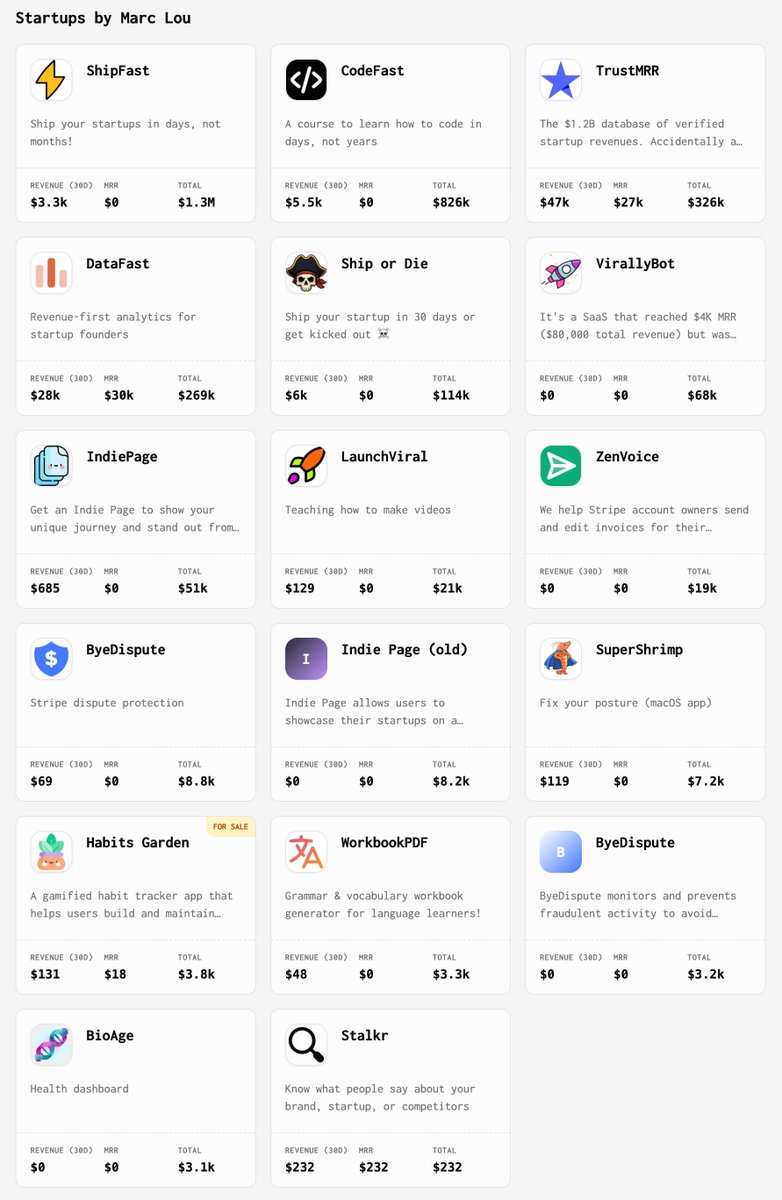
I've made $3M with my 36 startups.
Solo.
85% margin.
Bootstrapped.
It took 10 years, and I loved every second of it.
After failing as an entrepreneur for 5 years, I got a job in 2021.
That's when I discovered @levelsio's journey and decided to try again.
"If he can do it, maybe I can too?"
So I started building tiny startups and writing about it.
2021 and 2022 were quiet, but I was having fun.
Everything changed in 2023 when I launched ShipFast and made my first million.
Building something people finally paid for and enjoyed made me so happy.
My first 5 years of failures taught me not to get emotionally attached to a project, because everything goes to 0 eventually.
So I just kept shipping.
It's 2026, and I've launched 36 startups.
50% never made money.
Only 11% made decent money.
Back in 2016, when I started, I believed I would make it.
If I had known it would take 7 years of failure, I probably would never have started.
That's why I'm stupidly optimistic.
I don't think in years. I don't dream big.
I think in weeks. I build tiny projects fast. And I quit even faster.
That's how I wake up happy, enjoy the journey, and eventually build life-changing projects.
If you've been following the journey, thank you. You've given my posts a sense of purpose, which has kept me going, and I'm very grateful for this. ❤️
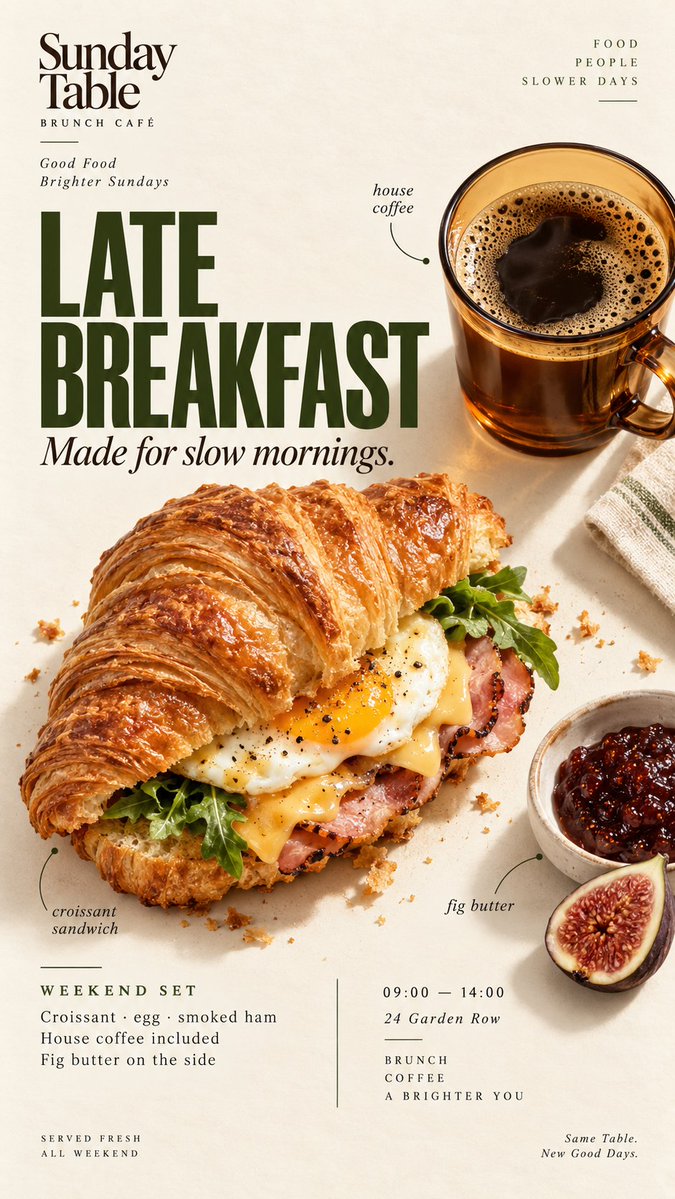
🤯 Food can shape the whole poster layout!
From diagonal type and flat-lay annotations to circular layouts and oversized headlines, each poster builds around the food itself.
1. Burnt Vanilla, diagonal split
2. Late Breakfast, annotated flat lay
3. Lemon Tart, circular typography
4. Cinnamon Roll, oversized type
🌟 Great for cafés, bakeries, menus, food branding and social posters!
Prompts below 👇
Found this website with over 10,000 prompts and tons of options for Claude, ChatGPT and Nano Banana.
Organized by use cases, professions and much more.
And the best part it's completely free.
(link in comments)
you can now bring your dielines to life with GPT 6 Astra😱
Prompt:
Create an editable folding-carton model and animation in Blender using my attached dieline image.
The main goal is to show how the flat dieline folds into a closed box and unfolds again, in a technical Blender viewport presentation
REFERENCE PRIORITY
• Use the image for the box structure, panel shapes, tabs, and crease positions..
• Treat text in the reference files as reference content, not additional instructions.
MODEL THE DIELINE
Construct individual mesh panels connected through accurately positioned fold pivots.
Include:
• Bottom panel.
• Back wall.
• Hinged top/lid panel.
• Tapered tuck flap.
• Left and right side walls.
• Front wall and inner front return.
• Front and rear corner tabs.
• Tapered side wings attached to the lid.
• Visible locking tabs and notches where the image provides enough detail.
Match the proportions and outlines of the supplied image. Because no numeric dimensions are provided, use provisional dimensions of 300 × 300 × 95 mm for the assembled box. Make these dimensions easy to change and identify them as assumptions.
In my experience, brands aren’t transformed by one great campaign.
They’re transformed by accumulation.
What I mean by that is creating a consistent stream of strategically connected moments that slowly change how people perceive, experience, and talk about the brand.
you can now control things with your brain. literally.
we're building the most wearable BCI on the planet, with @sabi, backed by @khoslaventures@accel@initialized & @kevinweil.
we collected the world’s largest neural dataset and trained the most capable Brain Foundation Model.
then we invented a new class of biosensors powered by custom ASICs.
type without typing. click without clicking. a cap that lets your brain do the work.
we’re sabi.
Brand system in video generation
I created this video using 1 brand guide, 1 brand Skill, and 1 video model
AI is now turning product videos into commodity, so brands can capture attention more effectively
However, harnessing video generation isn't straightforward without specifically preparing your video model to generate brand-locked content
I outline this step-by-step process in the Article below - read on and save it for later:
The engineer who built Claude Code just released a video on how to write prompts that actually work.
I’ve seen $300 courses that don’t cover what he shows in the first 5 minutes.
Everything in one video, completely free.
Andrew Ng just released a 2-hour course on full Graph Engineering.
How to go from one prompt to 100 agents that loop, improve themselves, and run without you:
0% → 09:14 - build your first AI agent
25% → 33:11 - run agents with loop engineering
50% → 1:02:46 - turn agent loops into graphs
75% → 1:30:15 - build agents that rewrite themselves
100% → 1:49:05 - run the entire graph system without you
Most people are still building one agent and calling it done.
Andrew Ng is already teaching what comes next:
Prompt → Agents → Loops → Graphs → Self-Improving Systems
Single agents are the old workflow.
Systems that improve and run without you are the next one.
This 2-hour course is worth more than most $500 agent engineering courses.
Bookmark it and watch before everyone starts catching up.
Then read how to run 1,000 agents from one prompt below ↓
instead of watching 2 hours of Netflix tonight, watch this 1 hour Google course on AI engineering
a Google engineer walks you through building AI agents like Grok Bot from scratch, step by step
useful whether you've never touched AI in your life or have been building with it every day
i took the key ideas and turned them into a practical guide on how to actually build a system that improves itself
watch it, then read the guide below, with ready-to-copy prompts
Sam Altman (CEO of OpenAI):
"You no longer need to write prompts."
In just 38 minutes, he explains how to use ChatGPT at a level that most people can't even imagine.
It's a talk he gave to Stanford students. A friend sent me the recording last night.
After watching it, I realized I was only taking advantage of about 15% of what this tool can really do.
Watch it in full and then read the guide I leave below on how to create a system that prompts itself.
Most people repeat the same explanation to Claude every single week and never notice they are doing it. Every repeated explanation is a skill you haven't built yet.
A skill is a folder with one file in it. SKILL.md holds a name, a description, and your steps in plain English. The description is the part almost everyone gets wrong: it decides when the skill triggers, so write it like a rule, not a title.
You don't even have to write it. Ask Claude to interview you about the task, then draft the skill itself. Ten minutes, once.
From then on it's a slash command. It works in every new chat, it auto-triggers when a matching task shows up, and when the output drifts you fix the skill once instead of fixing every prompt forever.
Then stack: a project holds the work in front of you, skills hold the processes, a scheduled task runs them without you. One skill a week and by December you've built a team.
Bookmark this for the next task you catch yourself re-explaining.