Influencer marketing is underrated.
Affiliate marketing is overrated.
Customer care is an overlooked brand touchpoint.
And if Alexander Morabbi were advising the CMO of a fast-growing DTC brand?
No discounts.
Comment “OMHU” and I’ll send you the full episode.
Premium doesn’t have to mean serious and inaccessible.
OMHU positions itself as a mid-to-high-end brand, borrowing cues from premium and luxury brands so its perceived value outweighs its price.
The difference? They remain playful, bold and accessible to a broad audience.
Comment “OMHU” and I’ll send you the full episode.
More creative output doesn’t automatically create better performance.
OMHU produces a high volume of content, but they’ve moved away from obsessively testing every individual creative.
Instead, they focus on selecting strong concepts, creating enough diversity to reach different audiences and trusting the algorithms to distribute them.
The goal isn’t volume or production value in isolation.
It’s producing the right variety of good creative.
Qualume as Hormozi would call it.
Comment “OMHU” and I’ll send you the full episode.
Most brands face the same creative tension:
Stay consistent & distinct enough to build a recognisable brand — but create enough diversity for the algorithms to find new customers.
Alexander Morabbi, CMO at OMHU, believes fewer than 1% of e-commerce brands have truly nailed that balance.
OMHU protects consistency across its website, email and organic social, while allowing significantly more experimentation in paid acquisition.
Because social-first brands can’t afford to make every ad look the same.
Comment “OMHU” and I’ll send you the full episode.
One hero product can make your business remarkably simple.
Fewer SKUs. Less complexity. More data. And a much sharper understanding of how to market the product.
But it also creates a ceiling: retention becomes harder, upsells are limited, and successful products attract copycats.
Alexander Morabbi, CMO at OMHU, explains the trade-offs behind building OMHU around the TEDDY sofa.
Comment “OMHU” and I’ll send you the full episode.
Discounting is easy to start and incredibly difficult to escape.
After building his own brand, running an agency and working with some of Scandinavia’s biggest e-commerce companies, Alexander Morabbi (now CMO at OMHU) biggest lesson is simple: If you’re building a lifestyle brand, avoid becoming dependent on discounts from the beginning.
Otherwise, the short-term cash-flow fix can quickly become a permanent downward spiral.
Comment “OMHU” and I’ll send you the full episode.
Products can be copied. A complete operating system is much harder to replicate.
OMHU moat isn’t only the TEDDY sofa.
It’s the combination of a distinct brand, growing awareness, DTC distribution, first-party customer data and a social-first marketing strategy.
The product gets attention.
The system around it builds the advantage.
Comment “OMHU” and I’ll send you the full episode.
Comment “OMHU” for the full episode.
Brand Operators is live 🎙️
In our first episode, we sit down with OMHU (https://t.co/0Sw8bBdEBv), one of Denmark’s fastest-growing interior brands and recent winner of several Danish eCommerce Awards, including Best Export Case, Best New eCommerce, 2nd place in Best eCommerce over 100M DKK, and the overall Gold Award for Denmarks best eCommerce.
We unpack how they’re building a premium, social-first DTC brand in a category dominated by showrooms, wholesale and discounts:
- OMHU’s MOAT, and why their advantage is more than just the TEDDY sofa
- Their zero discount policy in a category filled with aggressive discounting
- How they position OMHU between accessible & premium
- The pros and cons of scaling with one hero product
- How their social-first content system actually works
- Why influencer marketing is one of their most important growth channels
- How they structure the team across growth, influencer and creative
- Why they’ve stayed DTC over wholesale (for now)
- How they think about attribution with a long customer journey
- Why customer care becomes a brand touchpoint for high-ticket products - How to win when media gets more expensive
#ecommerce
We’re launching a new interview format: Brand Operators.
In-depth interviews with the operators and marketers behind leading lifestyle brands meaning fashion, jewellery & watches, interior & beauty.
Not surface-level growth stories.
The operating system behind them.
First guest: Alexander Morabbi, CMO from OMHU (https://t.co/FYkzf1R6JV, https://t.co/vgsh5dAtg2).
OMHU is one of Denmark’s fastest-growing interior brands, and a prime example of how to build a social-first DTC brand in a category traditionally driven by showrooms, wholesale and discounting.
In episode 1, we cover:
- OMHU’s moat
- Their zero-discount strategy in a category that rely on aggresive discounting
- Positioning between accessible and premium
- Scaling with one hero product
- Team structure to enable influencer and creative at scale
- Why they’ve stayed DTC
- Attribution in a long customer journey
- Customer care as a brand touchpoint with high-ticket products
- Winning when media gets more expensive
After recently winning several Danish eCommerce Awards, including:
- Best Export Case
- Best New eCommerce
- 2nd place in Best eCommerce over 100M DKK
- and the overall Gold Award
I couldn’t ask for a stronger first guest.
Comment “OMHU” and I’ll send it over when it goes live.
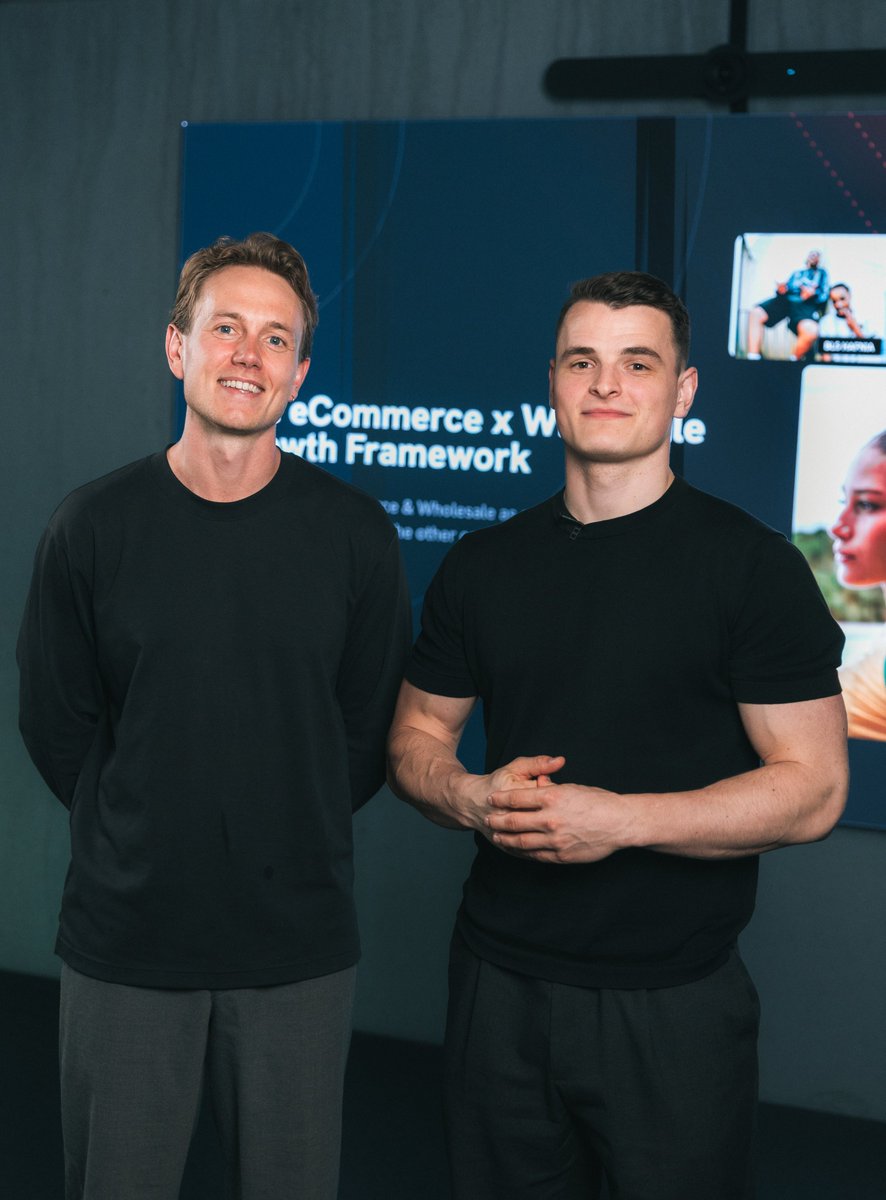
Brands running eCommerce and wholesale in silos are driving with the handbrake on.
eCommerce should make wholesale easier to sell-in.
Wholesale should make eCommerce easier to scale.
But when the two channels are run separately, the opposite often happens:
- Misaligned KPIs
- Poor budget allocation
- Weak retail activation
- Unclear ownership
- Channel cannibalization
That’s why I teamed up with Casper Brix from Atlo, former CPO at https://t.co/kcpPfktJIl & Berlingske Talent 100, together with https://t.co/fIwEUhPqXr.
Atlo works with lifestyle brands where wholesale is core to the business.
FABO works with lifestyle brands where eCommerce is the growth driver.
Together, we built a case and scorecard for how lifestyle brands can run eCommerce and wholesale as one connected growth system.
Not as “performance marketing”.
Not as “just get more retail partners”.
But as one commercial model where eCommerce builds brand and demand, while wholesale scales distribution and makes the brand physically available.
The case is built around our scorecard, which consists of eight recurring constraints we see across lifestyle brands, spanning both eCommerce and wholesale.
FYI it is the same scorecard we use in client work to pinpoint where a brand is strongest, where it's leaking growth, and which constraint to fix first.
If you run a lifestyle brand and you are:
- Selling eCommerce, but growth costs keep climbing → eyeing wholesale
- Selling wholesale, but want more ownership of demand and brand
- Selling through both, but in silos
Then this will be a must-watch.
We’ll share the case and scorecard very soon. Stay tuned so you don't miss it.
What biz owners think is the process for making good TikTok ads:
Send free product to an influencer because he/she looks cute, and have them make a video
What ACTUALLY convert buyers: Casting good creators, aligning on top value pops, framing, creating the script & storyboard..
Unpopular opinion from a media buyer:
80% of paid succes for e-commerce on Tiktok comes from having great creatives that feels native to the user, but includes all sales psychological triggers.
20% of results (or less) is the actual targeting and optimization.
Change my mind.
Tiktok videos not going viral? You're probably missing THIS 1 thing.
🚨 A great Intro-Hook 🚨
I made a list of last month's Top 65 Viral Intro-Hook's.
Want a copy? 👇
Each Intro-hooks has resulted in MILLIONS of views.
RT + Comment "send" and I'll auto-dm it to you