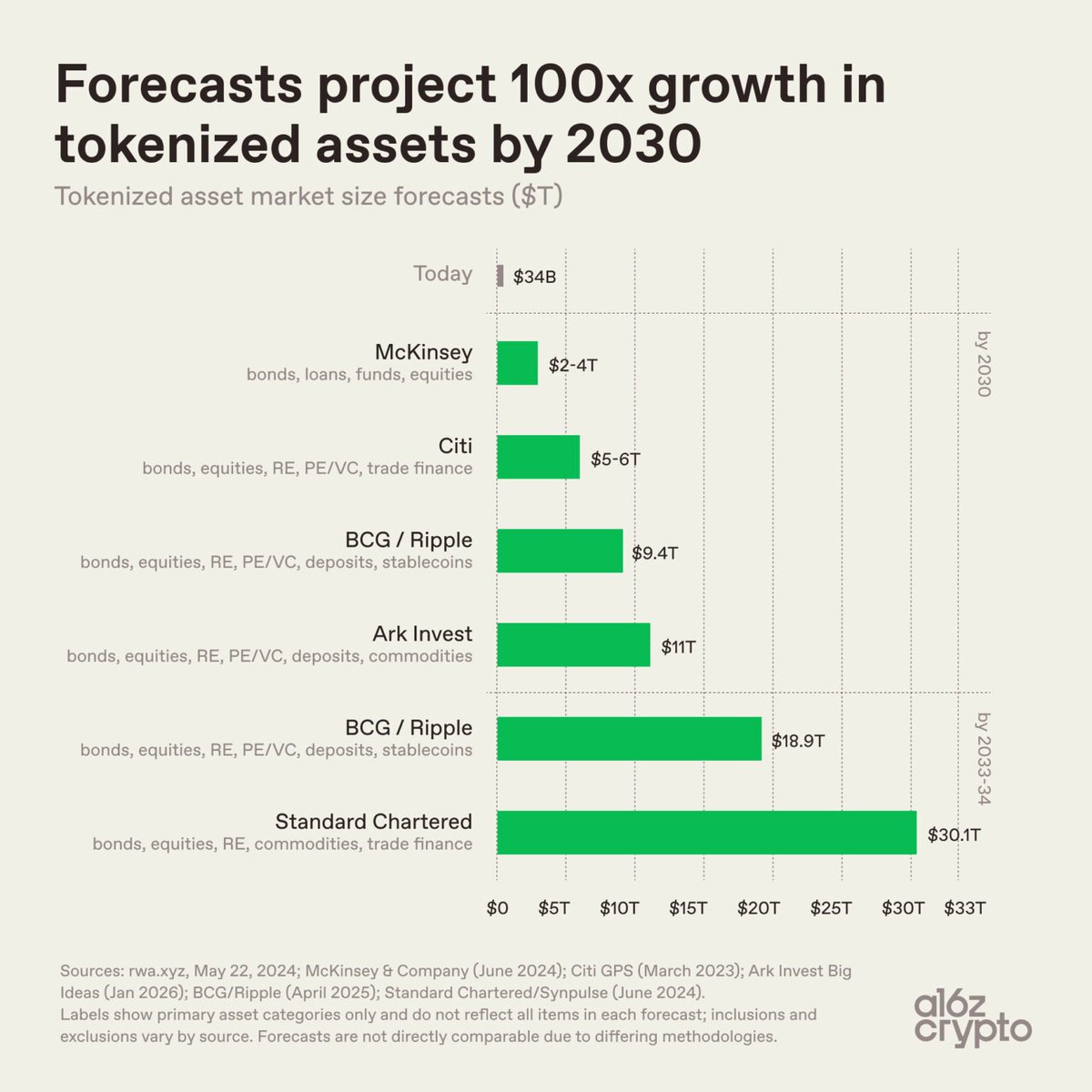
Looking ahead, forecasts for tokenized assets vary a lot but they all point in the same direction: growth.
McKinsey: $2–4T by 2030.
Ark Invest: $11T by 2030.
BCG/Ripple: $9.4T by 2030, $18.9T by 2033.
Standard Chartered: $30T + by 2034.
The gap between $2 trillion and $30 trillion is more about definitions than adoption.
Different institutions are measuring different things. McKinsey focuses mostly on bonds, loans, funds, and equities. Standard Chartered adds commodities and trade finance. BCG and Ripple include deposits and stablecoins alongside more traditional asset categories.
Despite these differences, the broader trend is consistent: Asset tokenization is expected to expand.
Base is doing things the right way: an L2 on top of Ethereum, that uses its centralized features to provide stronger UX features, while still being tied into Ethereum's decentralized base layer for security.
Base does not have custody over your funds, they cannot steal funds or stop you from withdrawing funds (this is part of the L2beat stage 1 definition).
You can see Base's status as an L2 on l2beat: https://t.co/bBrvnbxSgD
I feel like many people have been confused by recent cynicism and think that things like L2beat are a weird sort of nerd-sharia compliance authority. This is NOT what is going on. The security that L2s provide, that L2beat measures, reflects concrete properties that protect you as a user from being rugged.
Here is an explanation of how, if an L2 shuts down, users are automatically able to withdraw funds even without that L2's involvement:
https://t.co/r3EF8lhTEl
Here is an example of how L2s prevent the operator from censoring transactions, that happened on Soneium earlier this year:
https://t.co/Pi0InKekbZ
This is what we mean when we say that L2s are non-custodial, they are extensions of ethereum, not glorified servers that happen to submit hashes. There are concrete pathways implemented in smart contract logic on Ethereum L1, that have been successfully used in the wild, that ensure that the L2 users' funds are ultimately controlled by L1, they cannot be stolen or blocked by the L2 operator.
10 things we don't talk about enough that you can build on Ethereum:
1. Diplomas that can’t be faked
2. Traceable relief money that actually makes it to people after a disaster (saw this need first hand even in the LA fires)
3. Contracts that enforce themselves
4. Medical records you own & share when you want
5. Pay that shows up the second you finish a job
6. One login you can use everywhere online
7. Books you can co-write with your community
8. A savings account that doesn’t ask for your whole damn life story
9. Rent that splits automatically between roommates
10. Tickets to shows that can’t be scalped
And so. much. more......
What did I miss?
you don’t need to understand blockchains, you just need to want better tools.
tools that let you:
- get paid instantly from anyone, anywhere, anytime
- get paid today for work you did today
– hold your savings without worrying if your bank will freeze it
– own something online that actually belongs to you
– earn income even if you live far from opportunity
– borrow money permissionlessly
– own your own online identity
– crowdfund a dream with strangers who believe
- publish something that lives forever
- use a new financial system from your phone
- invest in projects made by people like you
and much, much more.
soon enough you won’t even have to say it’s crypto, you’ll just know it as “better.”
Times like this are always wobbly in the markets as this is where a lot of people end up selling because they think the bull market is over and want to protect themselves by taking profits (nothing wrong with this of course).
The issue is that once the market starts going again in the new year, these people will have insane amounts of fomo and jump back in with the profits they took - except now they're buying at higher prices and investing emotionally which clouds their judgement.
This is just 1 of the numerous ways that people can end up making no money or even losing money in a market where everything is going up and let me tell you my friends, this is one of the worst feelings and will burn you out of crypto very quickly.
As I've said before, the greatest trick crypto ever pulled was convincing people that investing is easy.
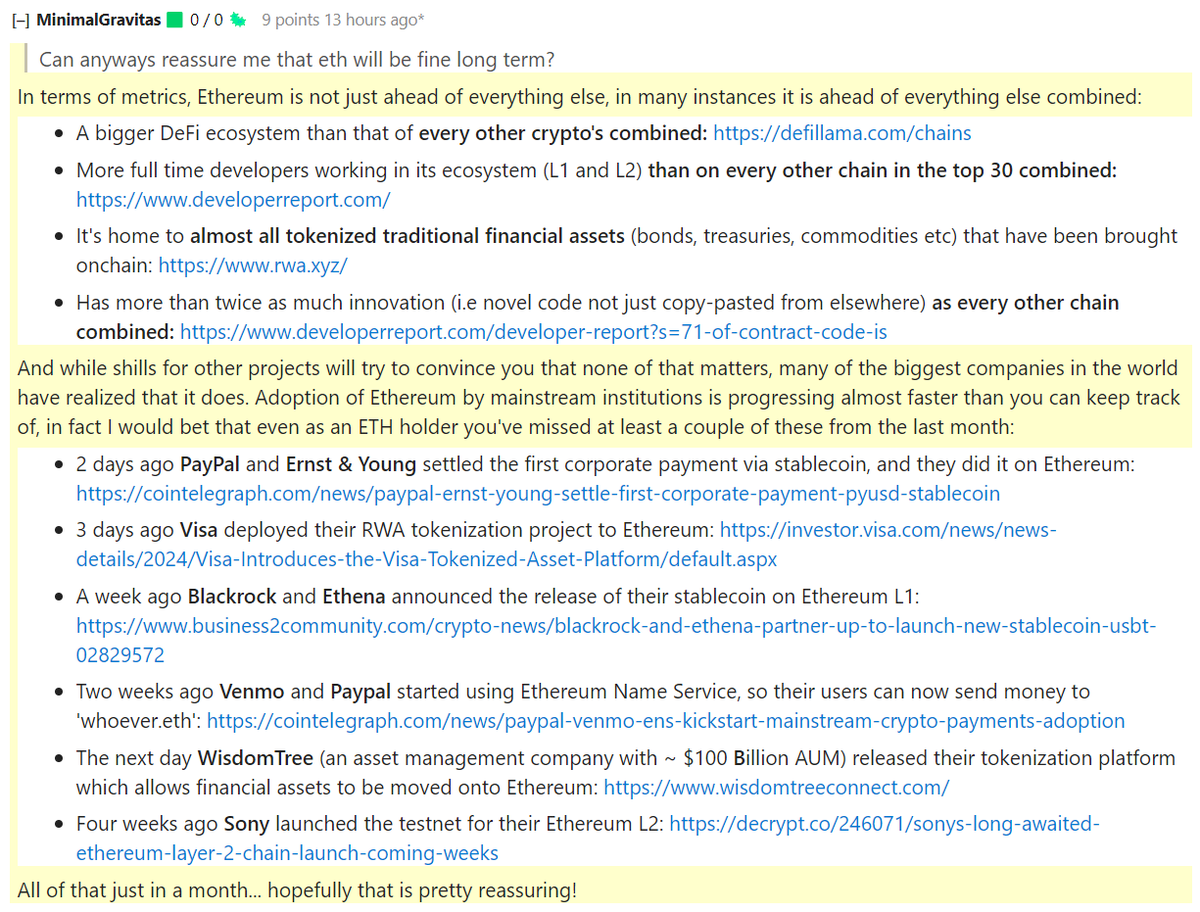
Major companies building on Ethereum:
- BlackRock
- Franklin Templeton
- PayPal
- Robinhood
- Visa
- Stripe
- Google
- Venmo
- Sony
- Samsung
- Deutche Bank
- Citi Group
- UBS
- Microsoft
- Christies
- Fox Corporation
- and many more
The ticker is ETH
Coinbase is the largest crypto company in the US
they know that exchange revenue will be a race to the bottom from here. every brokerage and every bank will soon offer crypto services
but they are not being complacent. their future as a public company now lies is disrupting the financial system by using onchain rails, and leaning hard into payments is just the start of that. i think their longterm vision is far bolder than that
and they’ve chosen ETHEREUM as the place where they’re primarily building onchain in the form of Base L2
probably nothing
Not sure there is a full appreciation for how special EVE Frontier is
You write solidity contracts on Ethereum L2 to help run your spaceship and starbases in a Triple-A PvP open world by the best space sim company in the industry.
Eth L2 contracts run your space empire 🤯
unpopular opinion: all of Ethereum's "problems" would be "solved" if the EF just hired a good marketing department and Vitalik RT'd one great project from the Ethereum ecosystem per week
I have thought through it again and again, and while Solana has some cool things, fundamentally there is no zero-to-one innovation there, it is a smart contract chain with beefier nodes and some cool optimizations, but should not be nearly enough to overcome Ethereum's advantages and more logical long-term roadmap. However, if the FUD and bad price action continues, Solana could 'win' despite Ethereum having every advantage because when new retail comes in, at this point they're going to be buying SOL in droves, not ETH, and this will attract apps, money, more network effects. etc.
The EF needs to *panic* and launch a great marketing operation*now*.
It's literally just a marketing issue, with people not understanding rollup-centric roadmap and its merits and other ecosystems FUDDing that roadmap all day every day (while also copying it under different nomenclature) with no direct rebuttals from Ethereum technical leaders (who are in a Farcaster echo chamber)
Going in a more Solana-ish direction by optimizing the L1 itself will not help ETH price or narrative, it will make it worse imo.
Also there is zero legal reason not to do heavy marketing now that: (1) ETH is irreversibly recognized as a commodity; and (2) Trump will win and all crypto is likely to be low-regulated similarly regardless of marketing or social decentralization levels
Will this happen though? Probably not unfortunately so yeah that is bearish and if I were to recommend to a normie to buy an L1 token right now, it would be SOL not ETH. I'd love for the EF and Ethereum technical leaders to wake up and realize they can have the best design and roadmap in the world, it will not matter if ETH keeps underperforming.
@coincashew_ Thanks for your guide - has been very helpful! FYI the instructions for How to Update MEV-boost on your site, Option 2 - Build from source code, downgrades me to v1.5. Option 1 upgrades me to 1.8 though.
If I was a VC funded L1, I'd be hating on Ethereum, too.
That's just game theory, it's the most successful L1 in the space to date, largest developer community, highest rate of homegrown code, and unable to be replicated in its origins. If I was a competitor, I'd be foolish not to be concerned.
Spinning L2's as parasitic to L1 is a great short term strategy, but it's irrational in the long term once adoption occurs and scaling needs to happen.
While I want to be diplomatic, good diplomacy also requires a backbone.
Centralized solutions are going to be eviscerated by enterprise clouds that perform faster, better, and cheaper. If your users 'don't care about the tech', then applications built on enterprise cloud environments are out competing blockchains on every single facet right now for enterprise and retail users alike - regardless of financial use cases or not.
The only thing cloud environments do not have is open decentralization. Ethereum works on that problem more aggressively and pragmatically than its competitors. This infinite game is the best strategy hands down.
Just recorded with Andrew Koller (Ink founder) and @hilmarxo
Notes on Kraken's new L2:
- 8 months from decision to launch @inkonchain
- Ethereum as DA, also looked at Celestia and Eigen
- L3 DA could explore more modular not just Ethereum
- Could have more than one L2 in the distant future (not anytime soon)
- Thought about building in-house but used RaaS provider Gelato
- Goal to get centralized order books onchain
- Wallet is the portal
- Thought about forking OP Stack but leveraging the interop of Superchain made more sense
- Didn't share revenue split but will be public soon
- Will lean into dev tooling ahead of mainnet
- 1000+ people at Kraken are in the Ink slack channel
- Hundreds of L2s are launching in next several months
- Very obvious now that every app will have its own chain
- BlackRock, Nasdaq, Dow Jones, etc will also eventually have their own L2s
- Launched with Base support
- Vercel, Amazon, Google, etc should build (or probably buy) a RaaS provider
- Kraken would launch a token for Ink if it wasn’t for the regulators
- Board members and investors liked it, doesn't think it will hurt future IPO prospects
- Unofficial vision is to have every PRD at Kraken have an onchain component to it
Way more details in the podcast, out on @theempirepod soon.
degens crying that there is nothing fun to do on Ethereum
meanwhile real world adoption is taking off with both corporations and governments building on it
ranging from onchain asset networks to identity solutions to stablecoin payments to decentralized finance
@EthereumFilm I think it recognizes my address now, but I’m getting “No compatible source was found for this media.” Received that using MetaMask on iPhone.
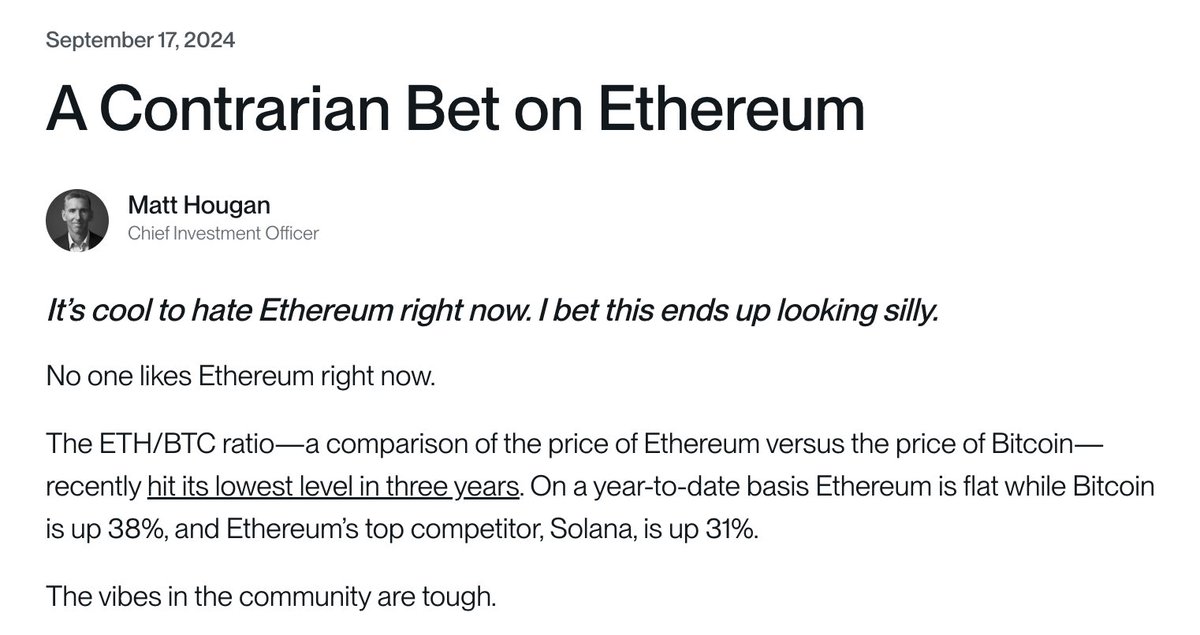
Ethereum’s slump has attracted some haters. What they’re missing:
- More than half of all stablecoins are on Ethereum.
- More than 60% of all DeFi assets are locked on Ethereum.
- Polymarket settles on Ethereum.
ETH looks like a potential contrarian bet through year-end 2024.
why look at ETH now?
because everyone and their mother hates it and crypto is cyclical and people have short memories. halvening will possibly mark a pivot
everyone acting like ETH is dead, but has 56% of TVL for the entire space- JUST at L1. and that percentage has been pretty much constant since May 2022, despite the rise of alt-L1 killer narratives
L2s taking off big since EIP-4844. most L2s use ETH as gas. Coinbase Smart Wallet about to launch to 100 million Coinbase customers. i think Base will all other L1s in TVL by EOY tbh, and everyone using Base will buy ETH for gas and programmable money
bottom-line is L2s now providing a surface for retail to participate, and with superior UX to other chains which make unworkable tradeoffs which result in network-killing spam routinely. this wasn’t the case 2 months ago, but it is now
EVM L2s also inherit tons of Ethereum apps and tooling which will accelerate dev. other ecosystems still suffer from poor tooling, block explorers, and tons of closed source apps
and restaking proving the value prop of ETH as a store of value asset
even Blackrock building on Ethereum. Coinbase L2 won’t be the last either. expecting plenty of corporations to FOMO in with their playbook. no more private blockchain theater. they will build L2s
ETF may be rejected in May, but that will start the narrative for eventual approval after a court case against the SEC which everyone expects will be won
combined with cyclical factors noted above, there’s never been a better time to look at ETH
.@cdixon spoke with @andrewrsorkin about future of crypto and benefits of blockchains.
‘Read Write Own - Building the Next Era of the Internet’ reveals how blockchain networks grant power/economic benefits to communities of users, not just corporations.