How to become AI engineer in next 6 months:
By the end, you want to be able to:
- build LLM apps end-to-end
- use APIs from OpenAI / Anthropic / open-source stacks
- design prompts and context properly
- add tool calling and structured outputs
- deploy real projects
So, let’s discuss your roadmap month by month
Month 1: Get solid enough in coding and fundamentals
What to learn:
- Python really well
- Git + GitHub
- CLI / terminal basics
- JSON, APIs, HTTP, async basics
- basic SQL
- basic data handling with pandas
- virtual environments, package management, error handling
- FastAPI or Flask
Month 2: Master LLM app development
What to learn:
- prompting fundamentals
- system vs user instructions
- structured outputs / JSON schemas
- function/tool calling
- streaming responses
- conversation state
- cost / latency / token basics
- failure handling
- prompt injection awareness
Month 3: Learn RAG properly
What to learn:
- embeddings
- chunking
- vector databases
- metadata filtering
- reranking
- retrieval quality issues
- hallucination reduction
- citations and grounding
Month 4: Agents, tools, workflows, evals
- agent loops
- tool selection
- state management
- retries
- when NOT to use agents
- multi-step workflows
- evaluation harnesses
- task success metrics
Month 5: Deployment, product thinking, and reliability
What to learn:
- FastAPI production patterns
- Docker
- background jobs
- queues
- auth + API key security
- logging
- observability
- prompt/version management
- eval dashboards
- cost monitoring
- rate limits
- caching
Month 6: Specialize and become hireable
these knowledge and skills you gained can be applied in three directions
you need to choose one of them and focus on practice
although everything mentioned above is also best learned purely through practice
Direction 1: AI product engineer
Best if you want startup jobs fast
Focus on:
- LLM apps
- RAG
- agents
- deployment
- product UX
Direction 2: Applied ML / LLM engineer
Focus on:
- fine-tuning
- when to fine-tune vs prompt
- evaluation
- inference optimization
- open-source models
- training pipelines
Direction 3: AI automation engineer
Focus on:
- workflow orchestration
- business process automation
- multi-tool systems
- CRM, docs, email, support, ops use cases
This roadmap will help you go through a practical path, and the key is to study each of these points and then test them in real work
By month six, you will already have several built products or examples of completed tasks
And it will be much easier to get a job as an AI engineer
Save it so you don't lose it and can return to study later
@spremark@Polymarket Its a service and not a business? 🤷 i’ve never heard anyone say the military loses trillion dollars every year. Because they are both service
Building a game is a great way to improve your programming skills.
It makes you consider things like performance, user input, and structure while getting creative with your problem-solving.
In this guide, @manishmshiva walks you through some of the key skills game dev helps you sharpen.
https://t.co/rKNXJS7o3i
Stop using Notion like a basic notebook. It can do so much more.
And if you really dig into it, you can make it your personal operating system.
In this course, you'll learn about formulas and automations, how to build databases, productivity systems, dashboards, and much more, all inside of Notion.
https://t.co/FghxqJc7Mk
AI agents can do more than send one prompt to one model.
In this course, Mumshad teaches you the basics of LLMs, workflows, tools, and agent loops.
You'll build agent personalities, use structured JSON outputs, add guardrails and human approvals, and more.
https://t.co/6b7BvWMzch
Healthcare data is sensitive, so sending it to a cloud AI service isn't always an option.
In this tutorial, Lakshmi shows you how to build a local healthcare AI assistant with MedGemma, Ollama, and Open WebUI.
You'll run the model on your own machine, chat with a medically tuned LLM, upload medical images, and more.
https://t.co/9IB0C7bT4L
If you want to learn how to build & deploy ML models, this course is for you.
It covers Exploratory Data Analysis, Feature Engineering, Model Validation, & MLOps integration.
By the end you'll be able to manage complex data projects & deploy your models.
https://t.co/ljX0ZUwvMc
As a software developer, you should know how to work with databases.
And if you need to learn the basics or brush up on your skills, this course is for you.
It covers client & network layers, execution management, storage engines, indexing, & lots more.
https://t.co/GIcztKboY5
BREAKING: We have just launched a free trial of the Unusual Whales API.
The Unusual Whales API gives full access to live options, equities, prediction market data, and much more.
Check it out here: https://t.co/JWOGQSKf9Y
Generative AI systems can create content, like text or code, based on data they've been trained on.
And in this 65-hour bootcamp, @andrewbrown (and many other instructors) teach you key GenAI concepts.
You'll get hands-on experience with Python data libraries, learn about prompt engineering, model fine-tuning, & AI agents, & lots more.
https://t.co/NWsYTv1nvV
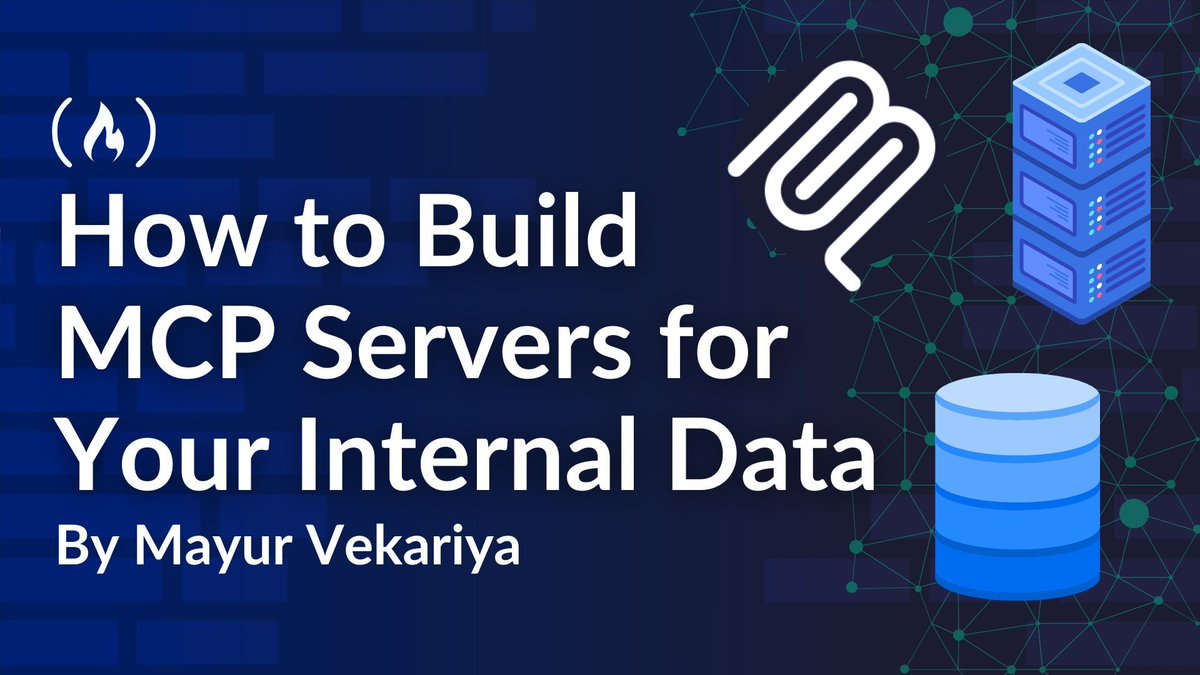
Internal data like databases and APIs are valuable.
So giving AI agents direct access can be risky.
In this handbook, Mayur shows you how to build a Model Context Protocol (MCP), which is a structured, secure way to give multiple AI agents access to your data.
https://t.co/H5xn8QfacM
Dashy reacts to a snake ruining a LAN 🐍😂
"MATT THIS IS LIKE A LAN CAFE, imagine if Mase brings in a f*cking anaconda, I'll be like 'wtf is going on?!"
"We're losing that event, I'm getting RAN that event, JP is just panicking we're so f*cked" 🤣
@qatarairways these two bags weighed the same and measured similar in size. How can i confirm the stuff is not missing and all the items inside are intact. Both of these are checked bags flying from Doha to IAD