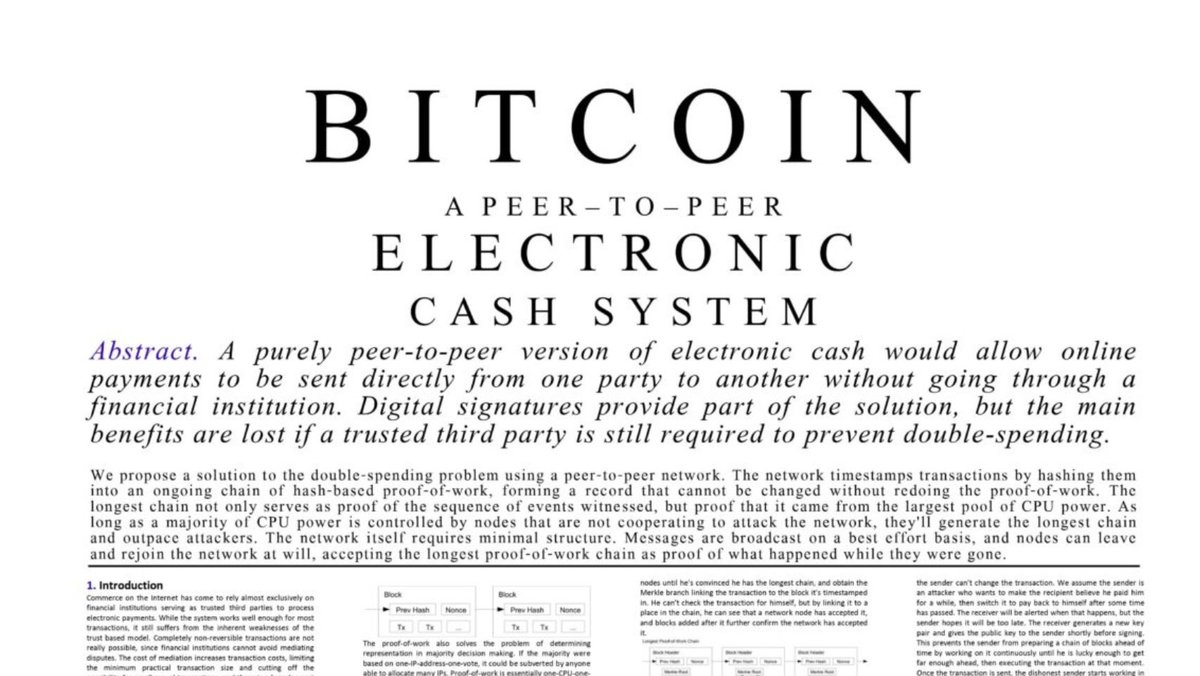
I think this is Elon's main point, the reason why he is joking around with Doge, and by ext. BTC.
He's saying, if anyone did big block crypto correctly, we could have a wonderful new world currency.
The one working toward that right now is #BSV, unless there's one I don't know.
In case you missed it, Teranode's source code is now public 🌐
Open for anyone to inspect, run and contribute. A unique milestone, scalable infra shared openly in a public repo.
There was a reason Bitcoin was set in stone. The foundation rules—the transaction format, the signature checks, the block structure, the supply schedule, the criteria for validity—were not left open to revision. They were closed, final, complete. Because if those rules could be changed, the system would suffer the same fate that has consumed every form of money in history: it would become political.
Money has always been political. It has always been bent, inflated, manipulated by those with power. Kings clipped coins, parliaments rewrote standards, central banks debased currency to suit policy. Each time, what people thought was stable was turned into a weapon. Bitcoin was created to remove that possibility, not by promise but by design. By setting the rules in stone, the levers of manipulation were locked away.
But people cannot leave it alone. They gather in groups, they write manifestos, they argue about visions of a “better” Bitcoin. And what do they create? Not betterment, but division. Endless disputes, rival chains, splintered communities—all claiming legitimacy. Every time a group tries to rewrite the base, the outcome is the same: another breakaway, another diluted ledger, another mess of confusion. Every airdrop, every new chain, every split proves the necessity of the stone.
When the base protocol is untouchable, commerce can build on top of it. Businesses can trust that the rules today will be the rules tomorrow. Contracts can be written with certainty that their terms will not be erased by committee. Developers can innovate in services, infrastructure, and applications without the fear that the ground will be shifted beneath them. The stone gives them permanence.
When the base is treated as malleable, it becomes nothing more than politics all over again. Factions fight to impose their will. Influence replaces certainty. The rules become bargaining chips. And what is left is not money, but an unstable experiment that people can no longer trust.
This is the purpose of the stone. To lock the base so that no one can drag it back into politics. To guarantee that validity remains validity, that supply remains supply, that signatures remain signatures, that the ledger holds. Without that, all you have is another currency bent by power. With it, you have a system that finally stands apart.
Open Run // Asia is around the corner.
Ready to code, collaborate and compete for $15,000+ in prizes?
This is the ultimate blockchain hackathon for Asia's next gen of builders.
Register by 21 October: https://t.co/jBQzZINe7R
Finance can remain the mechanism that drains, or it can become the circulation that sustains.
Finance was meant to channel value, not siphon it.
Debt has made it the archetype of entropy—consuming tomorrow to sustain today.
But entropy is not destiny. It can be turned the right way round.
https://t.co/kV5KVvEGlA
Focused.
GLOBAL currency for EVERYONE.
Instant transactions, fees next to zero, NO CENTRAL BANK & GOVERNMENT CONTROL, scalable & secure blockchain with NAKAMOTO CONSENSUS enabling economic trade freedom with no borders.
BSV is the people’s money ✊🏽
Have you been wondering where all these transactions on the bsv network have been coming from?
Me too!! 90 million a day is a lot!
What are op return transactions and are they fake like the btc maxis like to say?
We have the CIO of mint blue @TeamWinnaar to explain what their team has been up too and how these "fake" transactions actually have real world utility!
It’s that time of year again, when the gyms are full of ‘resolutionaries’ who swear—swear!—that this will be the year they get in shape and stick to a wellness program. Suddenly, everybody’s at the gym. And I do mean everybody. https://t.co/9Vm4GCEn7T
This time of year also brings a host of influencers pitching the ‘secret’ to getting in shape, dropping those extra pounds and living your best life. They all claim to have the key to unlock some magical shortcut to fitness/weight loss that has somehow eluded everyone else who’s ever tried this.
The thing is, there are no secrets to wellness, beyond regular exercise, eating real food and getting adequate sleep. That’s really all there is to it. But if you’re not already doing those things, it takes discipline to amend your lifestyle, and there are all sorts of tripwires along the way.
For exercise newbies, the gym can be an intimidating place. All those chiseled torsos, all that unfamiliar machinery.…it’s like your first day in a new school and you’re definitely not one of the cool kids.
But those torsos didn’t look so chiseled on their first day. And you’ll get the hang of the machinery in time. And if you’re truly clueless on how to get started, there are loads of instructional videos online, just steer clear of the ones trying to sell you something.
If you still find the gym just isn’t the place for you, buy a set of adjustable dumbbells, a chin-up bar and an adjustable bench and you can do every strength exercise you’ll ever need in the privacy of your own home. Plus you can work out whenever you want and your cat doesn’t care how you look.
And for those of you with bad backs: do dumbbell rows lying face down on a low-incline bench. Takes the strain off the lower spine. https://t.co/TQazq11fOf
As for cardio, you don’t need fancy machines. Running and walking cost nothing, and cycling outdoors (weather permitting) is a lot more fun than a spin class.
Or just structure your strength training as a cardio workout: no breaks between sets, shifting between antagonistic muscle groups—a set of push-ups (chest/delts/triceps), a set of rows (back/biceps), a set of lunges (legs/hips/glutes), then repeat—so the muscles get a recovery phase.
As for eating right, Michael Pollan maybe said it best: “Don’t eat anything your great-grandmother wouldn’t recognize as food.” Also, try to stop eating before you feel full, as the hormone that signals satiety takes a while to hit your brain. https://t.co/v62UZfLsHO
Try to stick to a routine bedtime/waketime. Keep the bedroom a few degrees cooler. If you live in a noisy area, get a white noise machine or earplugs. If you live in a brightly lit area, get some blackout curtains or just a sleep mask. And shut off the notifications on your damn phone.
I’ve been a gym rat since I was a kid. This year, I’m turning 64 (cue the Beatles song) and I have no intention of quitting. Certain types of sharks die if they stop moving and sharks have been with us for 450 million years. Lesson in there somewhere, I’m sure.
https://t.co/JQt4T2wb5n
Overcoming inertia is the hard part. Once that’s accomplished, you’ll find maintaining momentum is a piece of cake. But maybe save the actual cake for your next cheat day.
The number of enterprises that are taking blockchain seriously remains low, but the future belongs to entities that embrace this new technology and the competitive advantages it conveys.
While the value of the blockchain market has undergone significant growth over the past four or five years, we’re still only scratching the surface of what the technology has to offer in terms of efficiency, transparency and risk management.
In the UK alone, supply chain woes cost the economy £12b every year due to the inability to verify data quickly and accurately. Immutable blockchain-based data offers verifiable certainty and real-time confirmation, eliminating the possibility of laggard third parties gumming up your works.
Unboundedly scalable blockchains offer the possibility for cost-effective micropayments, opening up new avenues of commerce that were traditionally unworkable due to high processing fees imposed by the tradfi giants. https://t.co/EIK66aWjZy
Regardless of their amount, blockchain-based payments can occur across borders, outside traditional banking hours, for the same low fees. These savings can be passed on to customers, offering smaller firms a competitive edge over tradfi-bound rivals.
Blockchain tech is also making inroads in carbon credit markets, adding transparency to these trading platforms. Even companies not formally claiming credits can use blockchain tech to reduce paper record keeping/storage, thereby reducing their own carbon footprints.
If you wonder why I keep beating this drum despite the slow rate of adoption, it’s because enterprise blockchain’s functional benefits continue to be drowned out in the public consciousness by the ‘number go up’ crowd and their ‘have fun staying poor’ taunts.
The ‘crypto’ bull/bear market cycle is currently all horns and no claws, driven by a handful of BTC bulls engaging in reckless borrowing to artificially inflate the token price, while the general public has developed a fatal attraction to memecoins. https://t.co/MY4IyeQils
Mainstream media has helped amplify the current FOMO bubble, having memory-holed their praise of past ‘crypto’ projects/founders/visionaries that ultimately proved more Madoff than Marconi.
Bubbles always burst but enterprise blockchain tech just keeps moving forward, slowly but surely. Just as the tortoise beat the hare, in the long run, utility will prevail over speculation.
For a longer version of these thoughts, check out this Management Today article: https://t.co/VfgjaSZNoN
Someone sent me this link the other day showing legendary science fiction author Isaac Asimov discussing AI’s potential impact on society way back in 1982. https://t.co/6pIpQmuReR
Asimov plays down the doomer prophecies of smart machines/systems becoming self-aware and killing us puny humans. Instead, Asimov suggests the real fear is that machines will become so skilled and ubiquitous that great masses of people will find themselves without jobs.
Humanity has been at this juncture countless times before, when new technology threatens existing industries and the people who work in them. As Asimov notes, the new tech usually creates enough new jobs to compensate for the jobs it eliminates.
But Asimov makes a good point when he says that many of those who lose their jobs to technology might not be able to easily transition from one life to another. Remember all the people in America’s Rust Belt who were told to ‘learn to code?’ How’d that work out?
Those factory workers weren’t being replaced solely by technology, but also by cheaper labor based outside the U.S. Regardless, the prolonged unemployment is blamed for the opioid epidemic that ravaged the region (and later, the country). https://t.co/OaXFWTD4OX
While machine learning is threatening white-collar positions for a change, they won’t be alone feeling the pinch. Those Boston Dynamics videos of robots handling increasingly complex physical tasks should put a shiver down the spine of any warehouse employee. https://t.co/kCogcxIDtf
Asimov suggests it’s society’s responsibility to make sure the labour transition is “as painless as possible” and “work has to be found” for people whose jobs are assumed by machines. But Asimov acknowledges that “this is not going to be easy.”
Those who are developing AI systems talk of a coming ‘age of abundance’ in which scarce resources—commodities, tools, toys, free time—will become plentiful. This will lead to cheaper goods and services for all, assuming you still have a job that pays you something. https://t.co/PCibzsnONb
This argument falls a little flat for me, considering that many of those who are predicting everyone will get something for nothing are the same ones currently complaining about government departments stacked with freeloaders and do-nothings. (Maybe they’re just ahead of this curve?)
People who know me know I’m no AI doomer. I see great things emerging from machine learning, particularly when coupled with enterprise blockchain technology. But acknowledging the potential benefits doesn’t mean ignoring the potential costs. https://t.co/XE8aZ5aIeK
I’m also not a socialist, but Asimov’s not wrong that the AI-based disruption of work will be profound and the transition to new work won’t be easy. So planning for this transition needs to start yesterday. I don’t claim to have the answers, but I think we all need to start asking the questions.
It’s clear to me that some kind of universal basic income, irrespective of employment or financial status, will be required in the future. But to me the big miss in many countries is not spending nearly enough to date on education for the future we can clearly see is coming.
All bubbles eventually burst, and the bursting of the BTC bubble is going to soak a whole lot of people—even those who never bought the stuff.
Financial bubbles are the stuff of legend, and no matter how many times people insist ‘this time it’s different,’ it always ends the same. A few people get rich, a lot of people get wrecked, but somehow nobody gets any wiser.
Examples of some of the most devastating bubbles in history include the Dutch tulip bubble (1630s), the South Sea bubble (1720), Japan’s real estate/stock market bubble (1980s), the dotcom bubble (1990s) and the U.S. housing bubble (2000s).
https://t.co/ZddxRhNBNi
Interesting footnote: MicroStrategy’s Michael Saylor—the debt-heavy engine driving the current BTC bubble—was the biggest individual loser of the dotcom bubble. (Insert ‘foreshadowing’ alert here.)
https://t.co/wqn56c4vtd
What defines a bubble? Well, one clue is that “a bubble is often justified by the flawed assumption that an asset's intrinsic value has skyrocketed.” Given that the function-impaired BTC has zero intrinsic value, it’s easy to spot the flaws in its current valuation.
But my favourite bubble hallmark may be “THERE ARE IDIOTS. Look around.” Bubbles are “powered by a wave of credulous newcomers who are ignorant, innumerate, and looking to get rich quick.” Sound familiar?
https://t.co/UrRB8ffWaJ
Which brings us to a recent article in The Atlantic predicting ‘The Great Crypto Crash,’ a timely warning as America prepares to loosen the regulatory guardrails that until now have barely contained the worst impulses of the predatory ‘number go up’ industry.
https://t.co/URouHVF3cy
This new freewheeling environment will encourage a host of grifter types to seek (and obtain) licensing under the lowered standards and take greater chances with customers’ money, knowing that regulatory oversight will be both cursory and too late to protect anyone.
The ‘hands-off’ regulatory approach will also result in greater adoption of speculative crypto products. Wall Street will introduce ever more exotic ‘instruments’ that offer new ways to bet on how high token prices will rise.
These opaque financial tools will almost certainly offer the ability to wager on leverage, and with mainstream banks involved to a degree not present during 2022’s crypto crash, the threat to the wider financial system will be far greater.
‘Crypto’ lost 2/3 of its overall market cap in 2022. Imagine if a similarly sized loss was experienced across the wider financial sector due to the incestuous nature of all these speculative instruments.
So if you think we’re in a crypto bubble now, you ain’t seen nothin’ yet. An economist told The Atlantic that this ship may stay afloat for a number of years, but when “the only thing anchoring the value is investor sentiment,” a crash is inevitable.
Bubbles occur because markets move in cycles. Time passes and a new generation has no firsthand experience with previous booms/busts. Regulations imposed following earlier bubbles are slowly chipped away, with the lack of busts used to justify their relaxation. Wash. Rinse. Repeat.
And remember—when the housing bubble crashed the global economy in 2008, it was taxpayers, not banks, who got stuck with the bill. It will be the same when crypto crashes. So even those who steered clear of this boondoggle will pay the price.
As Sir John Templeton famously observed: “The investor who says, ‘This time is different,’ when in fact it’s virtually a repeat of an earlier situation, has uttered among the four most costly words in the annals of investing.”
Some of us have warned of this impending crash for some time but the Cassandra complex is alive and well. I’ll keep on warning people in the faint hope that blockchain projects that offer real utility don’t end up as collateral damage of the post-crash blowback.
https://t.co/OvtgN16nOy
When this crypto Titanic hits its iceberg and starts to sink beneath the waves, this is the song the band will be playing:
https://t.co/ogPmz50tzn
Banking may be mired in the 20th century but blockchain technology can help drag it into the modern age.
Banking is an institution that touches everyone’s life but it hasn’t always kept up with the pace of technological change. Nor has it met consumers’ desire for greater transparency, security and trust in their financial activities.
Blockchain offers a level of transparency that today’s banking simply can’t match. A public transaction record allows real-time monitoring by authorized stakeholders, while blockchain data immutability ensures transactions cannot be altered after the fact.
This offers an antidote to mismanagement or manipulation, be it internal fraud or external interference. It’s a level of security that currently doesn’t exist in the banking sector.
As financial transactions grow more complex, so does the potential for fat-fingered disaster. Blockchain-based smart contracts can help mitigate the potential for human error by automating transaction conditions.
For instance, the bank can’t claim that it didn’t receive your loan payment on time because the funds were automatically transferred according to the terms of the contract. Best of all, there’s a time-stamped public record that can’t be altered or denied.
Audits are a touchy subject for some in the blockchain community—here’s looking at you, Tether—but blockchain offers banks the possibility of 24/7/365 real-time auditing. This could help identify anomalies at the acorn stage, not after they’ve grown into towering oaks.
Not all blockchains are suitable for integration with banks, which generate a volume of transactions that would simply overwhelm most existing networks. Only a blockchain that can handle this volume at a minimal cost per transaction need apply.
https://t.co/EIK66aWjZy
Banking is one of history’s oldest institutions but it needs to embrace emerging technologies to honor its commitments to its customers. To read a longer version of this topic, check out the link below: https://t.co/hEEoO24vuF
Since @LukeDashjr has me blocked I’ll respond here. @elonmusk I hope you’re starting to see the real truth.
I know you’ve worked out that BTC is both crap/broken and centralised making it almost impossible to use. Did you know however that BSV is everything Bitcoin originally promised?
People like Luke here have no game because all they can do is shill their low effort zero utility investment strategy. That’s why they just call us a scam. It’s their only defence against the light - not that it provides them much shade to hide in.
With BSV we can change the world. We can turbocharge the US economy and every company in it. There is so much to be done!!!
Everything good that Michael Saylor says was said by better men a decade ago.
Most of those better men were pushed out of prominent roles in the bitcoin culture for refusing to be bought.
Now, the culture is run by usurpers and fakes.
Sad!
no one who has ever read the satoshi origional e-mails would ever support BTC. It is soooooo obvious that he talked about how POW scales, He talked about how use of server farms would work, over 100gb used per day, and that getting off layer one would defeat the entire trust of bitcoin. All this before even the launch of bitcoin. forever ago.
I should have read these before:
https://t.co/qlkJsvdFev
What sets BSV apart is that it’s being used right now to solve real problems. Companies are using it for supply chain tracking, efficient payments, and even healthcare data. It’s not just a speculative asset...
it’s a tool for innovation.
@_minisatoshi Not only is every claim in your sentence false, but CSW is also not the reason BSV exists, nor is he the focus of my post.
CSW’s most powerful cults are the BTC and BCH people who need a convenient boogeyman.