Definitely disagree. 4.8 is (slightly) superior, but you have to evolve with it.
It's more honest. Less avoidant. And workflows are really cool
Too bad they nerf the previous model to hype the next. The last week of a certain model before the nex is released, it's hardly usable
We're currently running this with the Department of Justice for online fraud and the National Office for Identity Data for securing ID photograph audit trails, among others
We have this running as a poc with tax authorities and common accounting software integration, including per field disclosure and split payment using stablecoins.
The latter matters as it does at least stop carousel fraud as the seller never holds the tax part.
These "third entry" timestamped audit trails with selective disclosure are abstracted and composable as state machines.
They can be implemented for any use case, such as digital product passports, micro platform compositions or any domain logic really.
claude code monthly subscribers are being served a nerfed version of opus 4.7. i'm convinced now after using cursor on same model.
anyone serious about agentic software development should be on cursor right now.
cursor on opus 4.7 max consistently outperforms claude code on opus 4.7 max.
if it's the same model, why does one feel like the real thing and the other feel like a shit?
I solve this by looping Claude code with codex review against the spec.
Spec is in directories with pre commit hooks blocking changes and instructing Claude to run a separate MR.
By morning I simply have a couple of MRs clearly showing where implementation drifted from spec.
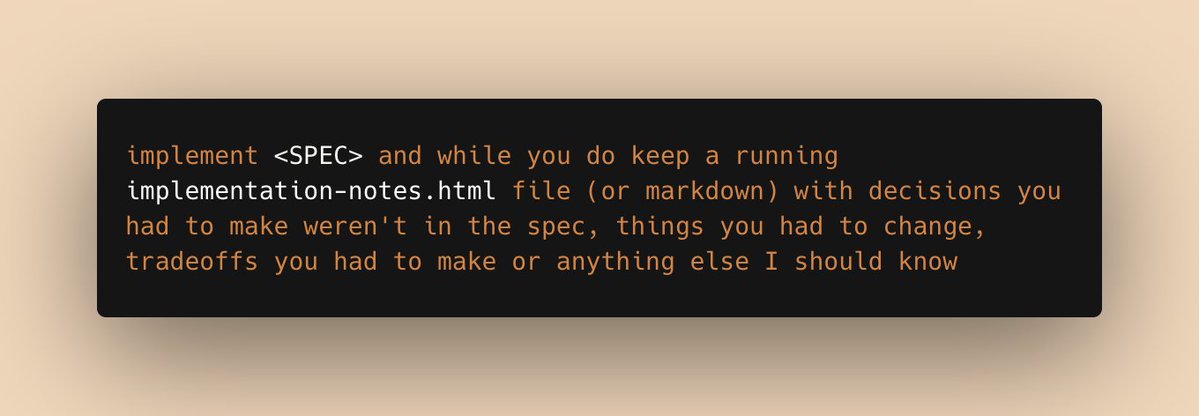
a prompt I've been using a lot recently:
implement <SPEC> and while you do, keep a running implementation-notes.html file (or markdown) with decisions you had to make weren't in the spec, things you had to change, tradeoffs you had to make or anything else I should know
@hiarun02 My experience is rather that I have 10x the output but the job became more demanding as I now have more complex problems to solve and decisions to make. 24/7
It's about scaling judgement
Then again, I'm not an employee.
@ProjectBabbage GASP is great, GASP is necessary, GASP is the substrate doing its job.
The thread is the layer above. Domain code vs infrastructure code.
Domain:
class TitleRegistry{
state = { titles, liens }
transferTitle(x,y) { ... }
registerLien(x,y) { ... }
}
The open BSV stack today: a wallet that signs, an overlay that admits and routes by topic, a script template that locks data into spendable outputs, proofs that travel with the transaction...
A complete substrate. It moves coins. It anchors data. It proves inclusion.