I made a videogame that teaches you how to use @LangChain’s open source agent harness, Deep Agents (to celebrate reaching 50M downloads 🤩)
Here's my playthrough, but there’s more educational content hidden in the game 👀
So play it yourself and give me your thoughts! I’m always looking for ways to make learning fun: https://t.co/rDO1BSvD09
I deleted Linux completely, baked Qwen3-0.6B into a 24 KB pure x86-64 assembly OS, and it runs up to 54% faster than native Linux llama.cpp.
The entire Multiboot OS binary (asm-llm-os.elf) is 24,252 bytes, written from scratch without Linux, Windows, C, Rust, or libc. It boots in 74 to 94 ms straight into 64-bit Long Mode, wakes every CPU core over APIC, maps the 614 MiB Q8_0 weights directly from physical RAM, and drops you into a live multi-turn KV-cache chat over VGA, PS/2 keyboard, and serial.
I ran head-to-head CPU benchmarks against llama.cpp (Q8_0, -ngl 0) on the same AMD EPYC 7642:
- 1 thread hits 23.67 tok/s vs 16.63 (+42%)
- 4 threads hit 78.89 tok/s vs 51.08 (+54%)
- 8 threads hit 118.08 tok/s vs 80.79 (+46%)
- 16 threads hit 134.94 tok/s vs 103.03 (+31%, 136.6 peak)
On a diskless 0 GB Proxmox VM (2014 12-core Intel Xeon E5-2670 v3, 2 GiB RAM), it boots straight to the prompt in under 5 seconds (95 ms kernel boot) and runs live out of RAM at 78 tok/s decode and up to 111.5 tok/s prefill, with a hybrid BIOS+UEFI ISO builder included too. Output stays bit-exact across thread counts and matches all 64 greedy tokens against PyTorch FP32 (0.99965 cosine).
The 14.7 KB Linux ELF build (FAST_Q8=1 INT8xINT8 AVX2+F16C) also beats llama.cpp by 18% to 36% from 1 to 40 threads, and booting bare metal with 2 MiB huge pages squeezes out another 10% on top.
Repo, ISO builder, and Proxmox setup guide are in the reply below.
If this rumors are true, it would explain why OpenAI and Anthropic are holding back their latest models:
Scott Aaronson says he's heard OpenAI or Anthropic may have found a way to factor large numbers in polynomial time.
Why this would be massive? RSA secures a huge chunk of the internet, and its whole security relies on factoring big numbers being impossible on normal computers. If an algorithm like this actually works on real key sizes, you wouldn't even need a quantum computer to break it. Fake software updates could pass signature checks, RSA-encrypted data could be read, and systems across the internet would have to migrate off RSA fast.
So yeah, something we expected might now actually happening.
Getting real work out of AI agents still takes a lot of setup. Skill files, workflows, connectors, prompts you keep adjusting.
@officialdemiai goes the other way. The team says it runs in the background across your calls, Slack and documents, picks up what needs doing and asks for approval before it acts.
In the demo, it fills in a vendor form from a W-9 and an insurance certificate, and flags the one field where the form says Net 45 and the invoices say Net 30.
If that holds up on real work, it's a big deal. Most people are never going to write a skill file.
experimenting with a lil personal project: an AI-native macOS dock with custom modes (writing, building, etc.) to help me stay focused
my agent is able to customize mode behavior and add new modes, it uses jev to classify my activity + notifications in real time & act on them
Vibe coding a game is fun until you don't know what your own characters do.
@trq212 on keeping creative control as models get better: readable specs, custom languages, and a software renaissance.
The Sweet Side of the Bitter Lesson.
Watch: https://t.co/ZmdjP55CL2
Software is both art and utility. AI is both an Industrial Revolution and a Renaissance.
Factories are for utilities, at AIE Code I talked about how we can make better art.
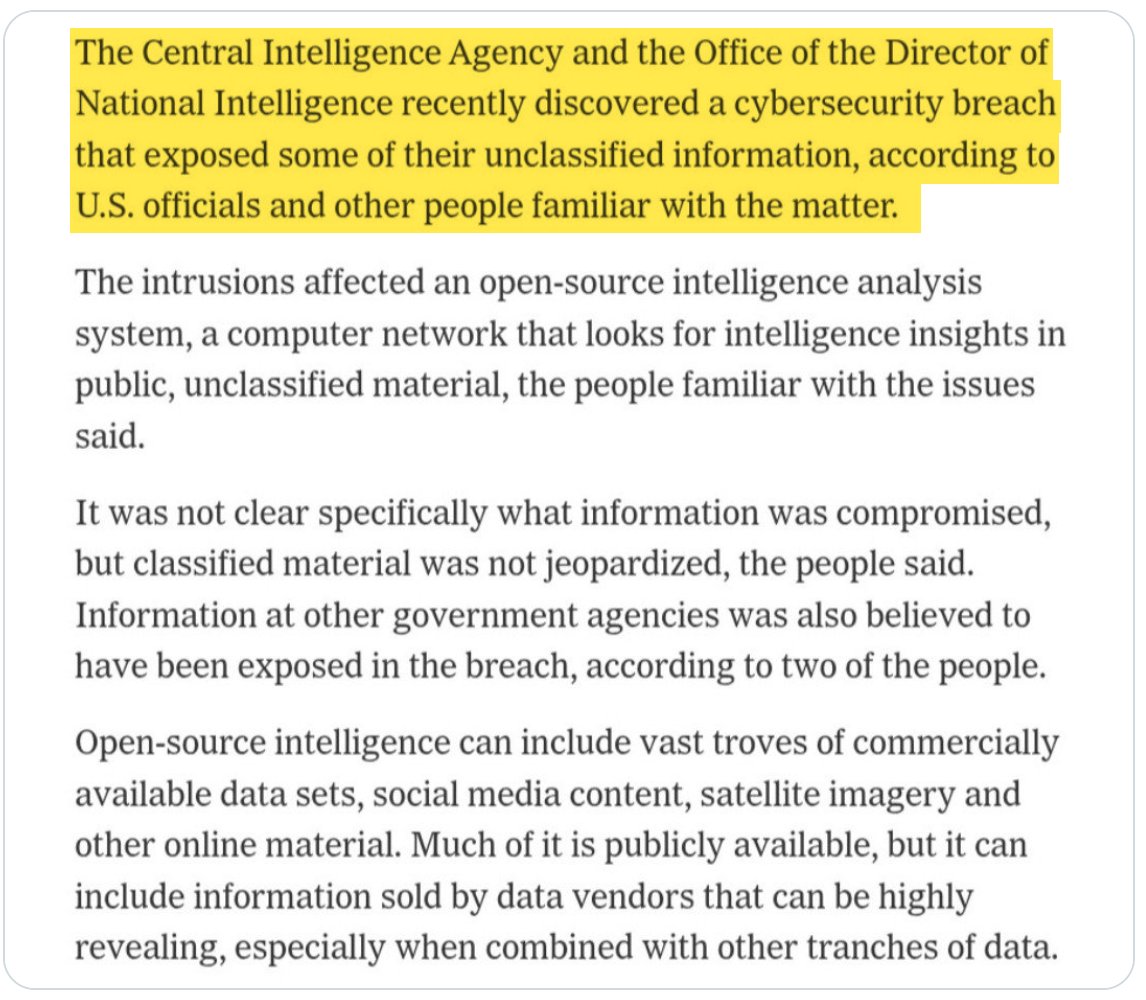
The CIA got hacked: a breach exposed unclassified data at the CIA and the Office of the Director of National Intelligence, the NYT reports.
It hit an open-source intelligence system.
Absolutely insane: OpenAI just dropped another nine new math papers in its repo, with Lean proofs.
- Matrix multiplication is the operation behind basically every AI model. Since 1969 mathematicians kept finding faster ways to do it, and nobody knew where the limit was. OpenAI says it proved the limit: the exponent is exactly 9/4. A 57-year search would be over
- Linear programming is the math that plans flight schedules and supply chains. We have fast methods since the 80s, but their speed still depends on how big the numbers are. A method that only depends on the size of the problem was one of Smale's great open problems for this century. OpenAI says it found it
Add the Erdős-Rado sunflower conjecture from 1960 and, one day earlier, VP ≠ VNP, the algebraic cousin of P vs NP, open since 1979.
Anthropic: your turn again.
Remember when OpenAI said that it was going to cut its subscription plans in half, then dropped the idea after people pushed back heavily?
Well, looks like it’s happening after all.
(I haven’t gotten the email yet, but I think it’ll land in my inbox soon too.)
God damn OpenAI.
For my first post, I’m sharing a letter @NVIDIA signed on why open models matter.
AI will transform every industry, power every company, and be built by every country.
Open models strengthen safety and cybersecurity, accelerate innovation and diffusion, and enable sovereignty.
The world needs both frontier closed models and frontier open models.
https://t.co/AUKzoQ5Ikb
honestly all the YC sandbox providers should just join in a conference center and sign a diplomatic treaty to end the YC sandbox wars and refocus on eating daytona's, e2b's and modal's lunch
Trust me, I'm not used to admitting this (I used to win mathematical and logic puzzle competitions in my youth), but this is now smarter than us.
Listen to it – line by line, word by word. We can't compete anymore. It happened in the last few months. These are the last moments when there is any point in humans doing analysis and writing their own texts. It has become superhuman, like in chess. We can still play, but knowing we can't compete.
All that's left for us is to have children. They will grow up in a magical world full of such machines. They will have to learn to use them – and then they can play tennis.
Not much else left for us to do. Funny how the oldest things – children and games – turn out to be the last ones that are truly ours.
JENSEN HUANG: "I was lucky because I had known Elon Musk, and I helped him build the first computer for Model 3, the Model S, and when he wanted to start working on autonomous vehicle. I helped him build the computer that went into the the Model S AV system, his full self driving system. We were basically the FSD computer version 1, and so we were already working together.
And when I announced DGX-1, nobody in the world wanted it. I had no purchase orders, not one. Nobody wanted to buy it. Nobody wanted to be part of it. Except for Elon.
He goes 'You know what, I have a company that could really use this.' I said, wow, my first customer. And he goes, it's an AI company, and it's a nonprofit and and we could really use one of these supercomputers. I boxed one up, I drove it up to San Francisco, and I delivered to the Elon in 2016."
WATCH: Palmer Luckey systematically DISMANTLES this smug NYT journalist’s entire worldview on Ukraine LIVE on stage.
He immediately tried to change the subject 🤣
Total masterclass.
Your 𝗛𝗲𝗿𝗺𝗲𝘀 felt sharp yesterday and slow today? 😮💨
-It's almost never the model getting worse.
-It's 1 of 7 things you can check in 10 seconds. 🧠
Check in this order:
▸ Shallower answers everywhere → /model. A switch only lasts for that chat
▸ Long chat getting worse → /context, then /compress or /new
▸ Hits limits way too early → /status shows the context size it detected
▸ Forgot what you said 10 min ago → memory saved mid-chat loads next session, on purpose
▸ Forgot last week → "search our past sessions for…"
▸ Lost a skill it had → open Capabilities and check it's still there
▸ Lost old details after a long chat → it was compressed. Ask it to search for them
I ran these on a demo: right model, only 5% of the window used, and the past-session search found a lease risk from yesterday.
Save this for the next "it got dumber" day. Which one got you last?
How a convolutional neural network turns pixels into a label.
A small kernel K slides across the image, multiplying the pixels under it by its weights and summing: S(i,j) = Σₘ Σₙ I(i+m, j+n) K(m,n). The result is a feature map that lights up where the kernel's pattern appears.
Several kernels give several maps. Max pooling keeps the largest value in each 2×2 block.
Fully connected layers combine the features, and softmax turns the scores into class probabilities.
You don't need to memorize algorithms. You need to see them move.
So I made an app to visualize data structures & algorithms.
Helps you build better apps, write better prompts, and ace interviews.
86 lessons. 21 languages.
https://t.co/7v6gEKlKzP