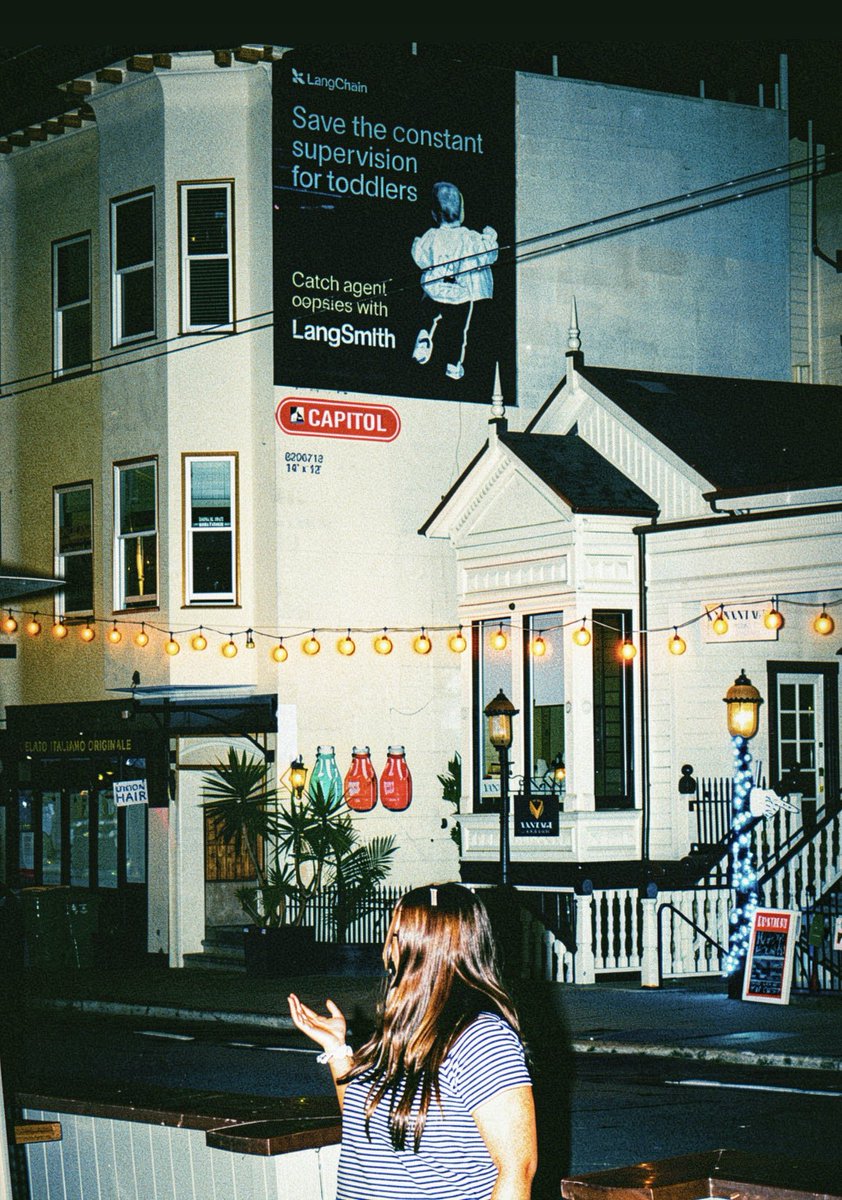
our design agent at @LangChain has shipped 3,000+ assets since august, and posts with its work pulled ~4.5M views on socials (it made this promo too)
it’s become the design brain for the whole org. decks, diagrams, ad creatives, launch films and more, all made from slack
we encoded our designers’ judgment into its skills, a design wiki and brand checks that run on every render, so it knows what good looks like for us
then we built a custom media harness around it: a headless photoshop, a shared visual canvas (thanks @paper), video tools like @HyperFrames_ plus our own animation engine, our brand assets and a library of design references
it runs on Managed Deep Agents, which abstracts away a ton of infra including sandboxes, agent memory, slack integration, scheduling and more.
we are going through the architecture, use cases and impact live at our oct 28 webinar 👇
https://t.co/QCSu0sIMIs
How much of the past in agent memory should enter the present?
Once we decide what to keep, we need to work out how the agent can access it.
@jess_weng18, an education engineer at @LangChain, showed several ways to manage this in Deep Agents:
1. A large tool result can be saved to a file. The model receives a short preview and a path to read more as needed.
2. A skill appears as a name and description, with full instructions loaded only when the task calls for them.
3. A subagent can work through a focused problem in its own context.
4. As the conversation grows, older material can be condensed while recent messages stay unchanged.
And the most important thing:
Continuity depends on the architecture around the model: where information lives, how long it survives, and how a later run finds it.
Jess Weng even showed that a persistent memory file could be read by another model.
But a condensed memory is easier to use and also easier to misuse because the agent may miss important details. So →
Agents need to recognize when the summary is insufficient, and we still need to figure out how much context and experience we can leave out.
Here I explain six more perspectives on how to turn an agent’s experience into better work and build agent memory. They are practical and so really worth your attention.: https://t.co/FWMQ93Jl1V
What is an agent skill? (Or how to protect your agent’s context window)
A 2 minute explainer from LangChain Academy.
🎓 Take our course on Deep Agents: https://t.co/w31FYeC83T