My experience is not so much the speed but the level of attention required when FSD is activated. In my opinion, it's less consuming to drive myself than keeping my eyes on the road in front of me and my hands close to the steering wheel. If I look out the right or left window for a few seconds, I get an alert. Maybe I still have to get used to it, but I was expecting less supervision, I guess. The tech is amazing and does make the same choices I would make most of the time.
@Pontifex If the Pope can speak about polarization in a way that resonates so deeply with people, that should prompt us as psychologists to re examine our own role in society.
When simulation becomes the norm, it weakens the human capacity for discernment. As a result, our social bonds close in upon themselves, forming self-referential circuits that no longer expose us to reality. We thus come to live within bubbles, impermeable to one another. Feeling threatened by anyone who is different, we grow unaccustomed to encounter and dialogue. In this way, polarization, conflict, fear and violence spread. What is at stake is not merely the risk of error, but a transformation in our very relationship with truth.
Dear Kurdish friends. Hundreds of city names and other toponyms in Asia Minor come from Greek. Fascist kemalists tried to change them to erase the Hellenic cultural heritage as they did with Kurdish names.
I want to call all Kurdish friends to start using the original old Kurdish and Greek names for all the toponyms in Anatolia. Your freedom starts in language 🙏❤️
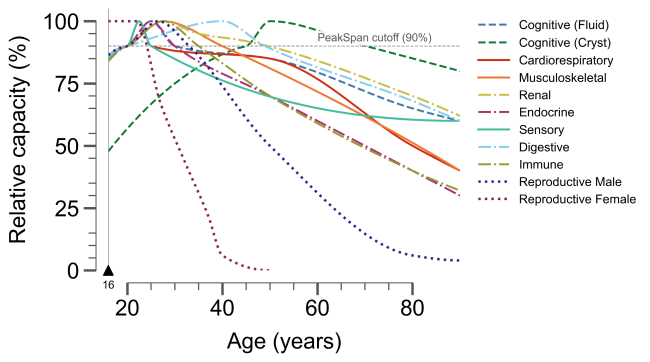
Instead of "healthspan," we should be thinking about "Peakspan."
How long can you maintain ~90% of your peak physical or cognitive function?
According to a new paper, different systems reach their “Peakspan” at very different times.
Fluid cognitive abilities like processing speed and working memory peak early, around ages 20–30, while crystallized intelligence doesn’t peak until the late 40s or early 50s and can remain stable into the 70s.
Cardiorespiratory fitness peaks from adolescence to the mid-20s and then declines steadily, while muscle strength peaks in early adulthood and falls sharply after 60. Bone density, kidney function, hormone levels, sensory function, immunity, digestion, and reproductive capacity all follow their own trajectories too—some peaking in the 20s, others in the 40s or 50s.
In other words, human aging is asynchronous. We don’t simply age “overall,” but instead age system by system.
Together with RDW, we have officially completed the final vehicle testing phase for Full Self-Driving (Supervised) and have submitted all documentation required for the UN R-171 approval + Article 39 exemptions. The RDW team is now reviewing the documentation and test results package internally. They have communicated the expected approval for Netherlands date of 4/10, shifting from 3/20 previously and we look forward to successful completion of this cooperation.
Following the Netherlands’ approval, European countries will be able to recognize this approval nationally. We are anticipating a possible EU-wide approval during the summer.
Over the past 18 months, this approval has involved a series of intense documentation, development, testing, research & audits. Including but certainly not limited to:
– 1,600,000+ km of FSD (Supervised) testing on EU roads
– 13,000+ customer sales ride-alongs
– 4,500+ track test scenario executions
– Thousands of pages of written documentation for 400+ compliance requirements
– Dozens of research studies into safety performance/results
We're extremely proud of the work conducted with the RDW team up until this point.
We very much look forward to the approval in April, and sharing FSD (Supervised) with our patient EU customers!
Psilocybin appears to simultaneously be an anti-depressant / quality of life enhancer, anti-addiction drug, neuroplasticity booster, and a plausible longevity drug.
Tried using the Handle Marketplace twice, but the handles I picked—which were available—were denied with bogus reasons (like the account not being active enough). After a few attempts, both were later denied again and ultimately given "rare" status. So X is changing the rules in real time. Unfair practices and months wasted, with no help from customer service (mostly AI). @nikitabier@elonmusk
💤Researchers found that prescription stimulants for ADHD act on brain networks that control wakefulness and reward, but not attention as previously thought. The study suggests that stimulants and additional sleep affect the brain in similar ways, and that getting enough sleep could help in managing #ADHD.
Learn more: https://t.co/85qfxSIjUN
#ResearchMatters
Dr. Russell Barkley, drawing from 20+ years of twin studies, behavior genetics, and neuroimaging: Parenting isn't engineering a blank slate—it's shepherding a unique genetic mosaic already loaded with 400+ psychological traits that emerge mostly on their own timetable.
You provide the pasture: safe, nourishing environments with adequate (not excessive) stimulation, protection from harm, and access to rich out-of-home influences (peers, schools, neighborhoods, community—the biggest shaper after genetics, per Judith Harris in The Nurture Assumption).
But you don't redesign the sheep. No prenatal Mozart, no overload of crib toys turns threshold development into engineered genius. Extra stimulation past basics yields diminishing returns; "more is better" is a cultural illusion, not biology.
Data is stark: Parental influence on core traits peaks before 7, plummets to ~6% in teens, hits zero after 21. Knowledge transfers via exposure—yes. Personality, abilities, temperament? Largely genetics + broader world.
This frees parents from crushing guilt ("If my child struggles, I failed"). Instead: Curate wisely, then enjoy watching the individual unfold. Open the Chardonnay, kick back—the show is brief.
Short of abuse/neglect/malnutrition, in-home tweaks are often trivial next to where you choose to live and the doors it opens.
Shepherd, not engineer. Let them grow into who they already are.
Does this shift relieve pressure—or challenge how you view "success" in raising kids?
In an interview with The National during the World Governments Summit in Dubai, Kurdistan Prime Minister Masrour Barzani expresses solidarity with Kurdish civilians in Syria.