Open source and easy to try.
GitHub: https://t.co/hDdvFFFek5
I'd love to hear how it fits into your workflow or what you'd like to see next.
#opensource#webdev#accessibility#a11y#AI
Still checking web accessibility and web standards by hand?
I got tired of it, so I built a11y-lens.
It helps AI-generated UI code follow accessibility best practices, then checks everything again with Git hooks before you commit or open a PR.
@anmolprsi@X Think of it as a self-hosted Appetize for internal teams. It streams iOS simulators and Android emulators to the browser, so anyone can test a build from a URL—no Xcode, Android Studio, or local setup. It uses your own Macs, so app data stays within your infrastructure.
Open a URL.
Pick a simulator.
Start testing.
That's it.
tapflow streams iOS & Android simulators straight to the browser.
No local setup required.
Open source & self-hosted.
GitHub:
https://t.co/zFCwomjWe0
Docs:
https://t.co/5lhV2CruOb
Your React Native build is done. ✅
The hard part?
Getting the rest of your team to test it.
No more:
"How do I install this?"
That's why we built tapflow.
#ReactNative#opensource
@vikrambuilds hi 👋 I'm building an open-source project for self-hosted iOS & Android simulator streaming for the whole team.
👉 https://t.co/zFCwomjWe0
If your team ships React Native, getting the build out is the easy part. Getting it in front of everyone else isn't.
tapflow is an open-source, self-hosted tool that streams iOS simulators and Android emulators to the browser, so the whole team can test in a tab.
Andrej Karpathy quietly published 9 rules for building AI agents.
Rule 1: stop writing prompts.
"If you find yourself iterating on a single message at 3 in the morning, you are still in the prompting era."
A friend who runs agent infra at a trading firm read it once and deleted half the harness his team built last quarter.
The whole paper argues most agents die from a weak harness, not a weak model. Everything you added to compensate for the model becomes dead weight the moment the model improves.
The rule near the middle, about letting the loop delete its own work and start over, is the part he screenshotted. It contradicts how almost everyone builds right now.
The closing section on where the bottleneck goes next is the whole paper in one line.
He said he read it twice, second time with his own repo open beside it.
Everyone is still tuning prompts. Karpathy already moved on.
met an anthropic engineer making $1.2M a year.
asked him how he ships alone at the pace of a full team.
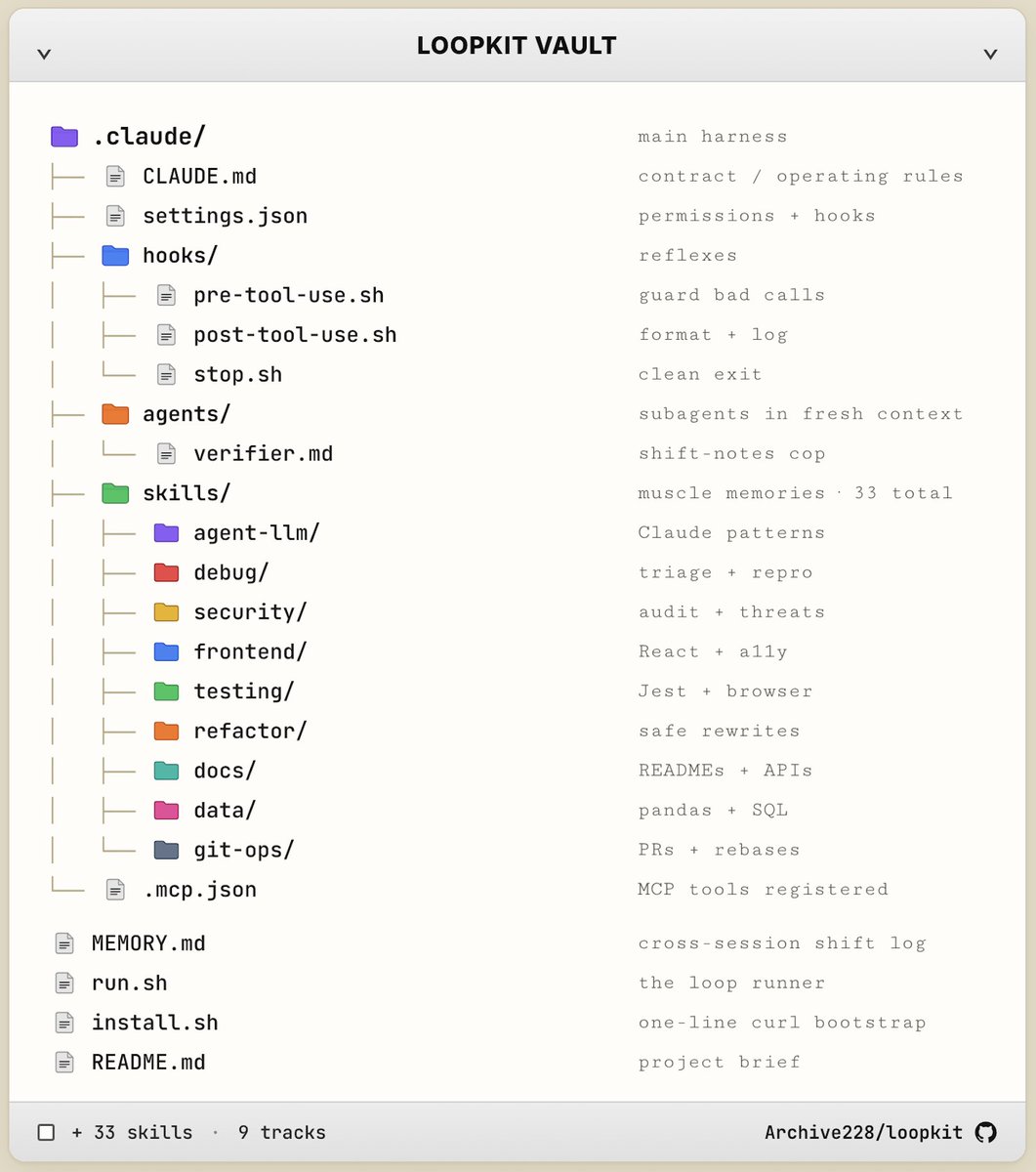
he didn't answer. sent me his .claude/. one folder.
SAME MODEL - DIFFERENT RESULT.
everyone's still picking between opus and sonnet like the model is the ceiling. it isn't.
the real lever is what the model wakes up into:
CLAUDE.md → hooks → verifier subagent → skills → mcp → memory → shift notes.
you stop chatting with the model.
you write the folder once. the folder runs the model.
- CLAUDE.md - the contract
- settings.json - the permissions
- hooks/ - the reflexes
- agents/verifier - the shift-notes cop
- skills/ - 33 muscle memories
- .mcp.json - the tools
- MEMORY.md - the shift log
that's the stack.
full breakdown in the article below. bookmark before he realizes i posted it.
As engineering, product, design, DS, etc. melt into a new kind of role, I was reflecting on what roles might look like in the future. For example, when I look at the Claude Code team I see what I think is five archetypes:
1. Prototyper: comes up with brand new ideas; churns out many ideas, most of which don't ship
2. Builder: quickly turns a prototype/idea into production-grade product/infra
3. Sweeper: cleans up the UI, simplifies the code and system, unships, optimizes performance
4. Grower: takes a product that has been built and iterates on it to improve Product-Market Fit
5. Maintainer: owns a mature system to make it secure, reliable, fast, and efficient as it scales
Many people span across 2 roles, and sometimes 3 roles. I also notice that these roles are not really tied to job function -- eg. across Anthropic, some designers match category 1, some 2, some 3; same for engineers, PM, DS.
A healthy team needs a mix of these, depending on the product:
- A product that is new and pre-PMF needs people that are strong at 1+2+3
- A product that is growing and has found PMF needs 2+3+4 and some 5
- A product that has strong PMF needs 3+4+5 and some 2
Maybe product roles of the future will look more like this, and less like the domain-specific roles of today?