Today, as a shareholder of Chintai equity, I added 1,000,000 $CHEX.
Not a short-term flip, but because this is one of the most serious RWA developments in tokenisation right now.
Here’s why 👇
@ChintaiNetwork@ChintaiNexus#CHEX
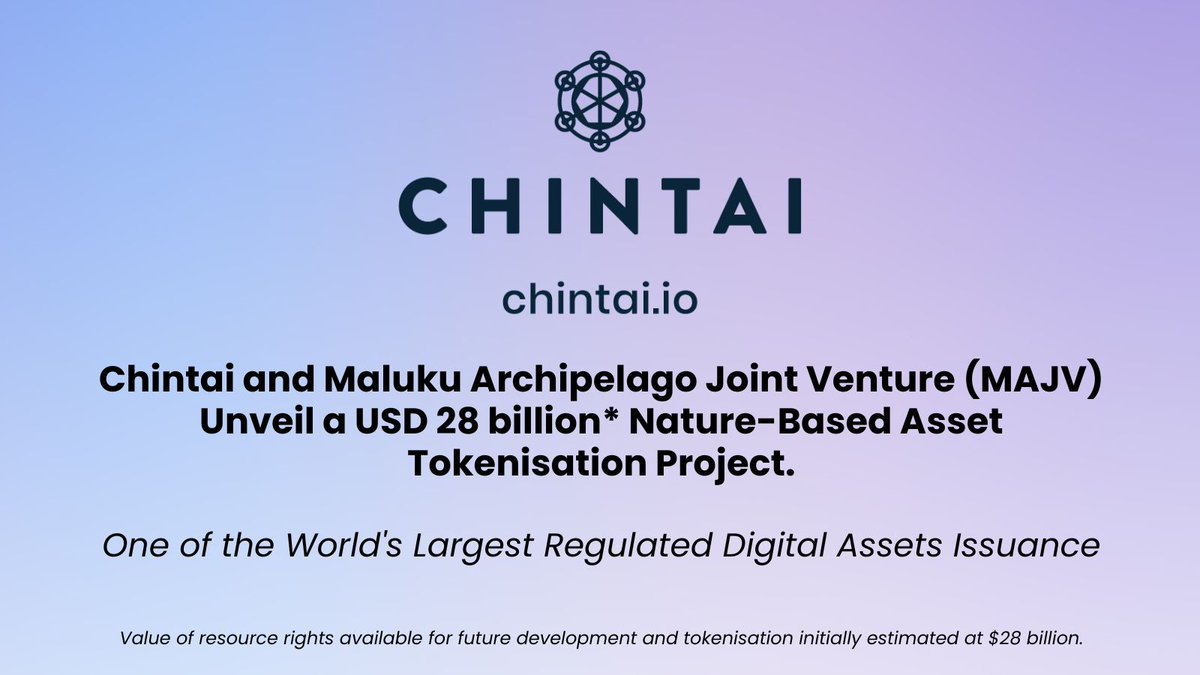
Chintai and Maluku Archipelago Joint Venture (MAJV) to tokenise real-world assets tied to the venture's 60-year nature-based development project for the Maluku and North Maluku provinces of Indonesia, valued at USD 28 billion, one of the most significant issuances to date.
https://t.co/jhsO1g0t0C
So after yesterday's introduction to the fundamentals of @OREsupply mining, today's educational seminar courtesy of @compoundORE - future home no click $ORE compounding and zero interest USDC advances without liquidation risk - is on where to start after getting $ORE-pilled.
As was the case yesterday, as an extra incentive to help spread this content I put a few hours into creating on my way back from Europe today, we will be doing a solo $ORE giveaway for retweeting. To be eligible you must all follow @zedge_ore and @compoundORE.
Okay so with the boring stuff covered... let's set the stage for what we're going to be talking about today. You've just been $ORE-pilled and you have $10k to invest and you're curious should I buy spot and stake or should I mine or do both or something else. Something else could be providing liquidity on @MeteoraAG etc but for now we will ignore than and just focus on the buy vs mine decision and touch a little on the go vs wait decision.
For today we will assume you have $10k to invest, $ORE is $150 and you earn 20% with compounding when you stake vs 100% when you mine (no compounding). As a reminder you pay a 10% tax when refining your mined ore... but the yield you get from holding unrefined mined ore is already refined and thus does not result in a tax when you claim.
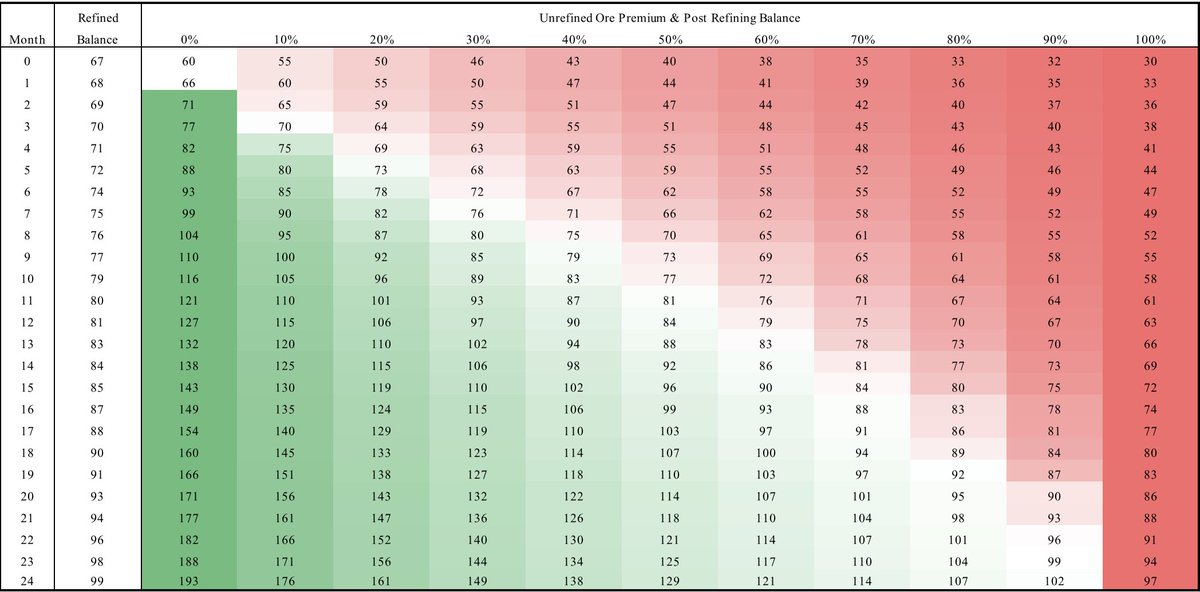
So below I've put together a nice table showing you how much $ORE you have buying spot vs mining and refining after various amounts of time and mining premium. As a reminder, mining returns as so attractive many people are willing to mine at a premium to spot (myself included - doing 3 sol a block as I write this patiently waiting for the @photofinishgame miner to launch).
It should be common sense that our goal should be to get as much $ORE as possible for our $10k. To answer what is optimal you need to know both what your time horizon is and how expensive it will be to mine.
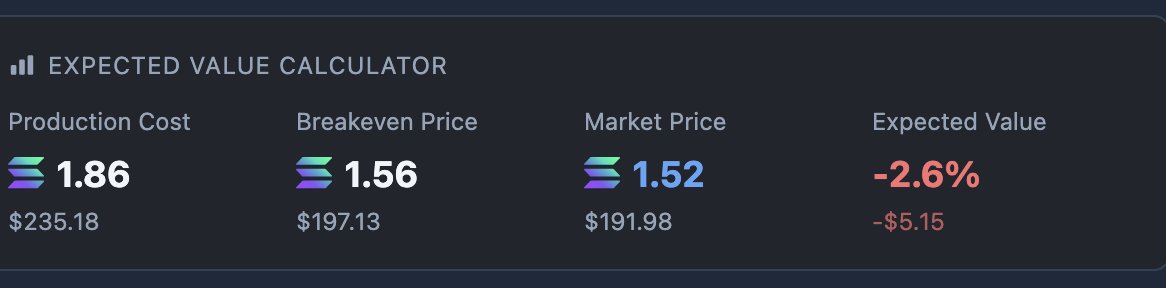
There are lots of good tools to figure out how expensive it is to mine (ore dot monster is a good new one I stumbled across from @oredotmonster). Below is a screenshot of what I look for... $235 production price and $191 spot price or a 23% premium. From spending a lot of time in the mines that is a pretty good price, especially for a large motherlode with around 200 ore and a low absolute price for ore (we were at 500+ not long ago so good time to stack up).
Bottom left there is a heat map showing the outcome in terms of number of $ORE you end up with after holding various amounts of time buying spot vs mining at various premiums. Mining is all about taking the long view so for now we will talk about the return for waiting a year (though I've included 0 to 24M in each figure so pick whatever you want)
In our example, your $10k buys you 67 ore at a $150 spot price. This ore compounds to 81 ore after 12 months. If you could instead amass an unrefined ore position for the same price then you would be better off after waiting 2 months (your 100% yield would more than offset the 10% refining cost). If you wait the full year, then your 0% permium unrefined ore position would leave you with 127 ore after refining. It is quite hard to mine for spot... perhaps some people can do it and the smaller the amount you need to invest the more selective you can be... if we instead say you mine for a 20% premium to spot, like current conditions and where I am generally mining, then you start out with only 50 ore... a lot less than buying spot. You pay a premium to get your ore and a tax to refine it... it really only makes sense to mine if you have long-term conviction in ore and the liquidity to not need to access your ore for awhile.
In this 20% premium example, you start to breakeven by month 5 and by month 12 you have 106 ore. Ending the year with 106 ore vs the staker with 81 gives you a nice margin of error. We will get into that more in the post below
Mining is one of the best and most misunderstood things about @OREsupply - today I will help demystify it and share a little on my strategy and mental models.
What is $ore mining?
Every 60 seconds miners place $sol on 1 to 25 tiles in a 5x5 grid. You can play all 25 and win every round... or you can play a subset of tiles and introduce more variability to your results. Unlike mining $btc or any other L1, $ore gives you the option to "mine" the winning block every round if you so choose. If you mine the winning block, then there is a 50-50 shot of the 1 ore being awarded to one person or divided amongst all miners. Your shot at winning the one ore and your share if it is divided is determined by your share of ore on the tile relative to the other miners. Every round 0.2 ore gets added to the motherlode with a 1/625 shot of hitting and getting split amongst the winning tile players proportional to their sol on that tile.
What happens to the sol used to mine?
In normal L1 mining, miners must spend significant resources to secure hardware and operate that hardware. When these miners "win" a round they must sell the token to cover their costs... this introduces a leak into the ecosystem. This leak grows with the value of the ecosystem as you need ever greater buy pressure to offset miner selling with higher prices. Ore in contrast can be done with any device that has a solana wallet and an internet connection. The solana miners use is also not lost when mining happens. 1% goes to fund the protocol, 10% goes to fund staking yield/buybacks and 89% is returned to the winning miners. The 10% that goes to fund staking/buybacks is split 10% staking and 90% buybacks.
Why should I mine ore?
Mining ore is the best way to exploit a long-term bullish view on the @OREsupply ecosystem. Currently you get a 19% APY from staking and a 86% APR from holding unrefined ore. The excess yield on unrefined ore from mining is why people mine.
What is the catch and why is the unrefined APR so high, is this sustainable?
All ore enters the world as unrefined ore. Now that you can buy ore or mine it you have to decide what is right for you. The yield from sitting on a mined ore position is so high that most people would prefer it over bought refined ore and that is why people mine it at a premium to spot ore prices. So long as people mine above spot then buybacks > emissions and circulating ore shrinks... either slowly or quite fast depending on the ratio of these two flows. The yield from unrefined ore comes from people refining it... when you want to claim your ore, you "refine" it and pay a 10% tax that goes to the other unrefined ore holders, proportional to their position in the overall pool. This is an anti-ponzi... the longer you hold the more you get from others refining.
What happens if others stop refining... wouldn't the yield collapse and bring the whole thing to a grinding halt?
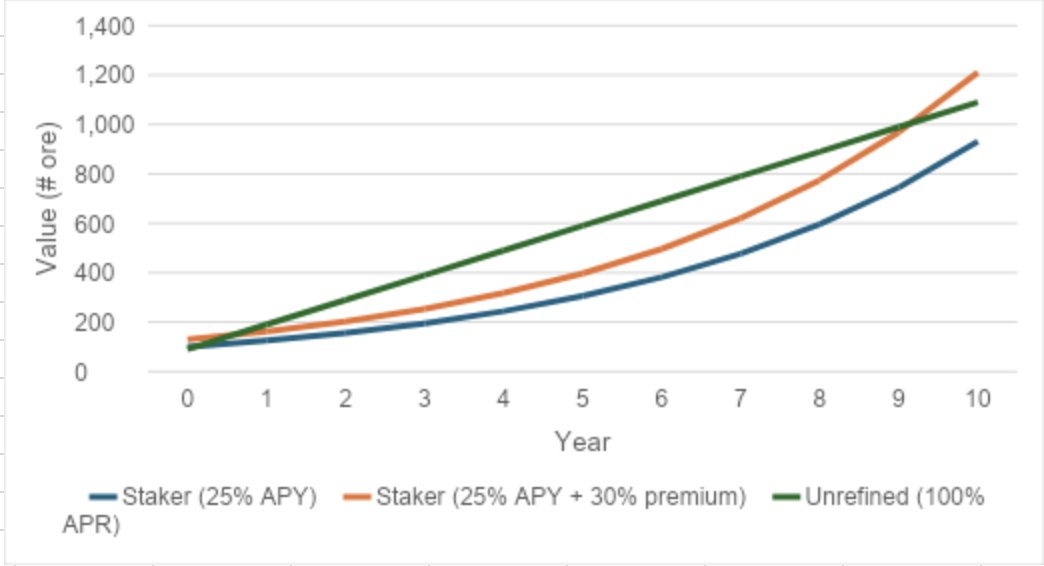
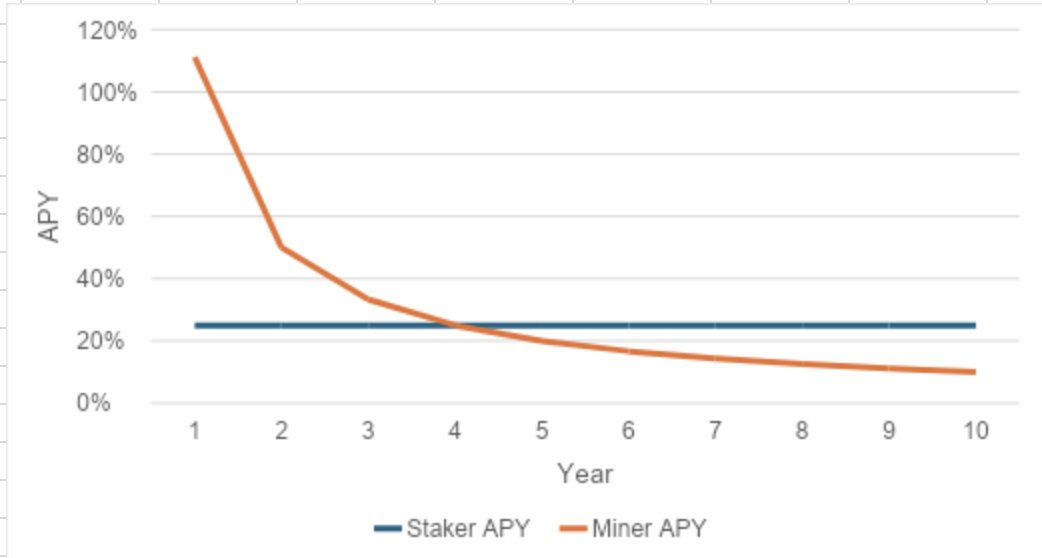
As prices rise people will want access to their mined riches and will be willing to forgo yield to have liquidity. The same happens when prices tank across the market and people need liquidity... sometimes expensive liquidity is all you can access. Soon I will have a defi protocol for you where you can borrow against your staked ore without paying interest or facing liquidation risk... but that's not quite ready yet so we can table that. A week ago during the market selloff, unrefined ore was yielding 150% as people choose liquidity over profit... and those of that could wait or had more conviction were paid for that. Even if everyone acts rationally there will come a time when everyone should refine as I demonstrate below. Bottom left shows you how $100 of unrefined ore grows vs $100 of refined or $130 of refine to represent the premium you likely need to pay to get access to unrefined. You can see in the chart that in the $130 scenario the staked ore eventually catches up and exceeds the unrefined mined ore. The reason for that is the unrefined mined ore gets paid in refined ore as others pay their 10% refining tax... while you do not pay a tax when you claim this ore it also sits idle. With time the ratio of very productive unrefined ore to idle refined ore skews towards the idle refined ore, bringing down the yield. As you see below right, while it may take a very long time horizon for the miner to fall behind... by year 4 the miners go-forward return has fallen behind that of the staker. The miner has such a huge lead that they do not fall behind the staker in absolute terms until year 9 but as soon as go-forward returns fall below that of staking they should refine and switch to staking.
How should I mine? Every tile has the same chance of "winning" in ore mining. As a result if each tile had the same sol on it then they would each have the same EV. When you enter the mines you will quickly realize that many people do not play all 25 tiles and as a result you often end up with some tiles that have relatively more sol and others with relatively less. Given each tile wins with the same frequency and you split the winnings amongst your fellow "winners"... it pays to avoid "crowded" squares. If you're mining with a small amount of sol you can target just the "good" squares and there are bots to help automate this... but be warned many are trying to do this and what the board looks like when you place your sol does not matter... it is what the board looks like when the round ends that matters. For this reason I always play 25 tiles as I want to win and I mine with too much solana to be effective any other way... I still end up with greater ownership of the "good" tiles and less ownership on the "bad" tiles. Some people will tell you mining 20 tiles has a better EV than 25... they are wrong. They are confusing outcome for process / math logic. The best way to explain it is if you play 24 tiles you will almost always win... you will win 24/25 times or 96% of the time... when you win you will have put less sol on the board than someone playing 25 tiles... you could do this strategy and see long winning streaks and think you've cracked the code... but there are no free lunches in ore mining... 4% of the time you will lose all of your mining capital and that concentrated loss will offset all the small gains in the other 96% of the time. The closest thing to a free lunch is selectively mining... mine when the effective cost of mining doing all 25 tiles is close to spot and avoid mining when it costs 2 or 3x spot. I personally mine when I can get unrefined ore at less than a 20-30% premium and mine very heavily when I can get it for close to spot. I do this by converting a little ore to sol and then mining with that... my ore portfolio is 90% refined and 10% unrefined so I have a long way to go... but the effort is worth it to me as if I can get more portfolio to 80/20 then I will have doubled my yield without any real liquidity cost as I will still have access to 80% of my ore without paying a 10% refining tax.
Hope that helps make mining clear... and to help get this message out to the world.. please drop your wallet address below and follow me, @OREsupply and my new defi protocol @compoundORE for a shot to win one $ore - winner will be decided in 24 hours. Expect regular long form posts with more chances to win $ore so please turn on notifications for all three accounts.
Maybe, just maybe... something's brewing at chintai:
Real-World Assets (RWAs) are quickly becoming the next major wave in crypto. Larry Fink's talking tokenization at the SEC, BlackRock and Franklin Templeton are bringing funds on-chain, and this week's Chainlink SmartCon (Nov 4-5) looks like the meeting point between TradFi and DeFi.
Right in the middle of that sits CHEX (Chintai), a regulated RWA platform out of Singapore that's been quietly building the rails for years.
The Setup
CHEX is an official sponsor of SmartCon, where Fidelity International, Franklin Templeton, JPMorgan, and others will discuss tokenized capital markets. CEO David Packham recently said they were "setting up a news cycle," and this event feels like the start of it.
Then, just two days later, comes another long-anticipated milestone: a dashboard launch *targeted* for Friday, Nov 7, announced in their Telegram channel. It should finally display their on-chain assets: reportedly $669 million issued (and $5.7 billion signed?).
The Day Before SmartCon
On November 3rd, one day before SmartCon opens, Chainlink dropped a major announcement: the Chainlink Automated Compliance Engine (ACE) partner ecosystem, featuring 20+ leading compliance providers, frameworks, and regulators.
Among the tokenization platforms listed: Chintai.
According to Chainlink, "Chintai uses ACE to define investor and transaction eligibility requirements for Chintai assets in public blockchain environments." Translation: Chintai's compliance infrastructure is now part of Chainlink's institutional-grade standard for onchain compliance, alongside identity providers like GLEIF and World, risk platforms like Chainalysis and TRM Labs, and frameworks like ERC-3643.
This positions CHEX as one of the few tokenization platforms officially recognized within Chainlink's ecosystem, the same week they're sponsoring SmartCon. Timing feels deliberate.
Partnership Web
Splyce × Solana: In a recent Twitter Space, Splyce said "Chintai funds will be available from the first half of November." That suggests tokenized products might go live right after SmartCon.
Arch Network + HoneyBee (Bitcoin): Bringing real-world yield to Bitcoin without bridges or wrapping. CHEX provides compliance; Arch provides the native BTC infrastructure.
Passion Venture Capital (PVC): Strategic plan to tokenize $1.2 billion in Asian assets over 18 months, covering bonds, private credit, real estate, and biotech.
Packham also dropped this line:
"We not only have one of the top 5 asset managers in the world but looks like we secured an additional top 20 to be a strategic partner with us."
The names remain undisclosed, but ecosystem overlaps point strongly to Fidelity or Franklin Templeton, both SmartCon participants.
The Leaked Slide
A PowerPoint slide recently surfaced showing Chintai's partner and ecosystem network. The roster includes major exchanges: Coinbase, Kraken, Bitfinex, Bybit, OKX, Binance, and Cryptodotcom. If accurate, it suggests CHEX has been building distribution infrastructure quietly while the token languished.
Comparing that slide to Chainlink's official ACE announcement, many of the same names appear: Chainalysis, CipherOwl, Hacken, Kaiko, Hummingbird, Persona, Proof, TRM Labs. The leaked slide wasn't speculation. It was a preview of what's now public.
Reality Check
CHEX hasn't moved fast. The dashboard's been promised for nearly a year, and the "top 5 / top 20" names are still unrevealed two months later. But unlike many fast-moving RWA protocols, CHEX built the regulatory foundation first. They hold dual Monetary Authority of Singapore licenses (CMS + RMO), one of the strongest compliance moats in the sector.
There's another reason the price stayed flat: a whale who held 100 million CHEX has been dumping for over a year. On-chain data shows they're now down to around 3.5 million tokens. That overhang suppressed price action even as fundamentals improved. With the whale nearly out, that selling pressure is finally gone.
Seems like things are aligning. Chainlink ACE announcement → SmartCon → Dashboard Launch → follow-up announcements feels deliberate, like the start of a coordinated news cycle after a year of silence and systematic selling.
The Bigger Picture
The global RWA market could reach $16–30 trillion by 2030. Solana's RWA TVL grew 260% YTD to around $600 million. CHEX is now active on three fronts:
Ethereum / Chainlink for interoperability
Solana / Splyce for distribution
Bitcoin / Arch Network for yield
Their token model ties directly to platform activity: 5% buyback + burn, 10% revenue to stakers, and a fully circulating supply. A rare combo of real yield and scarcity.
Bottom Line
CHEX has been one of the slowest-moving RWA players but also one of the most fundamentally sound, Tradfi based. After months of silence, repeated delays, and relentless whale selling, all catalysts now converge within a single week: official Chainlink ACE recognition, SmartCon sponsorship, new partnerships, the long-awaited dashboard, and confirmation that the ppt slide was real.
The whale's finally out. The partnerships are verified. The regulatory moat is defensible. And now, one day before the biggest institutional crypto event of the year, Chainlink just told the world that Chintai is part of their compliance standard for tokenized assets.
What's next, only time will tell
Excited to see @Solana's ecosystem leveling up finance to match the internet's speed. Capital flows 24/7, borderless and bank-free.
@SplyceFi is the spot where that capital unlocks real, sustainable yield - paying steady no matter if markets pump or dump.
Throw in Solana's announcement about @Fidelity as well as platforms such as @ChintaiNexus for seamless TradFi tokenization, and you've got the full bridge to Internet Capital Markets.
If you're not following yet, fix that.
🚨Connecting the dots: $CHEX utility BOOM
What we're doing: Making CHEX power the full lifecycle of institutional RWAs.
What we've done: White labeled tokenization for Tradfi via Chintai rails.
Where it's going: @ArchNtwrk = RWAs on BTC; @SplyceFi = RWAs on @solana.
...
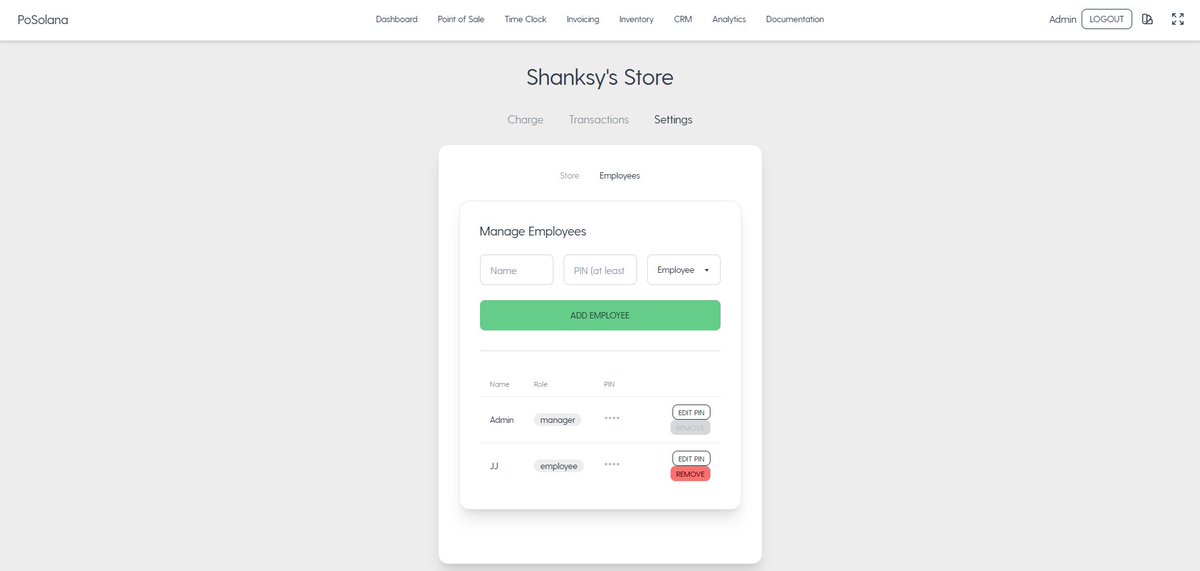
Big news! We're rolling out a massive update to the PoSolana Suite, focused on team management, security, and store operations. Introducing User Profiles! 🧑💼
Managers can now create accounts for employees, each with a unique, secure PIN.
The chart I posed the other day was the $CHEX token back in 2023. Already a 4 year old token at the time, it fell from its ATH of $0.08 down to $0.005. Fast forward 1.5 years and the token had done 160x to the ATH of $0.8.
Now the token has fallen from $0.8 to $0.05.
Nothing about how @ChintaiNexus operates has changed, in fact if anything they are accelerating ,and building, and landing crazy commercial traction faster and harder than ever before.
I'm probably the 2nd largest token holder on the network, and whilst I never like to see things dip like this, I know it is a short term problem. I have the patience to see what the token is worth in another 1.5 years, and I'm excited about that.
My only regret is that I misjudged the bottom and bought more CHEX too early.
Anyway, I'll see you all at the yacht party
Chintai and Passion Venture Capital Join Forces to Unlock over USD 1.2 Billion Tokenised Assets Across Asia over the next 18 Months
@ChintaiNexus@GunnisonCap@loancyborg@chintaiberry
https://t.co/Qy8Wgj6Gig
Tutorial
Recorded a step-by-step video guide for testnet node activation codes.
What's Next:
- Chrome Web Store release (imminent)
- iOS & Android apps in development
The mobile-first quantum blockchain is coming to all platforms.
#QNET #BLOCKCHAIN #postquantum #WEB3 #AI#1DEV