I am a Catholic priest. I went into the woods to live deliberately. I love to hear the steel belts hummin' on the asphalt. Otherwise my opinions are my own.
There is a growing desire in the world today to meet all things with compassion. On every side of every disagreement, we hear a call to restore the world through compassion alone.
But compassion has never been the final aim. (Thread)
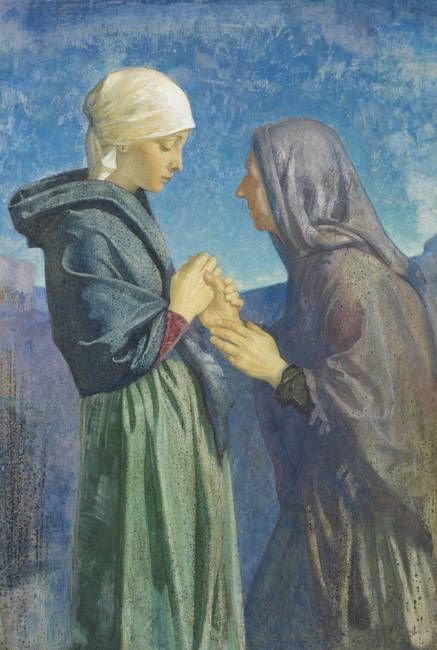
If you read or heard the Gospel from Mass today — the account by St. Matthew of the announcement of the conception of Jesus to Saint Joseph — thanks to our New American Bible translation, you might have gotten a strange impression.
In this account, Joseph is described as a “righteous man.” And yet, the Gospel states, “since he was a righteous man, yet unwilling to expose her to shame, [he] decided to divorce her quietly. Such was his intention when, behold, the angel of the Lord appeared to him in a dream….”
Did Joseph know what had truly happened, a miraculous conception? If he did know, why would he divorce her and not continue to protect her?
(The great exegete and theologian, Fr. Ferdinard Prat, SJ, has a masterful analysis of all this in his book, Jesus Christ: His Life, His Teaching, and His Work. I largely follow his argument here.)
At the time of today's Gospel reading, it seems clear that Joseph did not yet know of this miraculous conception. Otherwise, why would an angel then have to tell him of this miraculous conception?
If he didn’t know, what were the alternatives? Might she had been violated, perhaps on her journey to see Elizabeth? Could she have been unfaithful? A careful reader might suppose that Joseph could not be called righteous if he concealed the guilt of his spouse. (In fact, the Mosaic Law would have commanded him to reveal her adultery).
They were not yet living together, though legally bound as husband and wife (as betrothal worked at that time). Joseph knew Mary’s virtue and her resolution to stay a virgin.
(At the Annunciation, her response to the angel, “How can this be, since I know not man?” as traditionally understood, does not mean *I have not YET known a man* but *I am resolved not to know man*. Why, then, was she betrothed? Most profoundly, because she was the New Eve, anticipating in herself the states of marriage and the consecrated life. But as far as she knew at the time, it is likely her marriage was arranged to preserve the heritage of her familial descent. Her question to the angel was not impertinence: it can only make sense as virtuous if she had *already* believed herself to be called by God to celibacy, as Elijah, Elisha, Jeremiah, and other figures of the Old Testament had been similarly called, just as John the Baptist was called. But her celibacy was to be something far more profound.)
As a righteous man, Joseph’s resolve was to trust Mary, who had never given him any reason to doubt her unimpeachable virtue. But the signs of Mary’s pregnancy were there to see, if only yet to a select intimate few. Knowing her virtue, Joseph would have been as sure of Mary’s innocence as he was of anything. He did not want to dishonor her. Thus the idea of divorcing her quietly. But still, he must have remembered his vow to care for her as a husband, protecting her. Would a loving husband abandon his wife, even putting her away quietly?
The translation in today’s Gospel suggests that Joseph had resolved to divorce her but the angel appeared to change his mind, reversing his decision. Joseph was compelled then.
But this will not do. The Greek word for “decided” is not what is in the text. The word is “eboulēthē”, meaning to intend or desire, to plan, not “thelein”, meaning to will or choose (or decide). The NAB continues its poor translation in the key next sentence when it says that “such was his intention” when an angel appeared. Rather, the phrase “tauta de autou enthumēthentos” means “as he was pondering this.” Enthumēthentos means to reflect or meditate upon, to consider. If there were any doubt about how to translate eboulēthē, that next sentence should make it clear.
If he was pondering this, considering this, he would not have yet reached a decision or resolution. No, what he was doing, in fact, WAS PRAYING, as any good Jew in his position (and Joseph was certainly that) would be doing. And we know the quality of his prayer as we know anything else interior and spiritual — by its fruits. “When Joseph awoke, he did as the angel of the Lord had commanded him.”
As Fr. Prat notes, the Fathers were divided in their interpretation of this episode. Some believed that Joseph suspected Mary of adultery, which seems incredible, given he must have known her reputation and possessed no circumstantial evidence whatsoever. Would he not first try to investigate the case and clear up any doubt, especially since the reason for her divorce might be discovered and Mary’s life put in danger?
Others believed that, by some miracle, Joseph knew that a miraculous conception had occurred but thought himself unworthy of such a task, serving as Mary’s (and Jesus’) protector. Such an inference makes the angel’s appearance to Joseph strangely redundant and superfluous. Moreover, nothing in the Gospels elsewhere would imply such knowledge on Joseph’s part, nor his shirking of duty. We are told the opposite: he did what the angel commanded him, as befitted his righteous character.
I think best St. Jerome’s interpretation, which I have followed here. Joseph was certain of only one thing: Mary’s unimpeachable virtue. Therefore, he said nothing of what he did not understand, in true reverence. He knew only his duty, and he was intent on being faithful to it to the end. His consideration of divorce was something considered as one might entertain all possible licit alternatives; and if it was attractive, it was only because he thought it a prudent way to protect Mary, to do his duty. But he had not decided: tauta de autou enthumēthentos. He was pondering these things.
This is why the angel told him, "Do not be afraid to take Mary your wife into your home." Joseph was anxious and fearful because he wanted to do the right thing, but he did not see how he could without committing some injustice.
So Joseph prayed to the Lord, “O Adonai.” He was not praying for what he would have preferred: he was praying, “Thy will be done.” And when the Lord through the angel revealed his will, because of the quality of Joseph's prayer, seeking the Lord’s will and not his own, when that will was revealed to him, he promptly followed it:
“He did as the angel of the Lord commanded him.”
@quachelsey@TheHappyPriest How fallen nature is not corrupt but in a Providentially guided world our falls may be the means of triumph over impenitence.
Cf. https://t.co/PNqJlKm9v6
As the personal and social costs of the sexual revolution continue to mount and indeed become impossible even for those nearly blinded by ideology not to see, Ryan Anderson reflects on why what was sold to the public as "liberation" turned out to be so destructive.
The sexual revolution is built on a series of lies about the human person. And there are human costs to getting human nature wrong.
https://t.co/8yF9NND6Jk
@quachelsey@TheHappyPriest How fallen nature is not corrupt but in a Providentially guided world our falls may be the means of triumph over impenitence.
Cf. https://t.co/PNqJlKm9v6
@RodRuiz14@TheHappyPriest The bonds of familial love and intercession against the nihilism and pessimism of Dylan Thomas's "Do Not Go Gentle into that Good Night." A Catholic vs. a Newtonian understanding of time. Also, a kind of argument from fittingness for Purgatory. Lots of good stuff there.
@WB_Baskerville@suzania If created being is the limitation of act (esse) by potency (essence), a metaphysics of participation (like the Divine Ideas) would be a sort-of contrary example. The infinite potential ways in which Actus Purus can be participated in, and the Divine Knowledge of that.
@TheHappyPriest As for shows, I would add the Sopranos and Lost. (Lost is plainly the greatest thematically Catholic television show ever made.) Perhaps Fargo and Breaking Bad, too. Seinfeld was a superlative account of fallen human nature and the tragi-comic consequences of nihilism.
@TheHappyPriest - The Ninth Day
- To the Wonder
- The Mission
- The Seventh Seal
- Interstellar
- Lilies of the Field
- Gravity
- Babette's Feast
- On the Waterfront
- A Quiet Place
- The Last Days of Disco
- The Elephant Man
- Calvary
- Children of Men
- Hail Caesar!
- The Natural
- Once