Introducing a new method for simulating continuous-space systems with the help of quantum computers that does not rely on any form of discretization: https://t.co/qVI8suM5P8
w/ @pgabbo0@gppcarleo
at @cqs_lab@QSECenter_EPFL@EPFL_en
See 👇 for key points.
open PhD position 🧑🎓 in my group @mpi_pks: we work on the very latest challenges at the interface of two of the most exciting technological developments of our time – machine learning & quantum technology – and you have the opportunity to actively participate! Apply by Nov 1 📜
Introducing a new method for simulating continuous-space systems with the help of quantum computers that does not rely on any form of discretization: https://t.co/qVI8suM5P8
w/ @pgabbo0@gppcarleo
at @cqs_lab@QSECenter_EPFL@EPFL_en
See 👇 for key points.
@pgabbo0@gppcarleo@cqs_lab@QSECenter_EPFL@EPFL_en Moreover, we demonstrate that the hybrid quantum-classical wave functions can achieve lower ground state energies than the pre-optimized classical wave functions alone.
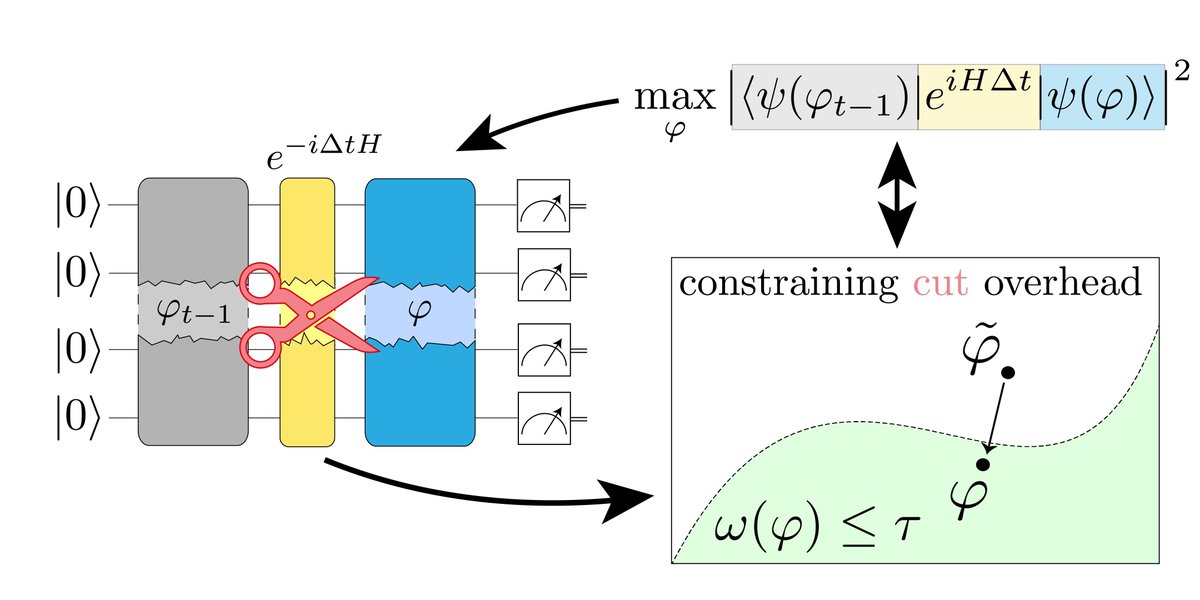
Accepted and published in Quantum: Overhead-constrained circuit knitting for variational quantum dynamics by Gian Gentinetta, Friederike Metz, and Giuseppe Carleo https://t.co/l7w3XjNxDY
New preprint out! 🎉 We show how to keep the sampling overhead controlled when using circuit knitting to simulate dynamics of large quantum systems on small quantum devices. With @frmetz and @gppcarleo
https://t.co/l6fOl7yUlZ
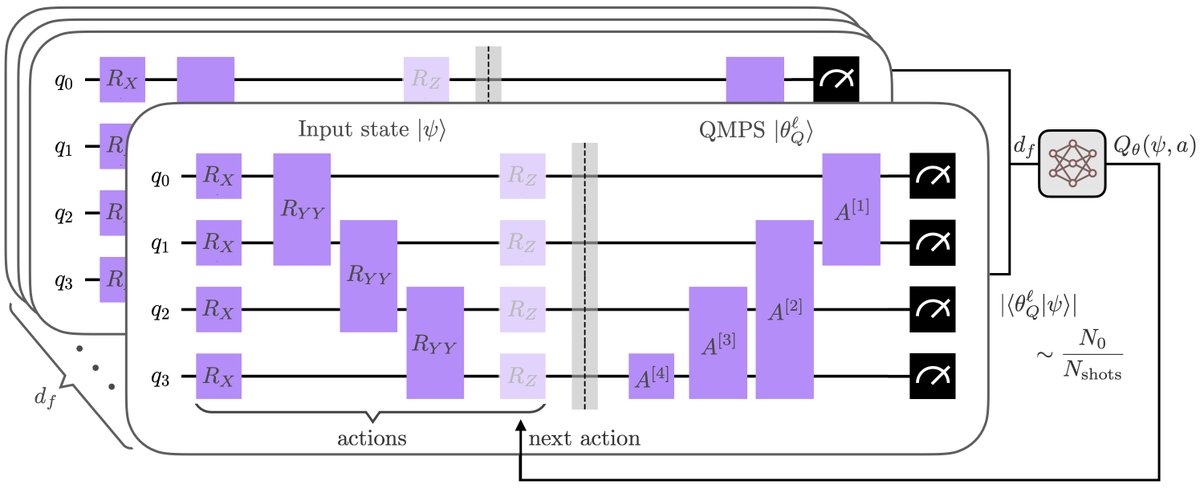
@MarinBukov@NatMachIntell Compared to the first version of the paper, we have added a couple of new things including a whole section of how one can map our QMPS framework to a hybrid quantum-classical algorithm that can be executed on quantum hardware. So it’s worth checking out again!
My paper with @MarinBukov ‘Self-correcting quantum many-body control using reinforcement learning with tensor networks’ has finally been published in @NatMachIntell 🥳
https://t.co/yTrWgPjcl2
Scientists use tensor networks to develop and train an artificial intelligence agent to manipulate many interacting quantum bits of information. Research by @frmetz and @MarinBukov@mpi_pks now @NatMachIntell: https://t.co/3CytvG4YlM. @OISTedu@universitysofia
@MarinBukov@NatMachIntell I have to say that I am incredibly proud of this work. It has been years in the making and took quite some effort and perseverance.
I also want thank my amazing mentor and supervisor @MarinBukov. I have learned a lot from you and am extremely grateful for all your support!
At today's CCQ Tensor Meeting, Friederike (Rike) Metz (OIST, MPI-PKS) spoke about control of quantum systems using reinforcement learning based on a tensor network architecture. See her recent work here: https://t.co/3Wej0Ej2j5
Quantum Physics & Machine Learning – Track spotlight ☄️
How did #MachineLearning helped groundbreaking advances in #QuantumPhysics in recent years?
Join us on March 29 at #AMLDEPFL22 to know more and have an overview of the topic!
More information ➡️ https://t.co/euUcNAR483
Introducing: Self-Correcting Quantum Many-Body Control using Reinforcement Learning with Tensor Networks
https://t.co/aSsG6QVYrL
w/ Marin Bukov at @OISTedu#mpipks#SofiaUniversity
Check 🧵👇for a summary
What's next? MPS can be mapped to quantum circuits and hence allow the framework to be integrated in NISQ device applications. MPS also come with a full toolbox for studying their properties. These can give insights into the ansatz, the data, and the training.