Founder of Potential Multibaggers & Best Anchor Stocks
Finding winners early. $SHOP $7.78, $NET $39, $CRWD $98 etc.
I help you stay calm when everyone panics.
I've owned $NET Cloudflare since 2020.🤑
Most don't understand the company.
So I wrote a guide about what Cloudflare actually does, why it calls itself the connectivity cloud, and what Act 4 means.
Cloudflare explained in plain language.
Grab it below👇
You can find everything here:
$NET's 4 acts
Why it's the connectivity cloud
Why AI turns the internet upside down and what Cloudflare does to build a new internet.
And much more.
Everything you need to know in 5 pages.
https://t.co/aLdk9Cwnvr
I've owned $NET Cloudflare since 2020.🤑
Most don't understand the company.
So I wrote a guide about what Cloudflare actually does, why it calls itself the connectivity cloud, and what Act 4 means.
Cloudflare explained in plain language.
Grab it below👇
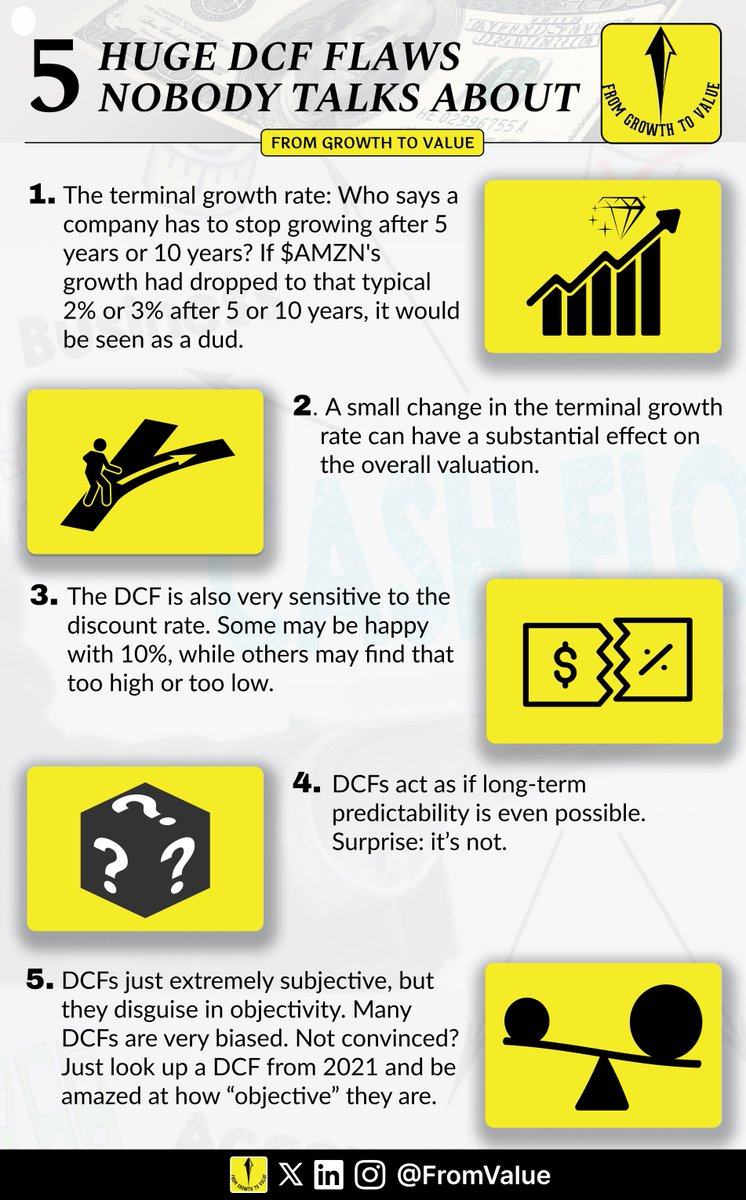
One of the most common delusions in investing is that numbers are objective and used by people who have no biases.
DCFs are very subjective, with very uncertain inputs that build on each other.
I don't say DCFs are useless, but they must be seen for what they are, mere guesses.
It is different from the dotcom bubble, and it's not $CSCO. Cisco had a PE of 200 near its top, around 140 forward PE. And as you can see on the chart, the stock price had skyrocketed much more than the earnings.
In the buildup to the Great Financial Crisis, banks and home builders also posted big earnings gains. This resembles it more.
So, it's not a multiples bubble, it's an earnings bubble.
And that's why $NVDA looks so cheap. The market thinks the heavy investments are unsustainable.
That earnings bubble will pop too, but not yet, I think.
Some see Jesse Livermore as the best trader ever.
I see a gambler who lost everything.
He started with just $232.82 at the age of 14 (in today's money).
At 23, he had more than $2M, but he lost it all at 24 (and then some).
He had more than $15.5M at age 29 and lost it all that same year.
That's pathetic behavior. Never enough.
2 years later: $194.2M; 6 years later: down $ 34.9 M.
At 52, he had more than $2B but at 57, he had $134M in debt.
Won it back at 60, lost it again at 63.
That's when he committed suicide.
A gambler who didn't know what was enough, 3 bankruptcies, multiple divorces, and making use of a market that was not yet regulated.
It's an entertaining character, even charismatic. And sure, he had some timeless lessons.
But he forgot his own most important insight: "The biggest enemy is yourself."
Not my type of guy.