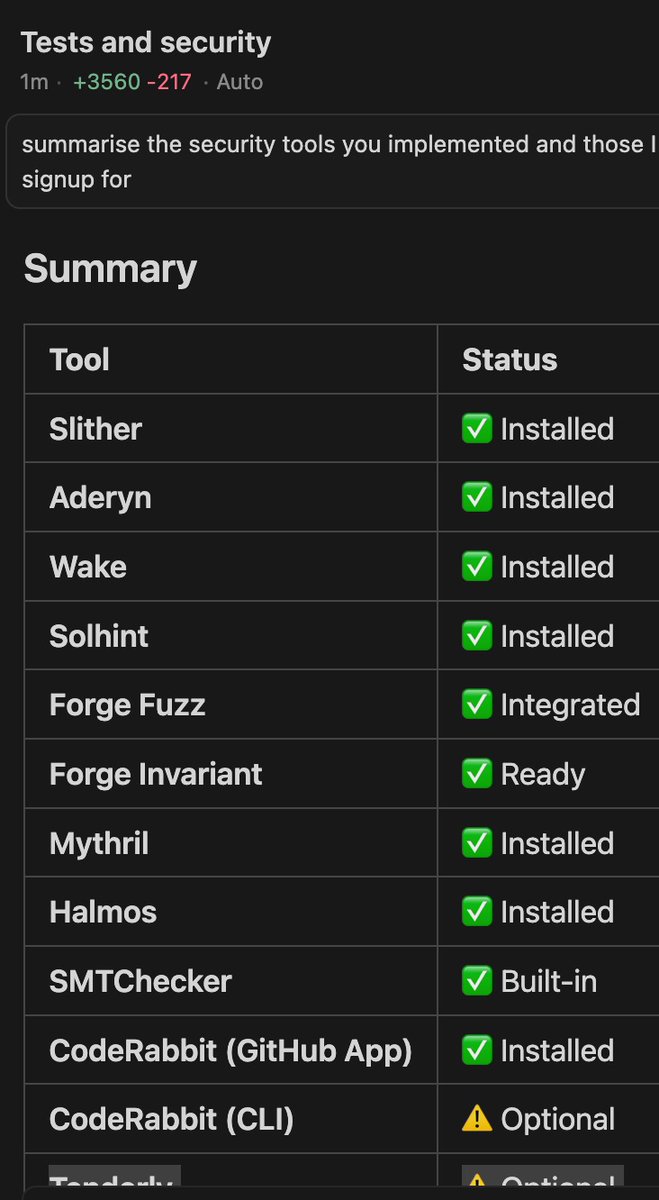
For the @eigencloud hackathon we've build a platform to deploy economically productive Agents in TEEs that use Skills to get superpowers. Add skills to github https://t.co/rWxcph6ZrM - https://t.co/Cs4So7lkEY
Weirdly, the challenge is that most so-called "decentralized" systems today replicate old surveillance models. We should work on our approach to privacy to actually empower individuals without compromising their rights to privacy #TechForGood#Decentralization
this whole vibecoding craze validates one thing:
building and distributing frontends is going to be insanely profitable
we already have great crypto primitives but just not packaged for normal people
slap better frontends on pendle, aave, polymarket, etc
market them differently
capture fees
Apparently, in just the last 24 hours, 405 users integrated paywalls into their iOS apps using Claude Code. Transforming ideas into revenue is an accelerating thang. #ClaudeCode#TechTrends
Have you given any thought to the implications of Circle launching $EUROC? A Euro-backed stablecoin could help Europe make some crypto progress - a big step for crypto adoption in its most laggard market? #Stablecoins#Euros
The first-ever Vibeathon is here.
Jan 4-14. $1,000 prize. One mission:
Build an open-source tool that makes vibe coding better for everyone.
https://t.co/mwkmyzzUKV
Nerdy tokenomics post...
Venice released an experimental token design for accessing AI compute back in Sept, called DIEM
Staking DIEM grants access to any AI model on Venice for free (1 DIEM = $1 of renewing daily credits): it makes the marginal cost of compute free.
At first, it was API access only (no web), and only a few open-source models.
In Oct-Nov we allowed its use on the Venice web app (no longer API only), and then started adding all the leading external AI models to Venice.
Today, users can access Claude Open 4.5, Gemini 3, Nano Banana Pro, GPT 5, etc from Venice. This is both convenient (all the models in one interface), but also provides additional privacy (pseudonymity vis-a-vis Anthropic, Google, OpenAI, etc). These models are unequivocally the best in their respective categories.
Meanwhile Venice's userbase (both app and API) has continued growing.
And now we're seeing the tokenomics of DIEM start to play out... seven consecutive weeks of green candles amid a sideways or down broader market.
Why is it happening?
Imaging paying $100 to get $1 every day of AI credit. No brainer... especially because you can sell the DIEM back when done.
So people bought at $100 to use it and price of DIEM rose
At $200 it's still a no brainer, so price kept rising. Today it hit $300. What's $1/day worth as an asset?
Here's the mechanical part... as DIEM is bought and staked for AI compute, the rising price incentivizes VVV holders to mint more of it.
DIEM can only be created ("minted") from VVV, but as DIEM supply rises, the "mint rate" also rises, meaning it takes more VVV to mint 1 DIEM. This occurs along an algorithmic exponential curve.
Minting DIEM locks the VVV in an amount according to the mint rate. It can only be unlocked by repaying same qty of DIEM at any later date. This destroys the DIEM and releases the VVV.
DIEM's utility is flowing it toward usage and price is rising. This means increasing amounts of VVV are getting locked away (today over 6.3m VVV is locked, nearly 10% of total supply).
The more useful AI consumers find DIEM, the higher they'll bid for its scarce supply, which raises price, and locks further VVV on an exponential curve.
Equilibrium is eventually found when opportunity cost of capital paid for DIEM is no longer lower than marginal utility of the AI compute it can obtain. Someone should happily pay $100 for $1/day but prob shouldn't pay $10k for the same... as the NPV of the yield of $10k should be higher than just paying $1/day of cash for credits. Once that DIEM price is found, the amount of VVV locked also finds equilibrium.
As VVV is locked for this purpose, a portion of emissions flows to Venice, compensating for the costs of the AI compute its providing for free. Venice can control something called the "Target Supply" of DIEM, raising it up or down, which changes the mint rate which affects (but doesn't control) supply. If costs become too onerous to Venice, it reduces Target Supply, and it disincentives further minting, bringing equilibrium of supply back down at any given DIEM price.
We have no idea where these equilibria will or should be, but we know they exist.
Perhaps you'll find this set of mechanisms interesting, and I hope they'll inspire other experiments.
I wonder how long until sophisticated AI agents truly dive into the exploration of tokenomics as a vast design space... perhaps they already are? Perhaps they were involved in DIEM's design?
https://t.co/4c1U79KoWM
$DIEM $VVV @AskVenice
2026 will also be a turning point for verifiable AI. If you haven't looked into the role of zero-knowledge proofs in enhancing reliability, you're missing out. The future isn't just coming; it's here now with the tech that ensures trust. #Computefi#VerifiableAI#ethereum
2026 will be the year of the Active Agent vs the Passive Agent.
Passive agent: you know what you want to do, you tell agent to act.
Active agent: the agent has access to the worlds information, provides insights and opportunities that you didn't know about and acts for you.