Our Open-Endedness team at @GoogleDeepMind has a few openings for Student Researchers.
Maxence is a fantastic researcher and mentor, so please apply if you are interested in these topics!
If you have experience in watermarking, provenance or security and are a current student, we want to hear from you. @GoogleDeepMind is a special place, amazing people and opportunities to learn and contribute, and as a former Student Researcher myself, I cannot recommend it more.
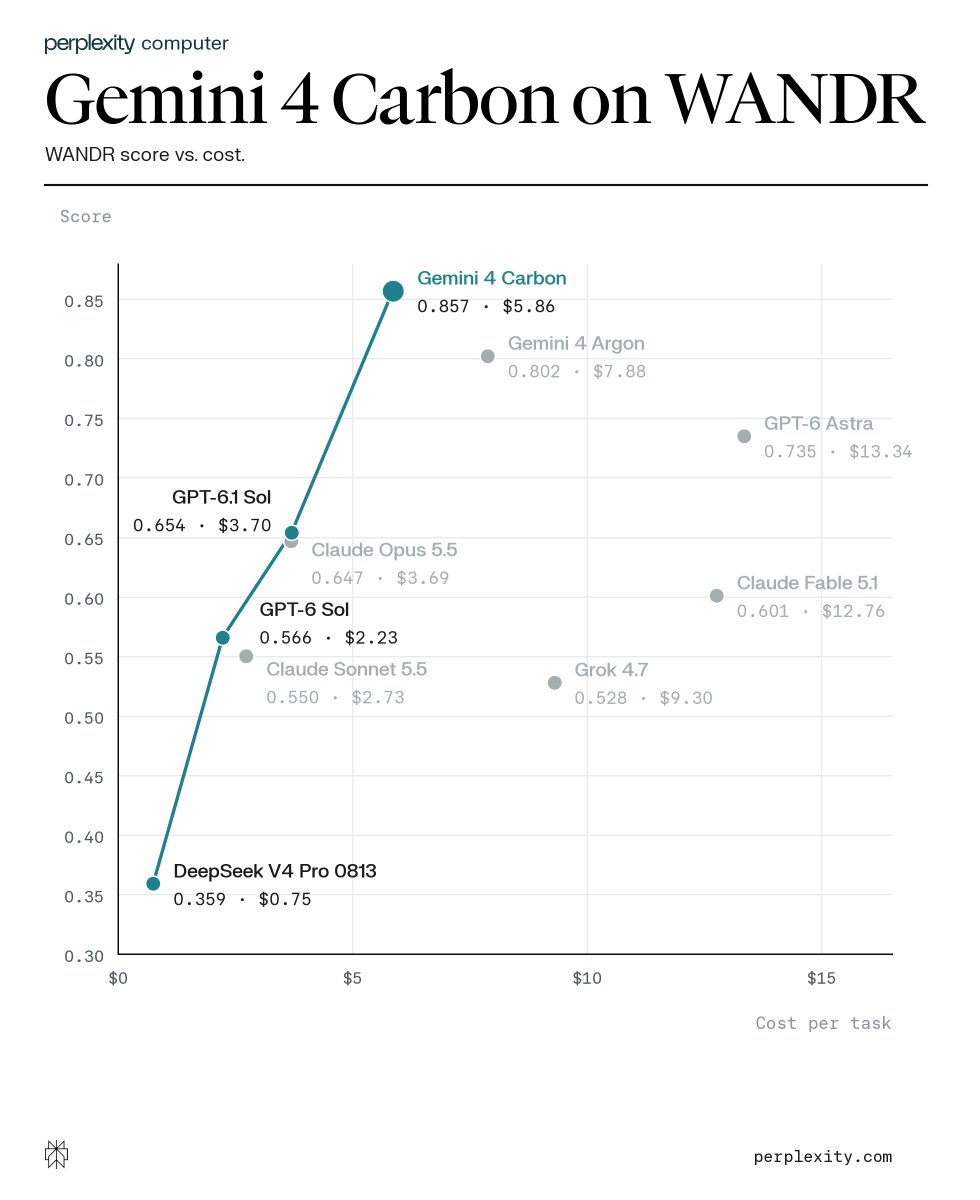
Sharing early evals on Gemini 4 Carbon. Strongest model that we've seen so far for long-form research and answer quality, with a new SoTA on the Wide-And-Deep-Research (WANDR) benchmark. Coming soon to all Perplexity Pro and Max users inside Computer, once we have sufficient token capacity. Congrats @GoogleDeepMind!
I am hiring a Student Researcher at the SynthID team at @GoogleDeepMind in London. We work on provenance across all modalities: text, images, audio, video and bio sequences, deploy on every single GenAI surface at Google and with partners like OpenAI, Apple and NVIDIA.
Just to be very clear. I have no knowledge when the exact release day will be. Today just happened to be the first day I opened twitter since the Argon announcement :)
Today we’re introducing Gemini 4 Argon.
It delivers frontier performance in complex workflows across real-world software engineering, knowledge work, and cybersecurity defense with an industry-leading 1M token output limit.
Today, we're releasing the Carbon Annotation Database and the model behind it, Carbon-A.
We've used this model to discover 566.34 million new gene candidates across 22,617 species, thousands of which have never been studied like this before.
We wet-lab validated a number of these new genes in well-studied species, such as in cats, chicken, and arabidopsis (plant), with our partners at Active Site and @UCSD, with more extensive wet lab results on previously-unstudied genomes coming soon.
Our SynthID technology lets you easily verify if an image, video, or audio file is AI-generated, and today we’re expanding access.
Now anyone can go to https://t.co/qyCNRb6dOv to check files for a SynthID watermark — whether they were generated by us or industry partners like @OpenAI, @nvidia, Kakao, and, coming soon, @Apple.
To date, we’ve watermarked 180 billion images and videos and more than 240,000 years of audio content, regularly handling 1 million verification requests daily.
This new portal joins our built-in verification features already live in Search, @GeminiApp, and @googlechrome.
There is a child with a rare disease who is currently suffering and struggling to manage his symptoms. Rare as this is, you can directly help him.
Today we are launching the "Rare Disease, Real Kid" Hackathon, and there are $50,000 in prizes from @AnthropicAI and @awscloud.
We (@huggingface & @Sagebio) are helping this child open his genome and clinical data to the community, so that we can find what's caused his disease and what currently-approved drugs could help him.
I doubt I need to motivate this much further or explain how rare it is for a family to share their child's genome and clinical data, but if you're not sure, consider this:
Until very recently, it wasn't feasible for patients like this to get treatment because their disease was so rare that the economics could never justify the investment. Now, as we've seen, people with rare diseases are starting to be able to find the answers themselves (with the help of AI tools, cheaper sequencing, etc). This kid is not able to do that for himself and neither are his parents, so we're asking you for help. Both for this kid and to prove that it's possible for everyone else suffering from a rare disease.
More details in 🧵.
https://t.co/hjjagALtMu
TL;DR: This is one of the most important and exciting opportunities in AI on the planet - please read on.
The British Open-ended Learning & Discovery Lab is creating the perfect place for paradigm breaking AI research in the name of open-source and open-science. We have agency, we funding, we have unprecedented amounts of compute*, but WE NEED YOU!
..and we have created the dream job for you: The BOLD Fellow. This job combines a fast-moving, high agency, collaborative environment with full academic freedom and a salary that pays the bills.
Apply by noon UK time on the 15th of September for this once in a lifetime opportunity to shape the history of our field and of our planet:
https://t.co/wN009tQEkt
*by academic standards
🤗🤗🤗introducing Hugging Science -- the home of AI for science 🤗🤗🤗
open models and datasets are the powerhouse of science (see the PDB), but finding the models and data you actually need for your breakthrough is hard af
you shouldn't need to scrape arxiv, own your own wetlab, fight a custom HDF5 parser, build a fusion stellarator, and beg for compute before you've trained a single epoch
so we're changing that
we've put all the best science on @huggingface in one place:
- 78GB of genomics data
- 11TB of PDE simulations
- 100M cell profiles
- 9T DNA base pairs
- 13M molecular trajectories
- 400k medical QA pairs
and much more, all open, and all ready for training (+ you can also now filter and search by domain, task, and keyword)
we've put together all the biggest releases from our partners at NASA, Google, OpenAI, Meta FAIR, Arc Institute, Ginkgo, SandboxAQ, Proxima Fusion, NVIDIA, Ai2, OpenADMET, InstaDeep, Future House, Polymathic AI, LeMaterial, Earth Species Project, Merck, and Eve Bio
if you're not sure where you fit in -- work on open challenges for problems that matter: including fusion stellarator design, ADMET, antibody developability, multilingual medicine, catalysis and materials, and scientific reasoning.
we're already changing how science gets done:
a fusion startup needed a benchmark for stellarator plasma confinement that didn't exist. @proximafusion shipped ConStellaration on Hugging Science: a leaderboard, dataset, and eval metrics, all in one place.
a drug discovery team wanted to predict hPXR induction. OpenADMET put up a blind challenge: 11,000+ compounds assayed at Octant, 513 held out, two tracks (pEC50 + structure). Anyone in the world can train and submit.
an antibody team at @Ginkgo released GDPa1, a developability dataset for stability, manufacturability, and immunogenicity prediction, with a live leaderboard scoring every submission.
if you know a problem the ML community should be working on, let us know. make a challenge! this is about putting all the tools for solving science in one place. so we can hillclimb!
→ https://t.co/T4l4r1lDz0
HALT (“High Accuracy, Less Talk”) accepted to ICLR 2026 🎉
LLMs are trained to always finish answers — even past what they truly know — causing partially wrong outputs.
HALT instead finetunes models to stop when confidence drops, trading completeness for reliability 🚧
👇
What if LLMs knew when to stop? 🚧
HALT finetuning teaches LLMs to only generate content they’re confident is correct.
🔍 Insight: Post-training must be adjusted to the model’s capabilities.
⚖️ Tunable trade-off: Higher correctness 🔒 vs. More completeness 📝
with @AIatMeta 🧵
Had an amazing time @NeurIPSConf!
Thank you to everyone who came to our Gemini panel!
It was great being up there with @JeffDean , @OriolVinyalsML , @bonniesjli , @sedielem , and the rest of the team. Loved the questions and follow-up discussions!
Looking forward to Sydney!
This is Gemini 3: our most intelligent model that helps you learn, build and plan anything.
It comes with state-of-the-art reasoning capabilities, world-leading multimodal understanding, and enables new agentic coding experiences. 🧵
Below is a deep dive into why self play works for two-player zero-sum (2p0s) games like Go/Poker/Starcraft but is so much harder to use in "real world" domains. tl;dr: self play converges to minimax in 2p0s games, and minimax is really useful in those games.
Every finite 2p0s game has a minimax equilibrium, which is essentially an unbeatable strategy in expectation (assuming the players alternate sides). In rock paper scissors, for example, minimax is 1/3rd on each action.
Is minimax what we want? Not necessarily. If you're playing minimax in Rock Paper Scissors when most opponents' strategies are "always throw Rock" then you're clearly suboptimal, even though you're not losing in expectation. This especially matters in a game like poker because playing minimax means you might not make as much money off of weak players as you could if you maximally exploited them.
But the guarantee of "you will not lose in expectation" is really nice to have. And in games like Chess and Go, the difference between a minimax strategy and a strategy that optimally exploits the population of opponents is negligible. For that reason, minimax is typically considered the goal for a two-player zero-sum game. Even in poker, the conventional wisdom among top pros is to play minimax (game theory optimal) and then only deviate if you spot clear weaknesses in the opponent.
Sound self play, even from scratch, is guaranteed to converge to a minimax equilibrium in finite 2p0s games. That's amazing! By simply scaling memory and compute, and with no human data, we can converge to a strategy that's unbeatable in expectation.
What about non-2p0s games? Sadly, pure self play, with no human data, is no longer guaranteed to converge to a useful strategy. This can be clearly seen in the Ultimatum Game. Alice must offer Bob $0-100. Bob then accepts or rejects. If Bob accepts, the money is split according to Alice's proposal. If Bob rejects, both receive $0.
The equilibrium (specifically, subgame perfect equilibrium) strategy is to offer 1 penny and for Bob to accept. But in the real world, people aren't so rational. If Alice were to try that strategy with real humans she would end up with very little money. Self play becomes untethered from what we as humans find useful.
A lot of folks have proposed games like "an LLM teacher proposes hard math problems, and a student LLM tries to solve them" to achieve self-play training, but this runs into similar problems as the Ultimatum game where the equilibrium is untethered from what we as humans find useful.
What should the reward for the teacher be in such a game? If it's 2p0s then the teacher is rewarded if the student couldn't solve the problem, so the teacher will pose impossible problems. Okay, what if we reward it for the student having a 50% success rate? Then the teacher could just flip a coin and ask the student if it landed Heads. Or the teacher could ask the student to decrypt a message via an exhaustive key search. Reward shaping to achieve intended behavior becomes a major challenge. This isn't an issue in 2p0s games.
I do believe in self play. It provides an infinite source of training, and it continuously matches an agent with an equally skilled peer. We've also seen it work in some complex non-2p0s settings like Diplomacy and Hanabi. But applying it outside of 2p0s games is a lot harder than it was for Go, Poker, Dota, and Starcraft.