Joe Lowry: Global Lithium Podcast #244
Lithium Data Opacity
This data is considered core confidential information. Internally, only a few mid to senior level managers know the true inventory levels, and this data will not be made public. Third-party platforms merely make estimates based on models and daily communications, which often deviate significantly from the actual situation.
And that paragraph gets to the heart of the matter. And I've said this for a long time. It was true when I was living in China. It was true before I moved to Asia. The lithium industry has changed a lot over the last three-and-a-half decades that I've been in it. But one thing has been fairly consistent is that lithium is opaque.
The lithium producers, in most cases, prefer opacity. And they're certainly not going to take a phone call from a PRA or somebody, and necessarily give them accurate information. You have to ask yourself, why would they?
What's in it for them? And there can be times when various entities want to overstate, want to understate.
And I'll read one more paragraph, or maybe two, but the next one is from Ganfeng.
“I believe that when conducting research, everyone needs to be logical. Your statistical sample and methodologies should not be arbitrarily changed and your logic must be realistic. A precipitous drop in demand definitely indicates a problem with the logic. If the logic is flawed, then the entire data should no longer be used as a reference.”
That's the opinion of the Ganfeng executive.
Okay, so I started off saying, I admire China, they make a plan, they work a plan. That doesn't mean everybody is universally in agreement on every aspect of what's going on. And clearly we see that here.
You have SMM, which I believe is a mouthpiece of the largest battery producers, rather than a truly independent entity. The other thing I would say about the SMM team is, it's a pretty young organisation and that's fine, but a lot of these people don't have any lithium industry experience and very little business experience. You can discover that for yourself by going out on LinkedIn and doing a search.
Changing their inventory methodology didn't make a whole lot of sense, especially when you take a very experienced long-term lithium producer in China that also makes batteries (that would be Ganfeng), making the very direct comments that they made about the process.
And then when you layer on the comments about the fact that a lot of that alleged inventory in the system, in the GFEX warehouses, is unusable. I'm not going to say that the SMM methodology change was sinister in any way.
I just think it brings up a very valid point that SMM may be doing the bidding of a certain part of the lithium-ion battery supply chain.
That is what I believe. It doesn't mean it's true just because I believe it.
But I think if you look at the history here, the way SMM talks about things, the way they get negative, and the way they talk about oversupply when there's clearly not a significant oversupply, there's probably reasons for that. But at a more fundamental level, the way they expanded the universe that they were calling and asking for information, if you look at the different components of the supply chain and who they were talking to, it didn't really make a whole lot of sense that magically there's six figures of new inventory out there.
Probably, there's less inventory out there that's usable by first quality cathode and battery producers.
Ganfeng described its own position as effectively a negative inventory situation, showing customers material while having difficulty satisfying deliveries. Even as GFEX warehouse receipts remained high, those conditions can coexist if a meaningful share of the warehouse material is financially available, but not physically available. The relevant number that's needed is not available. You can't take that system that China has right now, and that SMM is a part of, and the GFEX is a part of, and know how much actual battery quality lithium carbonate that meets various customers' specifications is available.
What you have now is a mishmash of different numbers that's continuing to create confusion, and obviously had ramifications in the price of lithium chemicals and the price of lithium equities, at least in the short term.
And this goes back to a concept that I have been preaching since I left FMC and started doing what I'm doing now, is that lithium is not a commodity, it's not a fungible good, therefore doesn't meet the definition of commodity.
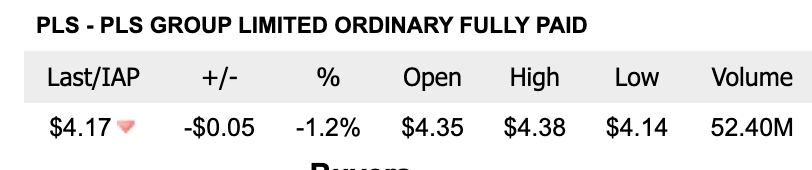
Someone has done a large exit of #PLS today, 52.4M shares traded while average over last 50 days was 22.7M shares - one of the few in my watch screen in red.
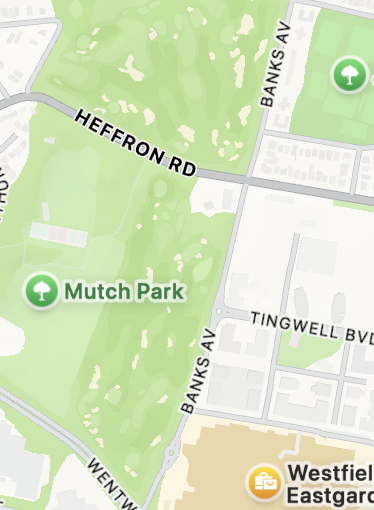
@4TESLANZ My mistake - it is where I turn left off Heffron Rd to go up Banks Ave to Bonnie Doon golf Club - it is a block further north from Eastgardens.