@ParadisLabs Thoughts on Oxford Instruments? InP plasma tools feeds into photonics supply chain, dilution refrigerator near monopoly for quantum with some advanced semi process equipment for packaging exposure
My best guess is that Elon took the lesson from YouTube and implemented it on X.
The lesson is: a TikTok like algorithm that surfaces viral content is far better at predicting what you'll engage with than channels you subscribe to or what your friends watch.
So on X, I used to get almost exclusively crypto content because I follow people that tweet about crypto.
But now X doesn't serve me that content, because the algorithm sees that the really high engaging content is culture war related, so I see that instead.
That shittiness is compounded by the fact that now the people who's crypto opinions I want are constantly being shown culture war content, so they end up tweeting about it.
So the content that I used to come here for doesn't even exist anymore bc everyone's minds are being effectively poisoned by the dregs of humanity on a regular basis.
It's been eye opening to watch how a minor tweak can completely alter so many people's mental states and change the way I consume information.
We weren't allowed to run this ad on TV in the UK, but that's fine, we can just share it online.
We're using humor to make a very important point: the current financial system simply doesn't work for most people. It needs to be updated.
For 3 months I've quietly been working on exposing what IMF has done behind the scenes to prevent Nation State Bitcoin adoption
It's out in the open now👇
https://t.co/aEJ7X0V3hj
Thanks @jperkinsauthor, @gladstein who inspired this. @HRF@BitcoinMagazine for your support
My new article for @HashlabsMining focusing on Debt within the mining industry is available now !!🚨
The first of series of debt-oriented articles to come.
Stay tuned!! 🧙♂️
https://t.co/YxRpFgWGur
Dear @Ed_Miliband
I heard from @freddienew that in response to @btcjvs's suggestion you look at Bitcoin mining as a way to monetize UK's large amount of Wasted Renewable Energy (something several nation states are now already doing, to good effect), you shut down the conversation with the response "Bitcoin is useless".
It is a free world, so I celebrate the fact you have the freedom to express your opinion "Bitcoin is useless".
Equally, as a public servant whose views, informed or otherwise, on energy impact the wellbeing of millions your citizens, you have the duty of care to make sure that your views serve your citizens.
Your comment "Bitcoin is useless" demonstrates that either
a. You are uninformed, or
b. You do not care for vast swathes of human life.
So as someone who has spent a little more time than you researching the uses of Bitcoin, let me lay it out to you unambiguously.
When you say "Bitcoin is useless", you are saying that:
1. Increasing the energy security of the UK, and other nations, is useless
https://t.co/fAehjlHpO9
https://t.co/aQs7ugnaYu
2. Monetizing otherwise wasted renewable energy (as several large companies and nation states are already doing, and using the proceeds to combat energy poverty is useless
https://t.co/clpE6EHoVm
3. Reducing the payback period of new renewable energy generation from 8.1yrs to 3.7yr, so that renewable energy projects can proliferate without government subsidies, is useless.
https://t.co/RGsIe6zEVx
4. Counterbalancing the intermittencies of rewewable power generation without expensive grid upgrades in countries with ageing grids (like UK) is useless
https://t.co/7pkhgwhbgi
5. Accelerating the renewable transition by making renewable generation more profitable is useless https://t.co/4SCHxTNpr2
(while in parallel becoming the world's most sustainably powered industry) https://t.co/llglfd4FMw
6 Reducing more emissions from landfills than the largest DAC project in the world ever achieved is useless https://t.co/5IysyKcugO
7. Developing an monetary financial system with significantly lower emissions and emissions intensity than the banking system is useless https://t.co/RIiW2jxDTp
https://t.co/IGf5oq5dkH
8. Bringing 28,885 African villagers out of energy poverty across 6 locations in Malawi, Zambia, Kenya, is useless
https://t.co/fPjggY0GIj
https://t.co/IHQswpaxzG
https://t.co/bgOaasQMKe
9. Fast tracking the delivery of renewable energy to millions of Ethiopians is useless
https://t.co/gb8KDhsCxX
10. Getting aid to 1000s of war refugees is useless https://t.co/4W8HogrTJP…
11. Developing energy independence for Bhutan is useless https://t.co/fKBkfELb3I
12. Saving National Parks in Africa from closure is useless https://t.co/455ChX6MZn
13. Helping Afghanastani women avoid State-level financial discrimination is useless https://t.co/GsClHWJUXf
14. Establishing the economic sovereignty of 14 African nations still experiencing French financial colonization is useless
https://t.co/s18NsVIiAr
15. The idea of creating an alternative to a monetary system which can and does elongate wars, increase wealth gaps, bail out bankers but fail to protect employees and small businesses is useless https://t.co/T6D7yoHx37
16. The potential to provide banking to up to 2 Billion unbanked is useless https://t.co/fKBkfELb3I
https://t.co/T4mjBZ8WGW
17. Providing a financial system that is harder to use for money laundering than fiat currency is useless https://t.co/CLghbaZNJD
18. Removing the risk of financial reprisal for running humanitarian campaigns in autocratic nations where 5.7Billion people live is useless https://t.co/2KM9kuBsFX
https://t.co/bnQQSFpFYc
19. Providing up to 250 Million people in countries experiencing hyperinflation a means to stop 50%+ erosion of their family savings per year is useless https://t.co/7Yu7IpTqeL
20. Allowing people in developing nations to receive remittance payments from family without delays and without heavy fees is useless https://t.co/NWTeMOMsd6
21. Having a secure, permissionless, decentralized, 24/7 store of value with fixed monetary supply is useless https://t.co/J75wOAYupq
Not all 21 uses of Bitcoin relate directly to your citizens, many of them do.
As I'm sure you'll agree, these uses are not only far from useless, but coincide with the very energy security, energy equity and energy sustainability goals that you claim to care about.
While you are within your rights to dismiss technologies you clearly have not taken the time to understand, the byproduct of your lack of research are not OK.
Right now, UK continues to cut pensioners' access to energy subsidies, placing more and more of them into energy poverty. If this were a necessity austerity, we could perhaps rationalize this as being acceptible
But this is anything but necessarily because you are concurrently and voluntarily wasting hundreds of millions of pounds in wind power that could be easily monetized through Bitcoin mining were it not for your intransigence.
As it stands, you are in your ignorance is not only belittling a technology that is helping vast numbers of people already - often on matters of human dignity and basic human freedoms. It is also unnecessarily increasing energy poverty in your own backyard.
Please do better in your research.
Sincerely
Daniel Batten
Climatetech Investor and Bitcoin analyst
Anyone at @MiningDisrupt this week?
Be cool to hang out with some of you if you’re over here. I work at Relm which provides insurance for the btc mining industry.
We can do policies in denominated in bitcoin. Hit me up if you want to chat.
Hi Folks, really excited to share with you today a granular map on Public bitcoin mining location !
Let’s track the Bitcoin data centers.
Interactive data accessible on the link :
https://t.co/PyZDAV1oZT
Do big government debts and fast rates of increasing them threaten our wellbeing? What will they mean for the bond market, other markets, and the world economy? Is there a limit to debt growth? Can a big, important reserve currency country like the US go broke? What can we do to prevent a government debt crisis and protect ourselves?
I am in the process of answering these questions in a comprehensive study about the mechanics of how countries go broke, where the US government is in its Big Debt Cycle, and what policymakers and investors should do about it. The study will be published later this year as a new book: How Countries Go Broke: Principles for Navigating the Big Debt Cycle, Where We Are Headed, and What We Should Do.
As with my prior books, I am going to pass it along as I am writing it and will discuss what it says with you on social media. I think this is especially important right now with the US government debt issues at hand. The book is a comprehensive study that covers:
- How the Big Debt Cycle works, which I don't believe is well understood. I will explain the template that I compare what is happening with to indicate where we are in the cycle and what is likely to happen.
- How the Big Debt Cycle that started in 1944 (and which we are now in the late stages of) has worked relative to that template.
- Projections for the future for the US, China, and other countries and what to look out for.
- What I recommend policy makers do to prevent a big government debt crisis.
Today, I am sharing Part One of the book, “Overview of the Big Cycle,” which will lay out in concepts and equations what the Big Debt Cycle is and how it works.
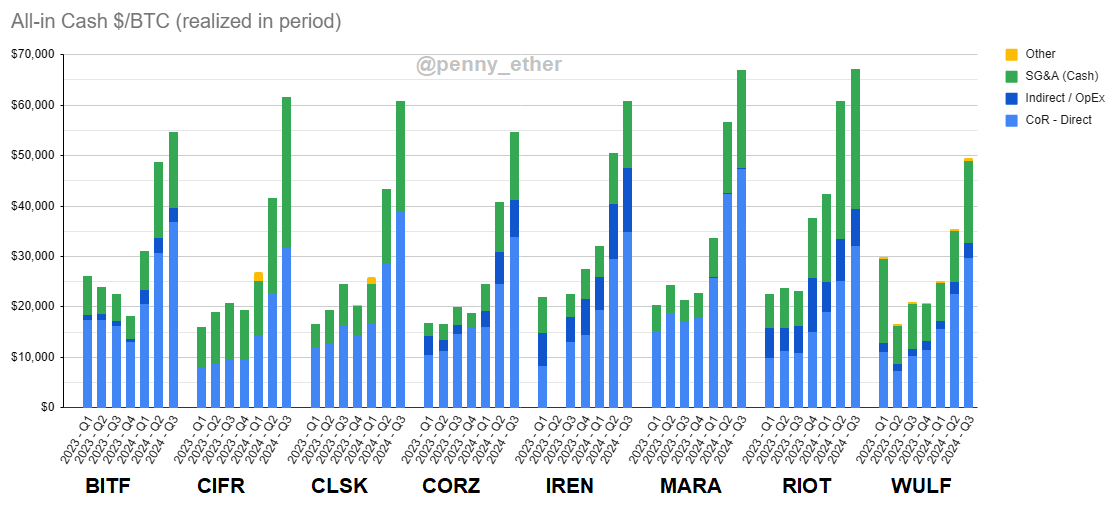
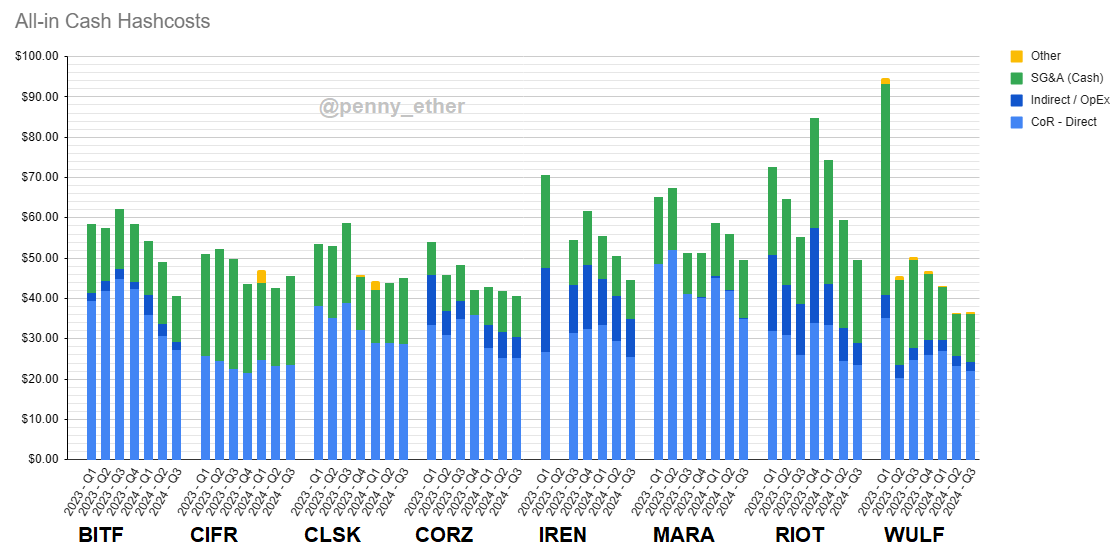
Megapost full of tons of miner data. Miners' all-in cash $/KWH, hashcost, and $/BTC. Segmented into cost category, and provided quarterly from Q1 2023 to Q3 2024.
I've put this off for awhile, but here it is. Likely the last time I share it, as I'll either be taking a job, doing this level of analysis on a profitable platform, or just keeping it for myself.
Lots of work went into this:
- Incorporating data from monthly ops reports, presentations, blockchain data, etc
- Adjusting for JV contributions (by estimating some opex costs)
- Prorated some costs across business segments
- Digging for how CoR is split between direct (electricity) and indirect
- Excluding non-cash costs, and one-off costs
- All sorts of 10Q/10K tedium (such as retroactively adjusting past figures when they change their accounting)
I'm pretty confident it is more exhaustive than anything else out there. But, who knows.
---
Methodology:
In these stats, I don't care what a company says their EH/s is, how many KWHs they say they use, or their self-reported hashcost and $/KWH.
Even if/when provided, it impossible to adjust for a variety of other factors which would result in an uneven playing field. Such as: PUE, dev/pool fees, under/overclocking of ASICs, luck, what is include/excluded in costs and EH/s and KWHs units, etc.
Instead, I use REALIZED stats. Eg: The costs for BTC they mined, where that BTC is represented as EH/s and KWHs.
This accounts for any efficiencies/inefficiencies between their mining fleet and the income statement, and as a result levels the playing field.
$/PH/s/day (hashcost): This is cost divided by total theoretical hashes, represented in $/day per PH/s.
The "theoretical hashes" is based on how many BTC they mine in each month, and the mining conditions in that month (tx-fees, difficulty). From those inputs, I determine the total amount of hashes (average hashrate) it would take to have mined that amount of BTC.
This means that my hashcosts are basically: They paid $X to get Z "EH/s worth" of BTC. I care not about how many *actual* EH/s they claim to have averaged. If it took them more/less than Z EH/s to mine that BTC, due to dev/pool fees, good/bad luck, whatever... I don't care. All of this will show up as an increase/decrease in hashcost.
$/KWH-mined: This is cost divided by total theoretical KWHs consumed (if they operated their fleet at nameplate efficiency).
If in a month they mine 10 BTC at 20 J/TH, I back out how many EH/s that would take (see above), and how many nameplate KWHs it would take.
Again, this means my $/KWH-mined are basically: They paid $X to get Z "KWHs worth" of BTC from their fleet. I care not about how many *actual* KWHs they claim to have used, or how much they paid for each of those KWHs. If it took them more/less than Z KWHs due to PUE, under/overclocking ASICs, etc... I don't care. All of this will show up as an increase/decrease in $/KWH-mined cost.
The key thing to note is that "EH/s worth" and "KWHs worth" are equal units for all miners.
So, these resulting stats represent a fair apples to apples comparison, and account for any increase/decrease in efficiency between the monthly reports and the income statement.
---
Lastly:
There is a degree of subjectivity in what to include as mining cost and what not to. There are tons of nuances, too many to go through, and frankly nobody cares.
Overall, I mainly include costs which end up hitting Adjusted EBITDA, with just a few minor adjustments to ensure it's apples to apples.
Since my decisions on these nuances may differ with your own, you'd do well not to sweat the small differences between companies here and there. Instead look at the large differences and the trends. And, of course, you're free to DYODD to create metrics best suited to your own personal needs.
Should you have any questions about this data, particularly if you work for any of these companies, feel free to reach out: I'll likely be happy to provide receipts for a specific company / quarter.
I like to know if/when I get things wrong and strive to have the best data.
---
Ok... here we go!
Insurance stocks are set to collapse:
LA wildfires have officially spread over 40,000 acres with insurance losses crossing $20 billion.
Since the market closed on Friday, estimated damages have TRIPLED to $150 billion.
Could this cause an economic ripple effect?
(a thread)
How bitcoin works:
1. Transaction and fee are selected
2. Signed by your wallet and sent
3. Distributed by network nodes
4. Miner adds transaction to block
5. Miner wins PoW contest
6. New block is validated
7. New block is distributed by nodes
8. Transaction completed
Hardware wallets should be called “signing devices”
As the hardware never *contains* the bitcoin.
Bitcoin never leaves the network, it just exists in a place on the network where ONLY YOU have the treasure map to its location.
The word “wallet” obfuscates reality.
My 2¢
1/ If your friends associate you with Bitcoin, Ethereum, or any part of crypto, you’re probably getting Qs about what to do. It’s tricky to guide someone from where we are currently ($BTC ~$100K), especially if they’re an inexperienced investor. Some learnings from 10+ years of watching this dynamic play out...