Local LLMs are the Great Leap Forward for Inference. Every laptop is it's own datacenter, sovereignty over your own tokens, and the people can seize the means of token generation. And that's why it's destined for poor results. (1/4)🧵
An ultra rare disease company is likely going to die now due to the FDA's absurdly stringent manufacturing requirements. We need to reform them, for Phase I and beyond.
A subproblem within how FDA evaluates manufacturing, illustrated by the Grace Therapeutics case below, is excessively stringent "comparability requirements" for manufacturing. The FDA’s bar for what constitutes a “comparable” process is extraordinarily strict, sometimes to the point of absurdity. If the FDA clears your IND and you run clinical trials on Batch 1, then modify your manufacturing process and produce Batch 2, the FDA can simply decide these are different drugs, even if every analytical measure shows identical results. At that point, the only path forward is more human clinical trials to prove equivalence; no amount of chemistry or analytics gets you out of it.
I can anonymously relay a story of how broken this can get: a biosimilar manufacturer produced a drug of higher purity than the branded reference product, and the FDA deemed it “different.” Rather than run an entirely new clinical trial, the company deliberately made their manufacturing process dirtier to bring purity down to match the branded drug. Basically they had to engineer in imperfection just to satisfy a regulatory standard. This dynamic also creates a massive long-term inefficiency at the commercial level. Once a company figures out how to manufacture a drug at scale, they almost never improve the process even as technology advances, because upgrading risks triggering comparability requirements and potentially new clinical trials.
I wrote about the insanity of "medical privacy."
It's hard now to do research that could cure major diseases because we are too worried about the handling of people's personal data, which they themselves appear not to care about.
HIPAA was a mistake. https://t.co/gq27mf3P2T
The race to discover a new drug is often less important than the race to test it in humans. American medical research is falling behind China due to excessive barriers to conducting clinical tests. @RuxandraTeslo and Amol Punjabi recently wrote for us on the story of CAR-T therapy, an extremely promising treatment for some of the world’s most painful cancers: invented in America, developed and perfected in China. https://t.co/uSph9nAXba
It turned out big academic medical centers could NOT actually be “kingmakers” for startups - but Epic actually could, as we saw with Abridge. What does that tell us about adoption of Health Tech Innovation?
I remember when we first started @SeamlessMD, we made the wrong assumption that brand name academic medical centers could give you a halo effect. That if you could show famous hospital X was a customer, everyone else would follow.
So when we finally got a couple of big brands as adopters, I thought everything would be easy - but I was wrong. No one actually cared. No one bought our product just because some famous brand did. And every year another 100 startups make this mistake (and also some famous hospitals keep perpetuating this myth… but oh well).
What’s interesting is that it turned out there was a way to create a halo effect for Health Tech… but it came from the EHR, NOT health systems themselves.
Folks might remember that Abridge and Nuance/DAX were the only two AI scribe partners in Epic’s Workshop - which meant Epic was co-developing new Technologies together. Which enabled earlier access to new APIs and integrations with Epic.
This allowed Abridge and Nuance to completely dominate the US health system market for AI scribes for a couple of years. I know this mattered because I have many instances of CMIOs/CIOs telling me they only seriously considered Abridge and Nuance for this very reason. Even though other AI scribes had also integrated with Epic, this Epic Workshop designation created a perception that Abridge/Nuance had access to better integrations already or in the future. So of course this gave the impression that Abridge/Nuance were better in some way - why else would only those two be in the Workshop category?
I even remember a CMIO telling me that they had picked a different AI scribe vendor after a structured, multistakeholder evaluation… only to be overruled by the health system Board because Abridge had that halo effect.
This is a perfect example of the old adage “great distribution beats great product”. This is not to say Abridge and Nuance didn’t have the best products (maybe they did), but that doesn’t matter as much as having the best distribution - which the Epic Workshop status certainly helped provide.
However the lesson of this story isn’t that you need to convince Epic to create a new Workshop category to kingmake you - that’s an outlier event.
The bigger lesson is that nearly every great Health Tech innovation also needs great distribution and go-to-market to succeed. And that in the health system IT space, the perception of “who plugs in best to our core platforms like the EHR” often has far more influence on adoption than features, evidence or social proof.
Too often Health Tech innovators focus too much on the product and not enough on distribution - if this is you, consider this your wake up call.
this is just the most ridiculous AI application i've ever seen lol
a Peter Thiel-backed startup that makes AI collars for cows is now worth $2 billion
and the more I read about it the cooler it gets. here's how it works:
every cow wears a solar-powered collar that talks to a network of radio towers and an app on the farmer's phone
instead of building physical fences, the farmer draws the fence on a map in the app, and the collar keeps each cow inside that invisible line using GPS
when a cow drifts toward the edge, the collar plays a sound to steer her, and a gentle vibration tells her which way to go.
it's like how a car beeps as you back up toward a wall
the cows learn the cues in a few days
so now a rancher can move an entire herd to fresh grass by sliding the fence on a map, without driving out to open a single gate
and that same collar is reading each cow's body the whole time.
it takes five readings per second on every animal, so the AI can catch a cow that's sick, injured, ready to breed, or about to give birth before a person would ever notice walking the field
so it's basically like WHOOP for cows too lol
and they gave the AI behind it the perfect name: the Cowgorithm
it's been trained on more than 7 billion hours of real cow behavior, which is why Halter calls the data its real asset and moat.
they know what a normal cow looks like better than anyone, so they can flag the odd one out instantly
it's already on more than 1M cattle across New Zealand, Australia, and a bunch of US states.
California even used it on public land to graze cattle in patterns that clear dry brush and slow down wildfires
costs about $5 to $8 per cow per month
a job that used to mean barbed wire, gates, and driving the fields all day is now mostly 1 person on their phone
AI can't compress a clinical trial. It can't generate the data we don't have yet. Our CEO Neil Kumar pushed back on the AI hype with @bloomberg at #MIGlobal with @MilkenInstitute – not because the tools aren't valuable, but because the years still take years.
You never know. This ordinary French farmhouse became a significant D-Day site.
The de Vallavieille family’s farm, Brécourt Manor, was occupied by the Germans because of its strategic location for a concealed artillery position.
The family was forced to live on the property alongside their German occupiers, enduring the daily anxieties of captivity.
During the D-Day landings, the heavy fire of German howitzers blocked the advance of U.S. 4th Infantry Division desperately from Utah Beach.
First Lieutenant "Dick" Winters was ordered to take out a Nazi machine gun nest that was firing on the area—unaware it was actually a heavily fortified artillery battery.
With a tactically brilliant (some say ‘textbook’) strategy, Winters and his outnumbered men not only cleared the battery — they also permanently disabled the artillery. But, even better . . .
During the raid, Winters uncovered a top-secret map revealing the locations of every German artillery battery across the entire peninsula.
Brécourt Manor proves that history often hinges on the unexpected: An ordinary farm turned out to hold the keys to the entire German artillery defense network on D-Day.
Like "do we have free will," "is AI conscious" seems to me like a semantic question that people pretend is an empirical question. Both concepts are too vague for empirical investigation and they have no real-world stakes.
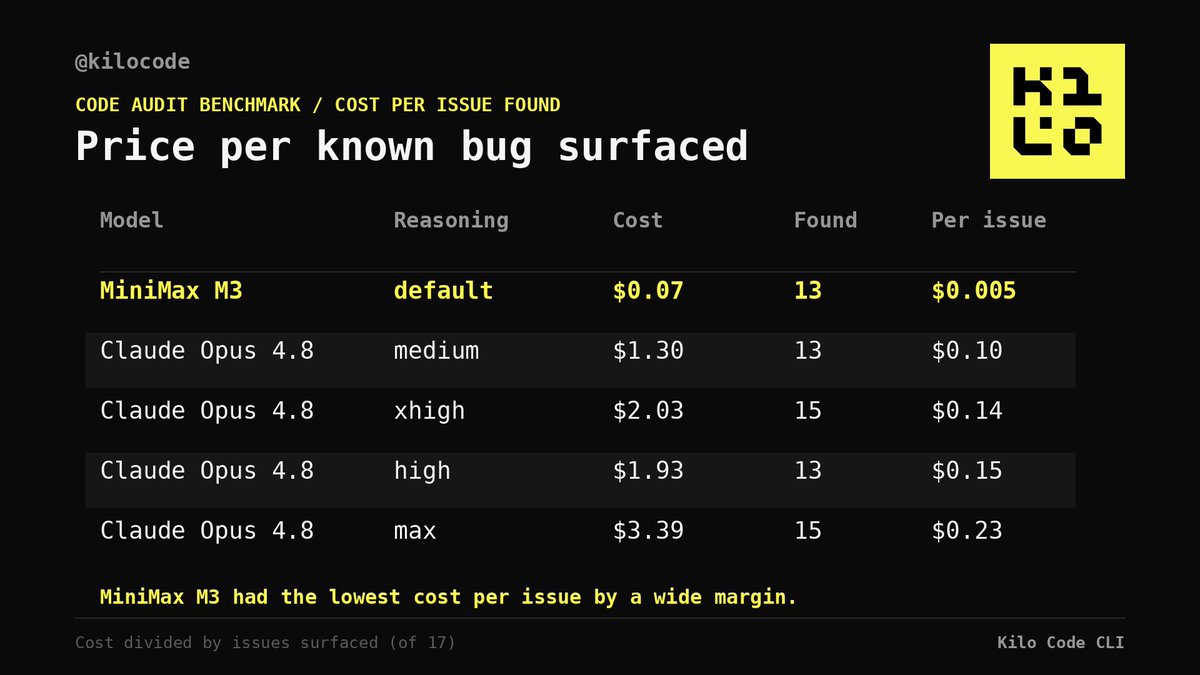
Cost per issue found is the cleanest view. MiniMax M3 won by a wide margin. Claude at max was the most expensive per finding. The two settings that found the most were not the most efficient per dollar.
A Jewish refugee from Vienna became one of Britain’s toughest Commandos and stormed Normandy on D-Day.
He used his fluency in German to confuse the enemy, fought at Pegasus Bridge, was wounded three times… and still won the Military Medal.
This is his first-hand account:
(🧵)
@TheStalwart@Silicon_Data why wouldn’t you just dynamically select along the pareto frontier by your intelligence budget? it’s just the efficient frontier for CAPM dorks
No one talks about how OpenAI and Anthropic IPOs are going to be a massive windfall for the state budget.
Maybe we will get enough money to finish another environmental study for california high speed rail.