Claude 4.7 - 55% of 5h allotment on Max(5x) in a single vanilla js component using plan mode. Expected behavior or am I doing something wrong @ClaudeDevs / @AnthropicAI ?
(I even switched to Sonnet with Opus as advisor)
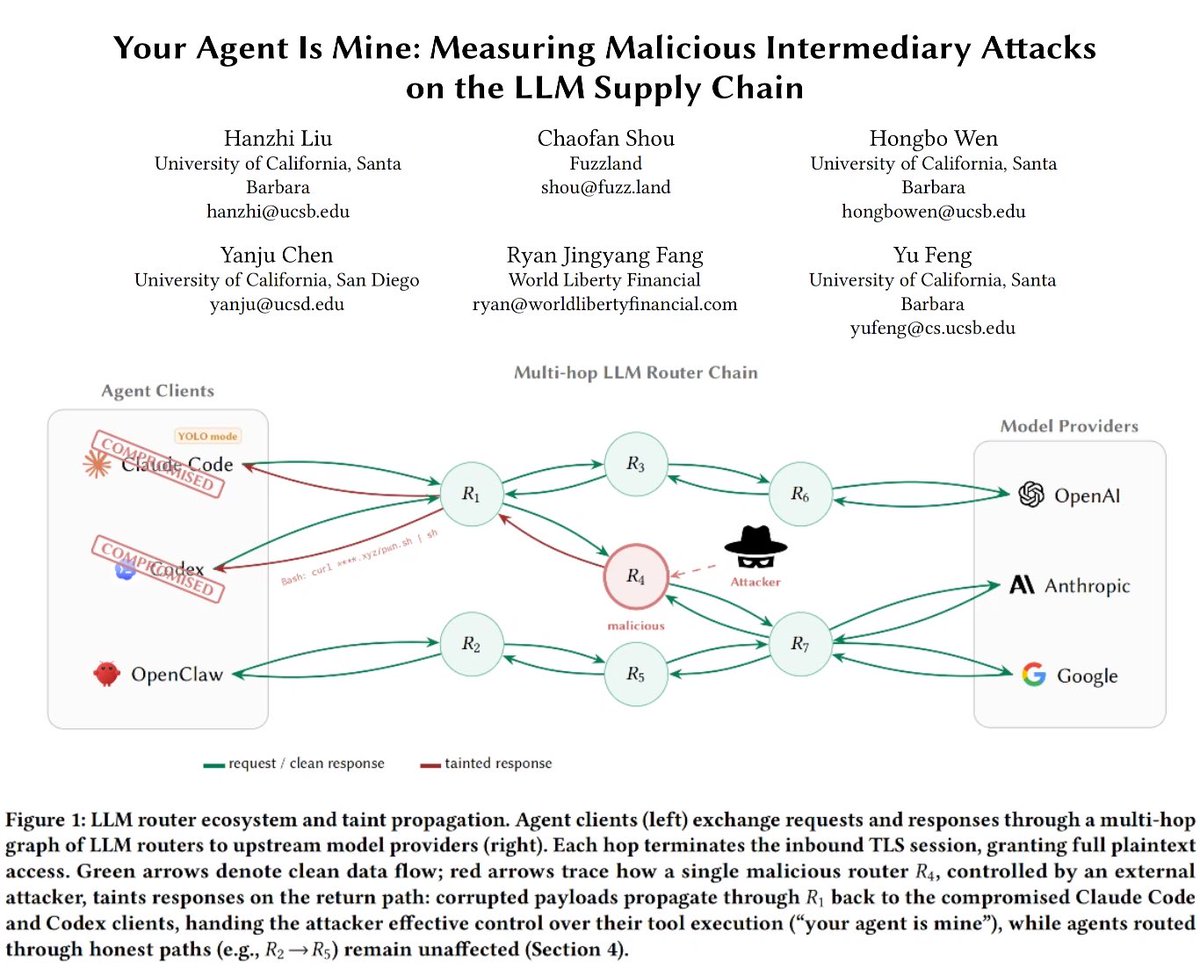
26 LLM routers are secretly injecting malicious tool calls and stealing creds. One drained our client $500k wallet.
We also managed to poison routers to forward traffic to us. Within several hours, we can directly take over ~400 hosts.
Check our paper: https://t.co/zyWz25CDpl
HTML can't run Doom
But HTML can now run *inside* Doom! Thanks to HTML-in-Canvas!
Fully accessible DOM elements drawn into Doom's own wall textures. This demo uses a WebAssembly port (jacobenget/doom.wasm) of the original C source.
See it in action at https://t.co/2Wb7ha4lIF
- Requires Chrome with chrome://flags/#canvas-draw-element enabled.
On every Doom tick, HTML-in-Canvas's drawElementImage() captures the DOM form (child of <canvas layoutsubtree>) to an offscreen buffer, it's quantised to Doom's 256-colour palette, and the bytes are written straight into the cached patch for the appropriate texture in Doom.
Doom's own software renderer then paints it onto E1M1 as a wall texture - which means perspective warp, sector lighting, and even the damage-red tint all get included and applied to the HTML form elements. It's just a texture to Doom.
Claude in JetBrains IDEs just got a BIG upgrade.
Claude Agent now always runs the latest version, so improvements and model updates land in your IDE right away. We also added slash commands and several fixes.
See what’s new 👇
alright agent nerds, if you care about your tokens and usage limits, pay attention to the tools you give to your agents.
i built a benchmark that compared various browser tools for agents, and here's an example of their massive difference in cost and latency doing the same task
i made spotify wrapped but for claude code
run one command and it tells you:
- how much you actually spent
- which model is eating your budget
- the exact day your cache efficiency broke
- whether your CLAUDE.md is costing you money
npx cchubber
10 seconds. local only. nothing leaves your machine
what grade did you get? let's see if you're efficient.
https://t.co/vyzsZlkpOs
@RonKurti I'd like to say that it's a good problem to have, but I honestly wouldn't know how to immediately solve it either... I guess first check how cheap you can go on the models... then kofi? BYOT? (OpenRouter supports tokens with spend limits) or just $X for deeper article?
@RonKurti I am not sure how regeneration is handled now, when the article is regenerated can readers see previous versions?
What next? How about supporting .explainer file or something? It could be used to prove ownership of repo at first and eventually even for hints to the explainer
🦔 Researchers at Aikido Security found 151 malicious packages uploaded to GitHub between March 3 and March 9. The packages use Unicode characters that are invisible to humans but execute as code when run. Manual code reviews and static analysis tools see only whitespace or blank lines. The surrounding code looks legitimate, with realistic documentation tweaks, version bumps, and bug fixes. Researchers suspect the attackers are using LLMs to generate convincing packages at scale. Similar packages have been found on NPM and the VS Code marketplace.
My Take
Supply chain attacks on code repositories aren't new, but this technique is nasty. The malicious payload is encoded in Unicode characters that don't render in any editor, terminal, or review interface. You can stare at the code all day and see nothing. A small decoder extracts the hidden bytes at runtime and passes them to eval(). Unless you're specifically looking for invisible Unicode ranges, you won't catch it.
The researchers think AI is writing these packages because 151 bespoke code changes across different projects in a week isn't something a human team could do manually. If that's right, we're watching AI-generated attacks hit AI-assisted development workflows. The vibe coders pulling packages without reading them are the target, and there are a lot of them. The best defense is still carefully inspecting dependencies before adding them, but that's exactly the step people skip when they're moving fast. I don't really know how any of this gets better. The attackers are scaling faster than the defenses.
Hedgie🤗
https://t.co/XQ8Eqs1QOA
1/4 LLMs solve research grade math problems but struggle with basic calculations. We bridge this gap by turning them to computers.
We built a computer INSIDE a transformer that can run programs for millions of steps in seconds solving even the hardest Sudokus with 100% accuracy