Get your kids excited by learning and solving problems! The app is full of fun games that can help your child's skills and confidence grow through play.
IQ obviously has a nurture component.
It’s not all nurture. Talent matters.
But nurture probably also affects future talent.
By doing these exercises early my son is signaling to his 4 year old brain to develop capabilities in this area.
@coleton@ninja_maths Once they can read, I like starting Dreambox with my kids.
Funexpected Math is another promising app but I haven't had the chance to explore it as deeply
It’s crucial to talk to children about the predictive power of science.
In our problems, we ask kids to predict which chair will fall, or which teapot will pour water.
At school, I once had an exam on electricity with just one task: put on rubber gloves, stand on a rubber mat, hold two nails, and stick them into a socket. You were alone. You had to decide for yourself. Rubber is an insulator—but at the same time, parents teach us never to put nails into sockets.
We study science to be confident that 2+2 is always 4, the Earth is spherical, and rubber does not conduct electricity.
How many learning opportunities we miss when we ignore touch!
Put numbers or letters in a bag and ask children to identify a symbol by touch. Most kids love it—and for kinesthetic learners it’s a powerful brain boost.
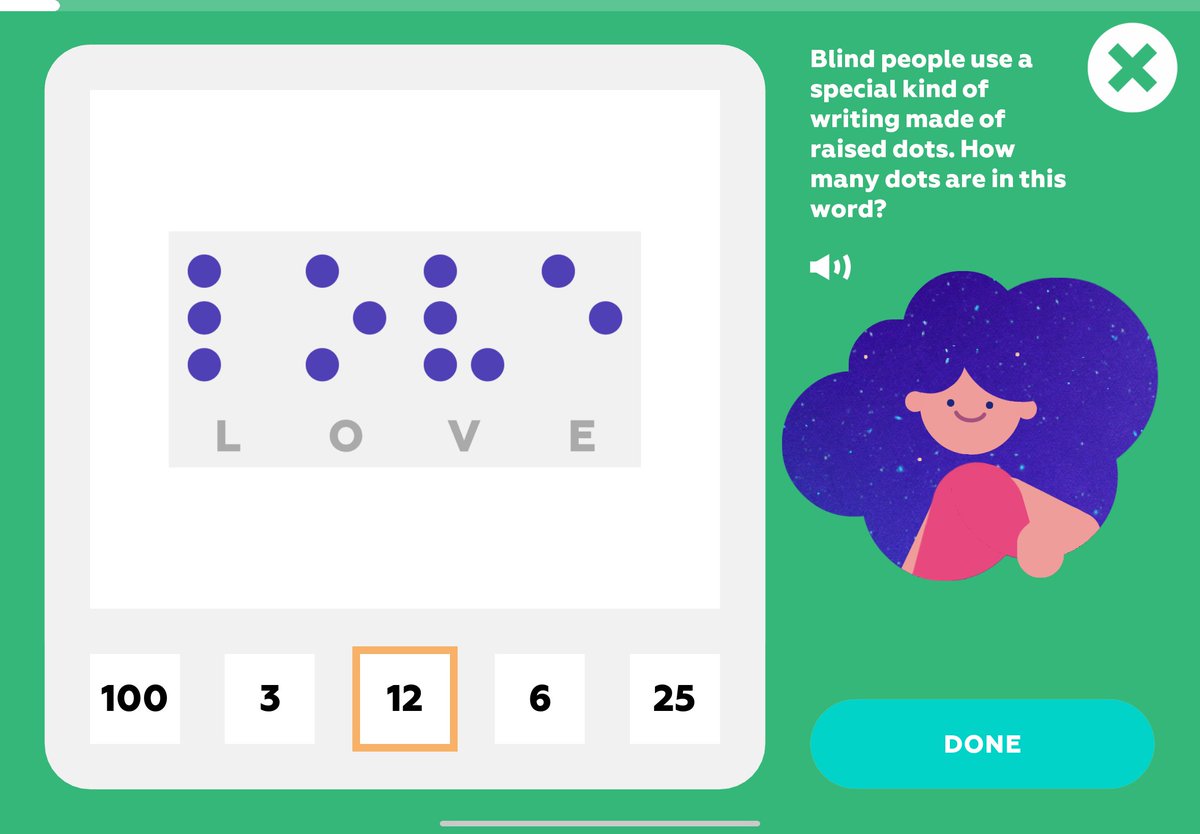
Braille is all around us: elevator buttons often repeat numbers in raised dots. Invite children to notice these signs, count the dots, or redraw them on paper. This builds spatial thinking as well as empathy.
For our Valentine’s event, we wrote the word LOVE in Braille. 💗
🎄 Watch our new Christmas video! 🎄
https://t.co/fhqu3Ca5T1
In our new Christmas video, we talk about bags of gifts.
Two gift bags are the same if they contain exactly the same things, no matter the order.
So {train, doll, candy} is the same as {candy, train, doll}.
A common difficulty for kids when solving problems is simply getting started. If they aren’t sure which method to use, they can freeze. School often makes this problem even stronger: in class, kids always know what topic they’re studying and which method the teacher expects them to apply.
But in real life, you often have to try different approaches before you find one that works. And that first step — trying something — is one of the hardest things to learn.
For example, you can start by plugging in a few numbers just to see what happens.
Combinatorics is absolutely within reach for little kids — as long as they’re enumerating something tangible.
For example:
all necklaces made from two red beads and three blue beads;
or all bags of plums and apples where plums are two more than apples, and the total number of fruits is at most 10.
These tasks lead to surprisingly rich discussions. For instance: if there are no apples and just two plums, does it count — or not?
In our mini-event Puzzle Week, we enumerate every way to assemble a 2х2-piece puzzle made of two blue and two pink pieces.
Gauss—and I, and many other children—independently invented how to add numbers written in a row.
It’s an invention that children arrive at easily and naturally.
And it’s striking how many adults remember arithmetic progressions only as “there was some formula”…
Watch our Hanukkah video.
I especially love the song at the end 🕎🎶
https://t.co/iIldIuyhOC
One of our best videos yet. We count how many candles one needs for all days of Hanukkah using an addition strategy. Happy Hanukkah!
https://t.co/82uQk4d9tS
One of the most amazing lessons that leads children toward the idea of how measurement and multiplication work went like this.
The teacher brought a bucket of water, a scoop, a ladle, and a tiny thimble into the classroom.
She placed the scoop and the ladle on her desk, and in front of the children she put the bucket and the thimble.
“How many thimblefuls do you think are in this bucket?” she asked.
The children started guessing. Hundreds? Thousands? Millions? No one really knew.
Then she invited them to try measuring.
One by one, the children came up to the bucket and scooped out water with the thimble, pouring each thimbleful into another container. At first they kept losing count. Someone suggested making a tally mark on the board after each thimbleful. That helped, but it quickly became obvious: this would still take forever.
And then someone accidentally knocked the scoop off the desk. It hit the floor with a clang — and another child suddenly said, “Wait! Why don’t we measure with the scoop instead of the thimble?”
They tried. It turned out the bucket held only 10 scoops of water.
Now many children saw the pattern.
If you can measure the bucket in scoops, you can measure one scoop with the ladle — and multiply by 10. They tried it and found that one scoop held exactly 10 ladlefuls.
And then, of course, they could measure one ladleful in thimblefuls.
That was the moment the structure clicked:
large → medium → small,
and multiplication as the bridge between units.
Before kids meet graphs in algebra or physics, it helps to let them feel graphs with their whole body. I always dreamed of a simple device that plots your position over time. Imagine a child running with it and watching the graph of their own motion appear live. You could even run competitions: kids get a target graph and try to run so that their own motion matches it as closely as possible.
We built a different game instead: the position of a point on the screen depends on your right hand on the vertical axis and your left hand on the horizontal axis. Kids have to coordinate their hands to steer a little ship toward a treasure — a full-body introduction to functions and coordinate planes.
https://t.co/XzsO2g7JwW
One of my favorite in-app events at Funexpected is Girls and Women in Science. When we were creating the tasks, we shared them in our team channel so everyone — and their kids — could try them.
Here’s the full text of this one:
“Maryna Viazovska won the top math prize for packing spheres in an 8-dimensional space. We’ll pack circles on a flat surface. Look how tightly they're packed! How many circles are touching the purple one?”
After this task, we had a great discussion with my daughter about 8 -dimensional space:)
Chickpeas and toothpicks — that’s all you need to build polyhedra!
Soak the chickpeas for 12 hours; they become perfect vertices for toothpick edges. You’ll get beautiful polyhedra with triangular faces: tetrahedrons, octahedrons, and icosahedrons.
Cubes and dodecahedrons are trickier — making a perfect square or pentagon frame takes a bit more work.
Of course, marshmallows and pasta work great too!
We’re mentioning Maryna Viazovska at our Girls and Women in Science event :)
Here’s a first math challenge for a three-year-old — the very first step on a long journey into science!
Maryna Viazovska won the top math prize for packing spheres in an 8-dimensional space. We’ll pack circles on a flat surface. Look how tightly they're packed! How many circles are touching the purple one?