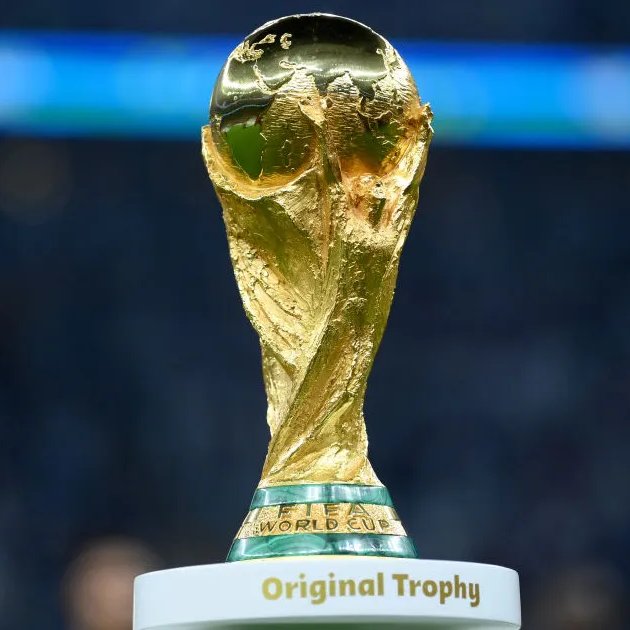
🚨 𝗡𝗘𝗪: Lionel Messi is in the race for every major individual attacking award at the 2026 World Cup.
• Goals: Messi 8 — Mbappe 8
• Assists: Olise 5 — Messi 4
• Successful dribbles: Messi 24 — Yamal 22
The NBA's $76 billion TV deal is currently on hold because one 41-year-old won't say where he wants to work.
Adam Silver, the commissioner, admitted it today: the league cannot finish the 2026-27 schedule until LeBron James picks a team. Teams are calling. Networks are calling. The answer to all of them is "we're waiting on LeBron."
The story gets wilder when you know the context. LeBron is the oldest player in the NBA, entering season 24. He's also still one of its best: he just dragged the Lakers to the playoffs, then announced he was leaving. Three franchises are reportedly in the running.
Here's why one player freezes a $76 billion machine. The NBA is one season into an 11-year deal with Disney, NBC, and Amazon. Those partners split a fixed pool of premium inventory: opening night, Christmas Day, the big national windows. LeBron has played on Christmas a record 20 times, the last 19 seasons straight. Wherever he signs instantly becomes a Christmas team, an opening week team, and a 25-game national TV team. Until he signs, none of those slots can be assigned. The whole calendar is downstream of one man's group chat.
Run the math on what's waiting. $76 billion over 11 years is roughly $7 billion a year in media money, and the schedule that deal was priced on can't be built. So the commissioner of a $7-billion-a-year league is doing interviews politely asking an employee of one of his 30 teams to please make up his mind.
No other league works this way. The NFL schedules around teams. The NBA schedules around a person.
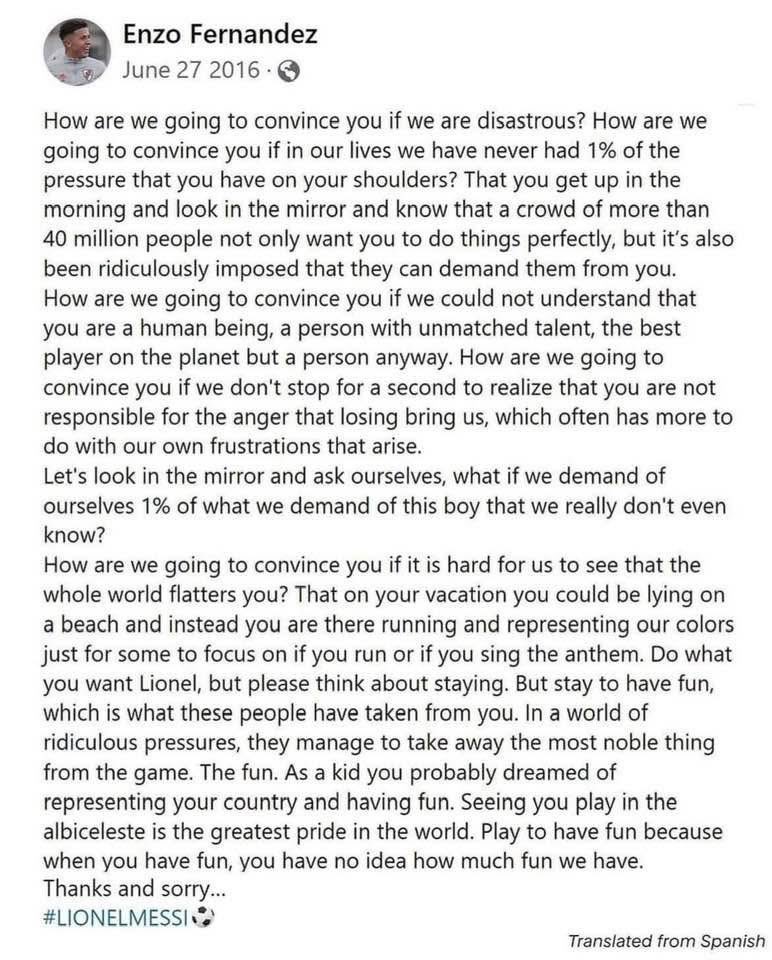
This was then 15-year-old Enzo Fernandez writing this on social media when Messi announced his retirement from the national team. These kids are now dying for him on the pitch. Its a fairytale ending to a perfect career. Not even in movies would this ever happen.
Mad how this World Cup had Carlo Ancelotti, Thomas Tuchel, Mauricio Pochettino and Julian Nagelsmann teams all blaze out while the final is between two teams managed by guys whose professional club management experience *combined* is 11 games at Alaves 15 years ago.
🚨🗣️ Leo Messi: "It's been almost a YEAR since I've been preparing for this World Cup, honestly."
"I spent December in Argentina, training in the morning and afternoon, non-stop."
"I knew I was going to give MY ALL to arrive in the best possible way."
It’s a Lionel Messi world, and we’re all just living in it.
What else is there left to say about a man who has spent nearly twenty years making the impossible look routine? Every generation has its great players, but once in a lifetime, football produces someone who transcends the sport itself. Lionel Messi isn’t just the greatest player of his era, he has become the standard by which every footballer before him and every footballer after him will be judged.
Back-to-back World Cup finals. Let that sink in. At an age when most all-time greats had either retired from international football or become squad players, Messi is still the man leading Argentina to the biggest stage in football. That isn’t longevity. That is sustained excellence at a level the sport has almost never seen.
His career has been one long masterclass in consistency. Seasons changed. Managers came and went. Teammates retired. Rivals emerged. Football evolved. Yet one thing never changed, Lionel Messi remained the best player on the pitch.
For almost two decades, he has carried the expectations of millions every single time he stepped onto a football field, and somehow he kept delivering.
People often talk about talent, but talent alone doesn’t explain Messi. There have been gifted players before him. What separates him is the obsession with perfection. The ability to improve every single season despite already being the best. He mastered dribbling, passing, finishing, free-kicks, playmaking, vision, decision-making and leadership. Every weakness people pointed out eventually became another strength.
His football IQ is something that may never be matched. He sees spaces before they exist. He knows where every player will move before they do. He doesn’t just play football, he controls it. The game slows down when the ball reaches his feet, and for ninety minutes everyone else is reacting to his ideas.
The numbers are there. The trophies are endless. League titles, domestic cups, Champions Leagues, Ballons d’Or, Golden Boots, Copa America, Finalissima, the World Cup. Every meaningful prize football has to offer has eventually found its way into Messi’s hands. Yet somehow, even those achievements fail to capture how dominant he has actually been. Statistics can count goals and assists, but they cannot measure the fear he put into defenders or the joy he gave to supporters around the world.
And perhaps his greatest achievement is that he conquered every criticism thrown at him. They said he couldn’t do it without Xavi and Iniesta. He won. They said he couldn’t succeed outside Barcelona. He won in Paris and transformed Inter Miami into the biggest story in American football. They said he would never win with Argentina. He answered with Copa America, Finalissima and the FIFA World Cup. Every doubt is just another chapter in his legacy.
There are footballers who become legends because they had incredible peaks. Messi became immortal because his peak lasted almost twenty years. Entire careers have come and gone while he remained the benchmark. Young stars grew up idolising him, became professionals, reached their own primes, and retired while Messi was still competing at the highest level.
There will never be another career like this. Never another player who combined artistry with ruthless efficiency so effortlessly. He gave us goals that belonged in Museums, passes that seemed impossible, dribbles that defied physics, and moments that made millions fall in love with football all over again.
When the history of football is written centuries from now, there will be one chapter that every generation returns to. The chapter about the little boy from Rosario who conquered every stadium, every competition, every continent and every expectation placed upon him.
Lionel Messi is no longer just part of football history.
He is football history.
messi has been one of the few constants in my life. twice a week i got to watch him and it felt like whatever was going on in the world didn’t matter for those 2 hours
2026 at 39 years old and he still gives me the same feeling. i’m weeping man
We really need to give Lionel Scaloni his flowers. What he has achieved with Argentina is one of the greatest managerial rebuilds international football has ever seen.
When he took over, Argentina were a broken side. They had just come off a disappointing 2018 World Cup, confidence was low, there was no clear identity, and Messi’s international career was becoming defined by heartbreak after heartbreak. Many people had already decided Messi would retire without a major trophy for Argentina.
Scaloni changed all of that.
He won the Copa America, ending Argentina’s 28-year trophy drought. He followed it up with the Finalissima, then delivered the biggest prize of them all by winning the World Cup. Now he has taken Argentina back to another World Cup final. That level of consistency at international level is crazy.
More importantly, he completely changed how Messi’s international career will be remembered forever. Before Scaloni, the conversation was about finals lost and pressure. Under Scaloni, the story became one of redemption, leadership, trophies and legacy. Every great player needs a manager who understands how to build around him, and Scaloni did exactly that.
But reducing Scaloni’s success to he had Messi completely misses the point.
This Argentina side plays outstanding football. They can dominate possession when needed, they can press aggressively, they can sit deep and defend a lead, and they can kill teams in transition. They are one of the most tactically flexible teams in world football because Scaloni doesn’t force one system, he finds solutions based on the opponent.
He’s also exceptional at squad management. Players never feel bigger than the team. Big names have been benched when necessary, young players have been introduced at the right time, and role players understand exactly what is expected of them. That’s why Argentina rarely looks like a collection of individuals, they move like a team with complete trust in one another.
Another underrated quality is how brave he is with his decisions. Whether it’s changing formations, switching full-backs, trusting youngsters in huge games or making bold substitutions, Scaloni isn’t afraid to make difficult calls if he believes they’ll improve the team. More often than not, those decisions pay off.
Even when key players are unavailable, Argentina rarely loses its structure. The pressing triggers remain the same, the midfield stays compact, the defensive line works together, and the attack always has clear patterns. That’s coaching.
The mentality he’s built may be his greatest achievement. This Argentina side never looks defeated. They believe they can suffer, adapt and still find a way to win. That resilience doesn’t appear overnight, it comes from years of work on the training ground and in the dressing room.
Scaloni inherited a talented but fractured national team. He turned it into a winning machine with a clear identity, tactical intelligence and incredible togetherness. Years from now, when people talk about Messi’s international legacy, Scaloni’s name will always be part of that story because he didn’t just coach the greatest Argentine player ever, he built the team that allowed that greatness to be fully realized.
We’ve all complained about Scaloni. We saw how Argentina were poor in previous games.
Today, he made a change. Simeone started the game instead of De Paul.
He may not have played well, but he did his job perfectly, he exhausted Gordon and Spence😂, and he made sure there were no penetrations from that side.
He also did not play his usual two strikers. Alvarez operated from the left in the first half. I remember many pundits saying Argentina play narrow, they don’t use wingers. So, Scaloni decided to actually use wingers, with Messi as a false 9 obviously.
Scaloni’s masterclass wasn’t just starting Simeone. Here comes the changes.
After exhausting the England squad with their dark arts, De Paul came in fresh, and started putting in sweet crosses. Otamendi also came in because he’s an aerial target for those crosses. If you noticed, even before the equaliser, they had so many good crosses and were close to scoring. Gonzalez and Montiel also turned up.
I was complaining about Enzo not playing well, but Scaloni took off Paredes, Enzo dropped deep and just came alive. Should we also mention the delay in the Lautaro substitution? I was wondering why Lautaro didn’t come in earlier, but it was just the perfect time at 81mins.
Please let’s clap for Scaloni. Everything he did today was CORRECT. Please clap for Scaloni👏🏽👏🏽👏🏽👏🏽👏🏽👏🏽
teams can exploit weak matchups to gain any sort of advantage in a match, its part of the gameplan, and digne-yamal was in play because he was the "weaklink" of that team, not tracking yamal's off ball runs was a characteristic to attack and it worked because of a bozo moment
As good as Spain were, would have been interesting to see how the game panned out if they hadn’t got a relatively random penalty so early in the match.
Fabian Ruiz is one of the most underrated midfielders in world football. He’s the type of player you only fully appreciate when you watch his team over 90 minutes instead of just looking at goals and assists. It isn’t a coincidence that both Spain and PSG look more balanced, more fluid and more dominant when he’s on the pitch.
People often focus on Rodri or Vitinha, but Fabian is usually the player connecting all those qualities together. He is the bridge between the first phase of build-up and the final third. When he receives the ball, Spain rarely lose rhythm because he almost always makes the correct decision.
His biggest quality is his understanding of space. He doesn’t just pass the ball. he moves into positions that make the next pass possible. He’s constantly creating passing lanes for teammates, giving defenders an extra problem to solve. That intelligence allows his teams to sustain possession without slowing the game down.
Then there’s his ball- Carrying. He glides past pressure with long strides . He can beat the first line of the press simply by driving into space, forcing defenders to step out and creating openings for his wingers
Defensively, he’s far more valuable than people give him credit for. He’s not an aggressive ball-winner like Rodri, but his positioning is excellent. He closes passing lanes, helps recover possession and understands pressing triggers.
That’s why coaches trust him in big matches, he brings control without sacrificing defensive stability. You see as Enrique started him straight in the UCL final.
Managers trust him. Luis Enrique trusted him at PSG. Luis de la Fuente trusts him with Spain. Multiple elite coaches have looked at squads full of talented midfielders and still decided that F. Ruiz has to play. That’s because they value the things casual fans often overlook.
He does the invisible work, keeping possession alive, moving opponents out of shape, offering defensive balance, and making everyone around him better.
El tipo puso de centrales a un chico de 19 años (Cubarsí) y a un futbolista que hasta hace poco jugaba en Arabia (Laporte). Y es la mejor dupla del Mundial. También mandó al banquillo a Pedri, Gavi y Llorente priorizando a Fabián, Porro y Olmo, encontrando equilibrio en el medio campo.
Ningún futbolista es inamovible. No le importa lo que diga la prensa o el estatus del jugador. Saca al que no rinde y según la necesidad del equipo.
Qué señor entrenador es Don Luis De La Fuente y qué diferencia con varios que vemos por aquí 👏🏻
🚨🍒 Bournemouth are closing in on Antonio Silva deal, here we go soon!
Agreement on personal terms with the centre back and very close also club to club with Benfica.
Nothing will be signed this week as Benfica will only allow exit to #AFCB later on.
It’s actually so easy to see why Spain will always beat this France.
France are at their most dangerous when games become transitional, chaotic and open. They thrive on individual moments, pace, and physical superiority. Spain deny them all of that.
Spain don’t just keep possession for the sake of it, they use possession as a defensive weapon. Every extra pass forces France to defend, every positional rotation drags their midfield out of shape, and every long sequence takes away the space Mbappe, Dembele and the rest need to attack in transition.
Rodri is the biggest reason. His ability to dictate tempo means France are constantly chasing shadows instead of dictating the game. Then you add the technical security of Pedri, Fabian Ruiz, Olmo and Yamal, and France are spending more time defending than attacking.
The other issue is France’s midfield. Against elite possession teams, they struggle to control matches because they lack a true metronome who can dictate rhythm for 90 minutes. Spain always have one, and usually more than one.
That’s why these games rarely become physical battles. Spain turn them into technical battles, and that’s exactly where France are uncomfortable.
Unless France find a way to consistently disrupt Spain’s build-up or become much cleaner in possession themselves, this matchup will continue to favour Spain more often than not. It isn’t about having better individual attackers, it’s about one team’s game model naturally cancelling out the other’s strengths.
This Spain–France game makes everyone understand one thing, elite midfield will always beat elite attack.
People are obsessed with front threes, goals and individual brilliance, but football has never stopped being a game controlled from the middle of the pitch. An elite attack can only be as dangerous as the platform behind it. If your midfield cannot progress the ball consistently, escape pressure, control transitions or dictate the tempo, then even the world’s best forwards will spend most of the game isolated, feeding on scraps. That’s exactly what happened today.
This is why history keeps repeating itself. The teams that dominate eras are almost always the teams with the strongest midfield, not necessarily the strongest attack.
Spain had Xavi, Iniesta and Busquets. Real Madrid’s three-peat was built on Kroos, Modric and Casemiro. Manchester City became the best team in Europe because they controlled games through Rodri, De Bruyne and Bernardo Silva. Even Barcelona’s MSN only reached their highest level because Iniesta, Busquets and Rakitic gave them complete control of matches.
People often think football is won in the boxes, but before the ball reaches either box, there’s a battle for territory, possession and control. That battle is fought in midfield.
An elite midfield doesn’t just create chances. It decides the rhythm of the game. It decides whether the game is chaotic or calm. It decides where the ball is played, when attacks begin, how quickly transitions are stopped, and whether the opposition’s stars even get enough touches to influence the match.
That’s why you’ll often see world-class attackers disappear in big games. It isn’t always because they had a poor performance; it’s because the midfield behind them lost control. No striker, winger or No. 10 can consistently dominate when every touch comes under pressure, every pass arrives late, and every attack starts 60 metres from goal.
People say goals win games, but midfields create the conditions for goals to happen.
You can have Mbappe, Haaland, Vinicius, Salah or any elite attacker. If the opposition controls possession, wins second balls, dominates the centre, and dictates the tempo, those attackers become passengers for large parts of the game.
That’s why, if I were building a team from scratch, my biggest investment would always be in midfield first. Elite attacks win moments. Elite midfields win matches. Over the course of a season or an entire tournament the team that consistently controls midfield usually ends up lifting the trophy.