If you are interested in the use of single-cell data to map drivers of infertility, have a look at this preprint from the excellent Ipsita Agarwal and others!
https://t.co/ySUyezQBzP
We show how unpaired chromosomes generate aneuploidy, and map new genetic drivers.
New work from us pooling together clinical sequencing data to identify large effect common risk variants for rare cancer types. This included a novel HLA locus that interacts with HPV infection to increase Anal Cancer risk.
New preprint led by Hrushikesh Loya, Leo Speidel, and I where we introduce GhostBuster! https://t.co/MgfPEVeHQJ
Our method uses genealogies to find "ghost" ancestries hidden within DNA. We find both modern humans, Neanderthals formed as mixtures of two ancient hominin groups
Very interesting and rich work by @hrushikesh_loya@leo_speidel@simon_r_myers and others has many interesting findings. I want to highlight this figure, which is similar to the model David recently proposed. Can’t wait to read it more deeply
Nice article in the New York Times (https://t.co/i4KSK7zm2u) on Akbari et al. Nature finding a large number of novel loci under selection in ancient DNA data. Here's what I wrote when asked for comment:
New work from our group developing a method to estimate the molecular heritability of longitudinal traits (e.g. disease onset, progression, or death). Many traits appear to be a genetic mixture of onset/liability and progression components. See Kodi's thread for more:
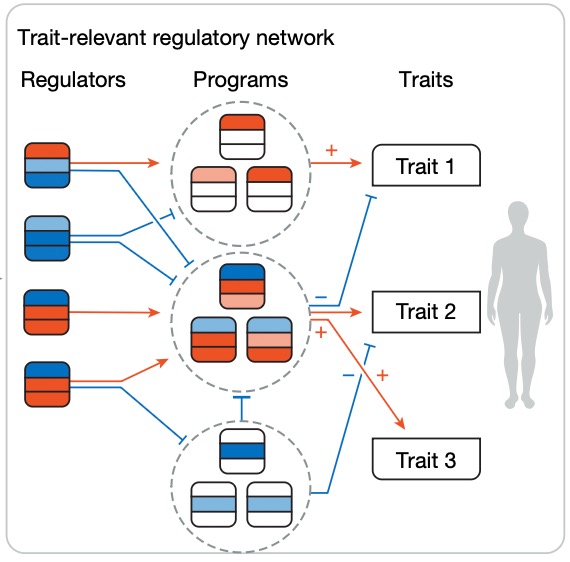
Modern GWAS can identify 1000s of significant hits but it can be hard to turn this into biological insight.
I'm excited to share our new work combining genetic associations and Perturb-seq to build interpretable causal graphs, out today in @Nature:
Excited to share our latest work on the factors that determine what genes we find (and don't find!) in GWAS and burden tests.
We describe a critical concept that we call *specificity*.
Led by Jeff Spence and Hakhamanesh Mostafavi:
Happy to share that our work from the @nmancuso_ lab is out in @NatureGenet! We developed SuShiE, a multiancestry fine-mapping method for molecular traits. https://t.co/8gySuJkDEw
The HLA region is key to human health, but is often excluded in large-scale GWAS. Informing future studies on its influence, @AJHGNews' latest article reports HLA haplotype-based associations across thousands of diseases: https://t.co/JePsBwgT2j #ASHG@jkpritch
Grok 4 is the first time, in my experience, that an AI has been able to solve difficult, real-world engineering questions where the answers cannot be found anywhere on the Internet or in books.
And it will get much better.
Postdoc position in my group in Tokyo!
Please get in touch if you are interested.
And happy to discuss projects - ranging from developing new methods to analysis of new genomes that we are now sequencing in the lab.
https://t.co/RurkIGI2TC
Lab page: https://t.co/Y12xg6qiG8
I'm very happy that our paper on admixture in deep human evolution is out now in Nature Genetics!
https://t.co/cASkPsSPhI
Thanks very much to my PhD supervisors Aylwyn Scally and Richard Durbin for their support throughout
VERY excited to announce a pre-print that represents the culmination of several years of work*: “On ARGs, pedigrees, and genetic relatedness matrices”
https://t.co/MNnonK88ep
Led by @BrieucLehmann with contributions from @epigenci @LukeAnderTroc@jeromekelleher@petrelharp