Technology Evangelist | RPA | Maps | Product Management | Hobbyist Photographer | Batman fan | DC Comics fan
Please take my opinions at your own risk...
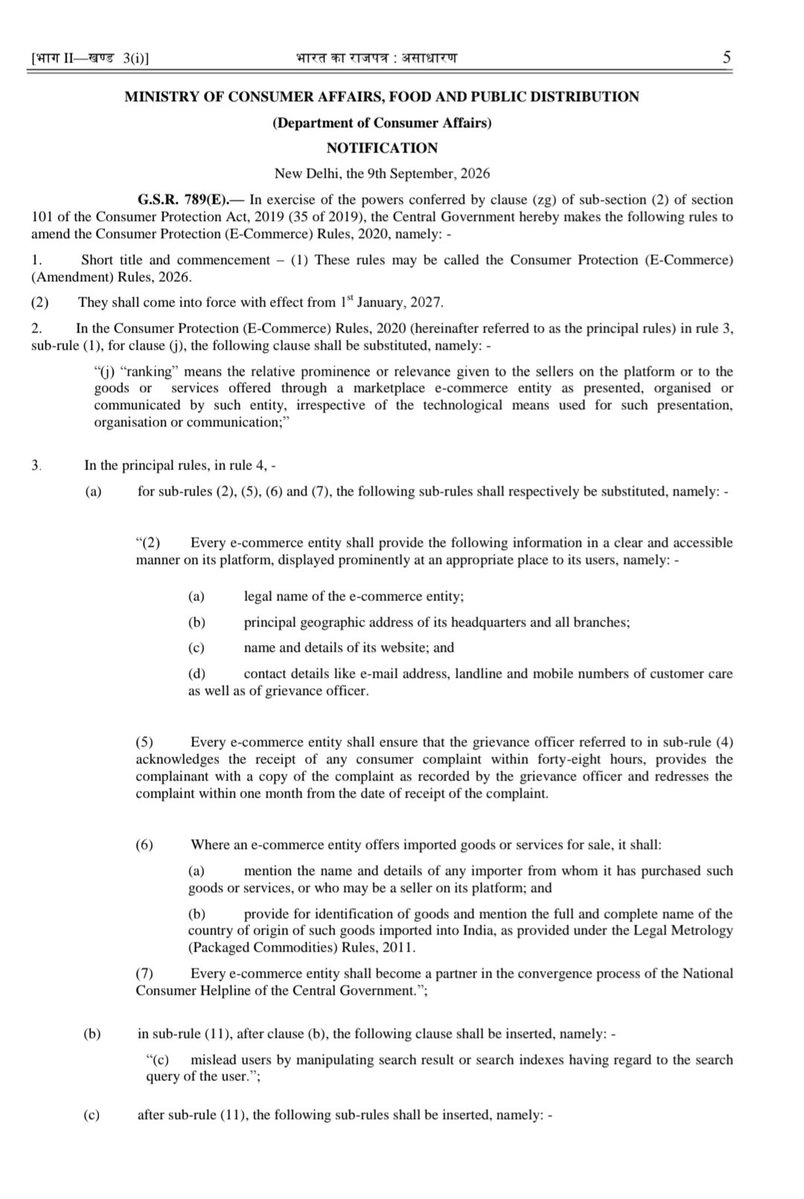
🚨BIG changes coming for online shopping in India from 1st January 2027!!
The govt has notified new e-commerce rules targeting misleading discounts, hidden charges, dark patterns and opaque algorithms.
- Discounts must show the lowest price of product.
- Paid/sponsored listings must be clearly marked.
- Platforms can't manipulate search results to mislead users.
- Key search-ranking factors must be disclosed.
- Annual dark-pattern self-audits will be mandatory.
- Complaints must be acknowledged within 48 hours and resolved within 1 month.
- Consumers must get a copy of their recorded complaint.
- Seller details, return/refund, warranty, delivery and payment info must be clearer.
- Imported products must show country of origin + importer details.
- Seller name must appear on invoices as prominently as the platform's name.
- Certain uses of consumer data will require express consent.
- Unrelated bundled charges will face restrictions.
- Sellers may have to display IDs such as GSTIN/MSME registration numbers.
- E-commerce platforms will have to join the National Consumer Helpline convergence process.
@TiffanyJachja Makes sense too. It helps better understanding and effective communication between them. Also, became an icebreaker of sorts for both of them.
I should do this too. 👍
The flood in Nepal moved boulders the size of cars for one reason. The stuff flowing through those valleys weighed almost twice as much as water.
Regular floodwater is about 1,000 kg per cubic meter. This surge came off a glacier avalanche loaded with pulverized ice, silt, sand and gravel, all moving as a single fluid. An engineering professor studying the disaster compared it to liquid cement. Debris flows like this approach 2,000 kg per cubic meter.
Density is why the boulders move.
Granite runs about 2,650 kg per cubic meter. Sitting in clear water, a boulder stays put forever. Sitting in a 2,000 kg slurry, buoyancy cancels roughly three quarters of its weight. A 500 ton rock suddenly pushes down like a 125 ton rock, and the current handles the rest.
The same density means every wave hits a building with about twice the force of clean water at the same speed. That's why entire settlements ended up encased in mud instead of just soaked.
The surge was violent enough to show up on instruments built for a different disaster. The USGS logged a magnitude 4.4 earthquake near the source, and researchers are still untangling whether a quake triggered the avalanche or the avalanche slamming into the river registered as the quake.
On one stretch of the Trishuli, the water rose 30 feet in half an hour. More than 95 people are confirmed dead and over 1,000 are still missing.
The boulder in the video is a measuring device. When something that size tumbles like a pebble, you're reading the density of everything around it.
@jopriyu267 Exactly.... We would run to our school canteens and the vadapav wala outside our school to see we get our lovely vada pav to tell our friends - aaj maine vada pav khaya 😅😅
Too many emotions 😄
It's been almost 20 years since I got my Airtel connection, and I've easily paid them more than Rs. 25 lakh in that time. I can't think of any other business that has made even close to this much money from me.
Now the reason why I am saying this is I was watching the latest episode of the Intermission by @TheKenWeb. In case you haven't checked it out, it's a wonderful show on the history of some of the biggest businesses in India. Their latest episode is about Airtel and Rohin, and Seetharaman traced the entire Airtel journey, and I didn't realize that Airtel has had many, many near-death experiences and yet always came out stronger to be the business that it is today.