@ramit I love that he had to courage to speak up.
I also wonder whenever this happens and is replaced with someone who is compliant with the new leadership.
On balance doesn’t it hurt more to lose good people vs making a headline for a week and then being replace by a shill?
@theistinthought@sghoul We enjoy being close and buying what ever meat and produce was fresh or on sale that day on the walk home from work. Then menu planning was based on that instead of having to think of what to make. A fun game but definitely not a prescription I would force others to do.
@lnkldt@GreenPlusAnE Ok we will put SS aside. Your proposal makes the income stream erratic for towns and the property tax bills will jump around for the non-senior residents. It seems unnecessary.
@dmwoof@GreenPlusAnE Seniors are choosing to retire and not have income which is why they can’t pay the taxes.
I would rather support raising social security so they can keep their same standard of living instead of lowering the property tax which the city needs to run.
@shellenberger Hi there. I really enjoyed your episode with @coldxman I have to give you one correction around Vancouver. I assume you mean Vancouver in Canada, which does have a moderate city council majority right now.
@dmwoof@GreenPlusAnE Even if their income is very low it is their choice to stop working. If I voluntarily quit my job at 40 and can’t afford my house any more I have to move.
Seniors chose these homes and chose to retire.
Do I think social security should be higher? Yes! But no tax break
@Judi417527@GreenPlusAnE You chose to buy the house. You chose to buy a house with that tax payment. If you no longer can make that tax payment, then you cannot afford the house and need to move.
If I voluntarily quit my job and can’t afford my house, then I have to move. This is no different.
@DavidMoralesPVD Won’t they just pass the higher costs through to their customers, which likely end up going to the city or state for roads?
Can we ban the pollution instead?
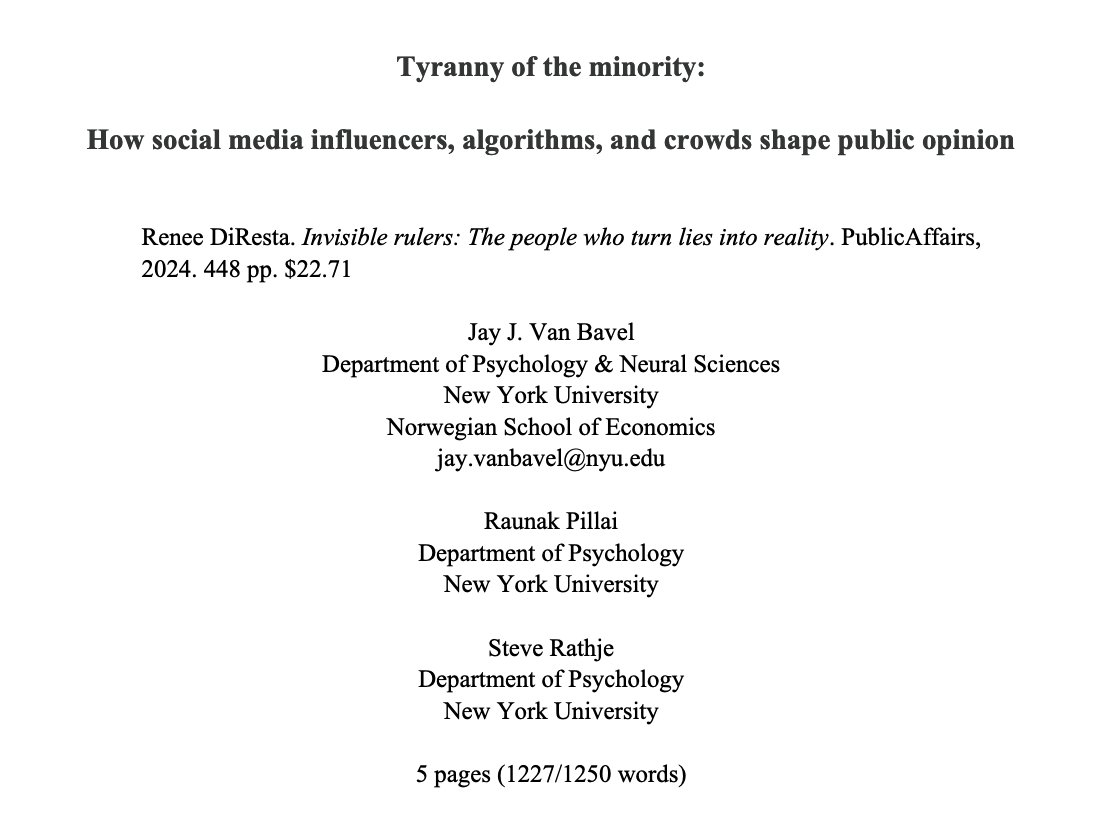
A small fraction of online actors now exerts outsized influence over what the public sees, believes, and argues about.
In a new short review paper, we trace how social media influencers can turn fringe claims into viral narratives—often by exploiting a feedback loop between influencers, algorithms, and crowds.
As such, the modern information environment enables a tyranny of the minority: extreme and coordinated voices dominate attention, distort perceived social norms, and create a “funhouse mirror” version of public opinion that makes fringe positions look common and conflict look inevitable.
We synthesize emerging evidence that a tiny number of highly active users drives a disproportionate share of misinformation and toxicity, and explain how platform incentives reward moralized, identity-salient, and emotionally charged content.
We conclude by outlining pragmatic responses—individual, institutional, and policy-level—and by highlighting how generative AI could either accelerate bespoke realities or help rebuild shared understanding, depending on how these systems are designed and governed. https://t.co/9oZRF8y8mL
We (@PillaiRaunak & @steverathje2) reviewed @noUpside's fantastic book "INVISIBLE RULERS" and connected it to the research we have been doing on this topic for the past decade.