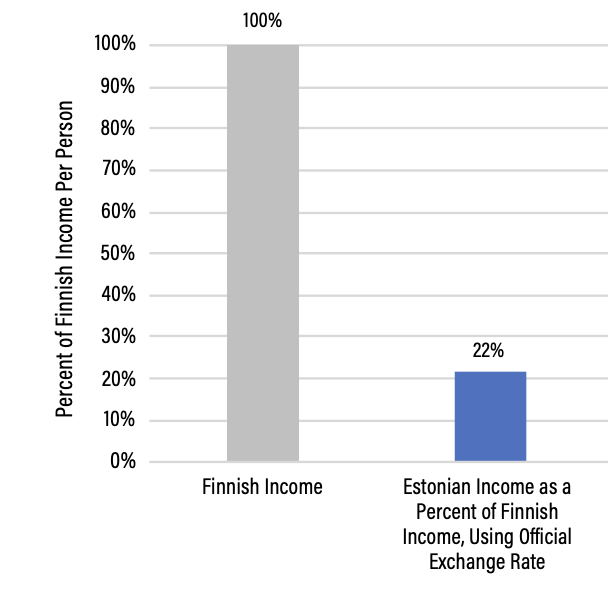
People keep asking what the Soviet occupation actually cost the Baltic states. You don't have to imagine it. There's a control group, and it's sitting right across the gulf.
In 1938 — the last full year before the war — Estonia and Finland had essentially the same GDP per capita. Two small nations, same sea, neighboring languages, the same starting line. By some rankings Estonia was even slightly ahead. Heritage FoundationX
Then history split in two.
Finland fought the Winter War and kept its independence. Estonia was occupied, annexed, and folded into a planned economy. Same decade, opposite roads.
Fifty years later:
🇫🇮 Finland — ~$24,000 per person (1992)
🇪🇪 Estonia — ~$2,800
An eightfold gap — from an identical starting point. Not because Finns worked harder. Not because Estonians were less capable. One country was free to build. The other was told what to build, for whom, and at what loss.
The wages say it even more cleanly: in 1938 Estonian purchasing power was just 4% below Finland's; by 1988 it was 42% below. That cliff is the occupation, drawn in numbers.
And here's the part that ends the argument. Set free for a single generation, Estonia has already clawed back to roughly four-fifths of Finnish income. A gap that took 50 years to open is closing in 30. That's the proof it was never about us — it was the system imposed on us.
There's a cost that never shows up in GDP, either. No occupation means no cattle cars to Siberia. No murdered and exiled intelligentsia. No decades of settlers moved in to outnumber the natives — which means the very "Russian-speaking minority" Moscow is now parading before the ICJ wouldn't exist at anything like that scale. The grievance Russia is litigating is one it manufactured itself.
So no — we don't wonder what we lost. We can see it from the ferry.
And free at last, it's what we're finally becoming again. 🇪🇪🇱🇻🇱🇹
I don’t think conservatives realize how much Russian propaganda we have been fed over the last few years as “independent journalism”.
It’s starting to become very clear to me how many people who claimed to be defenders of the West were just saying that to suck in a pro-West audience so they could slowly brainwash them with foreign propaganda until they could convince their viewers to work against the West.
Those “interviews” we all defended were not actually interviews. They were psychological operations meant to weaponize political factions in America for the purpose of pushing foreign interests.
And many of us fell for it because we let our anger with the system get the best of us and we decided to trust personalities who have never been honest about who they are and where they come from.
I’m starting to think the entire podcast ecosystem is and always has been on giant psychological and information warfare operation.
Criminals and terrorists no longer need billions of dollars for weapons and aircraft. They just need an influencer and podcast budget to create more damage to our society than high powered weapons.
I hope the DOJ will investigate all of this.
It’s a shame so many false accusations of Russian collusion were spread over the last 10 years as a way to smear Donald Trump and his allies with lies, because now that actual Russian interference is here in our media and on social media, nobody believes it’s real.
It’s starting to get very creepy just how coordinated, organized and well funded this OPP is.
I genuinely think a lot of millennials are reaching the same conclusion at the same time.
We grew up watching technology make life better every year. Cell phones. iPods. Smartphones. An app for everything. It felt like the future was arriving right in front of us, and we couldn’t wait for what came next.
Then somewhere along the way, it changed.
Everything became a subscription. Social media became algorithms. Every day feels like another once-in-a-lifetime event. The things that were supposed to save us time somehow ended up demanding more of our attention than ever.
We were sold convenience.
What we got was a world that feels faster, louder, more expensive, and somehow less human.
And that’s why so many people I know dream about a completely different life now. Not more technology. Not more optimization.
Just a quiet job, a flip phone, a small town, and a place where life feels real again.
Frankly speaking, neutrality is a morally bankrupt concept.
Having studied sanctions evasion and wartime supply chains, I’ve found some facts particularly striking: neutral Switzerland is the leading European supplier of microelectronics that end up in Russian weapons, while another neutral European country, Ireland, is the leading supplier of aluminum for Russia’s war machine.
So that’s what “neutrality” often means in practice.
Blue states have built some of the country’s most generous safety net programs. But in places like California and New York, those gains are being swallowed by the cost of housing.
That’s the core problem: Poverty isn’t just about how much money people have. It’s also about how much it costs to meet basic needs.
Cash transfers, SNAP, and the Child Tax Credit still matter, but in high-cost states, redistribution can only go so far if rent keeps rising faster than income.
Read Zach Parolin on why building more housing is an anti-poverty strategy: https://t.co/rpUfK4Oisu
@BrianScott86975@anneapplebaum@SydneyAnneToo If you’d read the article, you would know that Sacks has never been a Democrat. He’s a conservative libertarian who wrote for the Stanford Review (a campus conservative outlet) since his time in college.
This. For Putin, the US is the main enemy. Putin has considered wars in Syria, Ukraine, and Iran as wars against the US proxies. Any reasonable US' strategy towards Russia should take into account the fact that Putin's regime is trying to harm the US as much as possible.
I'm glad that the author of "Rent Control Is Fine, Actually" calls themself Unlearning Economics, bc it's good to just state things clearly, such as the open animosity that many left economic populists have for the field of economics and economists themselves.
Economists aren't gods, and economics isn't a divine truth, but economists are good--better than most--at something critical for making public policy: They're good at identifying tradeoffs. "Rents are too high, so freeze them" is compelling politics. But in the absence of other pro-supply policies, if you make it illegal to increase rents, landlords will stop upgrading units and convert them to condos, which reduces the supply of units for rent, reduces mobility, and drives up rents for everybody else.
The left econ populists have some clear, and clearly stated, policy ideas:
- Rents are too high, so freeze them.
- Electricity is expensive, so stop rate increases.
- Homes are too expensive, so ban institutional investors.
- Power prices are rising, so ban data center construction.
... All these policies feel like solutions because they're brisk, they name enemies, and they take on the most visible source of frustration. But they are much better as villain-naming exercises than they are as a complete public policy. On their own, each creates other problems: less housing built, less clean electricity built, abdicating energy policy by encouraging AI firms to build data centers abroad in unsavory countries with more emissions, etc.
I can't think of a single economic populist idea that wouldn't be helped with a little dose of economics, which is why it's troubling when I see the left participating in, and even celebrating, the great unlearning of economics.
"Moscow has provided intelligence to Tehran, including satellite imagery showing the locations of American warships and military personnel, according to U.S. officials. European officials have warned that Russia may be preparing to deliver advanced drones to Iran."
"Blue cities are radical hellscapes that can't fix crime."
Counterpoint: Baltimore.
Baltimore had 334 murders in 2022. Last year it had 133, the lowest since 1977.
The turning point was that voters defenestrated a Soros-backed prosecutor Marilyn Mosby who averaged 333 homicides a year across eight years and declined to use mandatory minimum sentences. (She was later convicted of mortgage fraud, so there's that too.)
Her replacement, Ivan Bates, ran on the Democratic ticket with a simple message: repeat violent offenders belong in prison.
Maryland law already allowed five years with no parole for convicted felons caught carrying a gun, but Mosby never used it. Bates used it a lot. In just two years, his office sent more than 2K repeat violent offenders to prison, double his predecessor's TOTAL.
The city paired that with a precision intervention program that identified the small number of people driving most of the violence, which led to 631 arrests (94% haven't reoffended).
Police also seized 2,480 firearms last year alone, including hundreds of ghost guns, while maintaining a 64% homicide clearance rate. When shooters know they'll get caught and actually prosecuted, behavior changes.
Sandtown-Winchester, once the most violent neighborhoods in the city, just went a year without a killing!
Carjackings (-51%) and robberies (-24%) are also down.
Baltimore didn't change demographics, or its culture, its rules, or much of anything else in those years. It simply voted in a new Democratic prosecutor, who decided the city needed to finally put violent criminals in prison.
Warren Buffett, in his first sit-down since stepping down as Berkshire CEO, gave the cleanest indictment of legalized gambling in a decade. He called it a tax cut for the wealthy. The math proves him exactly right.
Americans wagered $165 billion at legal sportsbooks in 2025. They lost $16 billion of that. FanDuel pulled $6 billion of the losses. DraftKings pulled $5.3 billion. Every state with legal mobile sports betting collected a tax on the bettor side. New York alone took in over $1.2 billion in 2025 sports betting tax revenue.
Layer the lottery on top. State lotteries generate over $90 billion a year. The bottom half of income earners account for roughly 70% of total spend. The average lottery player makes $38,000. A household earning $20,000 spends three times more on tickets than one earning $30,000. The implicit tax rate, meaning whatever the state keeps after prizes, runs 30 to 50% depending on the game. No other revenue source in America has that base and that rate.
The structural design is the engine. A single straight sports bet carries a hold of 4 to 5%. A four-leg parlay carries a hold above 30%. FanDuel and DraftKings spent five years rebuilding their apps to make parlays the default product. FanDuel's blended hold rate hit 11.4% in 2025, up from roughly 7% in 2022. The product got worse for the customer and the customer wagered more anyway.
Now look at the substitution. Nine US states have no state income tax. Seven of those nine run state lotteries. Seven of those nine have legalized sports betting. The states most committed to never taxing wealth are the same states running the largest extraction machines on people who cannot afford to lose. Read it as policy.
Here is what Buffett is actually pointing at. The state needs revenue. It can raise income tax on the top decile, or it can run a lottery plus a sports betting tax. The second option raises the money from the people who can least afford it. The first option becomes politically optional. New York's $1.2 billion in 2025 sports betting tax is $1.2 billion the state did not have to ask of someone earning $5 million.
DraftKings and FanDuel sell a privatized collection mechanism for a regressive tax that the state never has to defend at the ballot box again. Voters approve legalization once. Collection runs forever. The state takes a cut. The wealthy get a quieter top bracket. The bettor's cut shrinks every quarter as the parlay menu gets pushed harder.
The function of a government, Buffett said, is not to play its people for suckers.
Thirty-nine state governments now do.
When your childhood photo album looks like the Ralph Lauren catalog but you legitimize looting and shooting rich CEOs as an adult
Tom Wolfe is somewhere laughing his ass off
Whenever someone blames the rise in autism on something real, like acetaminophen or statins or folate exposure, just ask them:
Then why hasn't there been any actual increase in autism?
They need to square the circle, because we know diagnostic drift explains 100% of the rise.
CHART OF THE DAY: The size of the 🇨🇳 Chinese strategic petroleum reserve is mind blowing: larger than 🇺🇸 US + 🇯🇵 Japan + the whole of 🇪🇺 Western Europe combined.
Via @EIAgov — more: https://t.co/bZVjzOHL7Z
"Since [the Jones Act suspension], 40 tankers have been able to deliver oil between US ports from California to Texas to Florida and Alaska, increasing the de facto fleet by 70% and helping to reduce costs as a result, according to data provided to Axios by the White House" 😲
New UK screen time rules just dropped — and they’re stricter than most parents expected.
From 27 March 2026, England says: zero solo screens for under-2s (except quick video calls with family), and max one hour a day for 2–5 year olds — no screens at meals or the hour before bed. Co-view everything, stick to slow-paced content, and ditch fast social-media clips and AI toys completely.
The science is sobering: toddlers’ brains process info up to 10 times slower than adults. Fast-paced screens push them into fight-or-flight mode — racing heart, surging energy — while they’re sitting still. Researchers at the University of East London say this mismatch can wire kids for more tantrums and emotional struggles later. Using screens to calm meltdowns? It often backfires long-term.
As a parent, it’s brutal — we all know that explosion the second you take the tablet away.
But this feels like evidence finally catching up with what our gut has been telling us.
How are you handling screens with little ones — strict limits, co-viewing, or mostly winging it?