Good pts. I don't think human judgement is magical or mysterious - its essentially a decision procedure with inputs and outputs...I see no reason why it cannot be simulated by a machine, neither that it cannot be improved upon (especially for contexts alien to the conditions in which it evolved)...having said that, its always a good idea to remember that evolution is pretty dam smart! So a healthy dose of humility is in order...
Incidentally, I think we tend to do the same with 'free will' or 'consciousness' - to think that there is no way that it can be mechanised or turned into an algorithm...I see no reason why this is impossible...and many reasons to think that both of these features of the human condition is some form of information processing performed by the brain...with the brain being a kind of computer (not one with a Von Neumann architecture to be sure, but one nonetheless)...
Given this, it seems very likely that computers will outperform us in analytical tasks (they can run bigger, more sophisticated programs, more quickly.).
I think there’s a fundamental assumption here worth challenging: why should machine judgment resemble human judgment in the first place?
Human intuition is, in many respects, an evolutionary workaround for severe cognitive constraints. Limited working memory, finite attention, emotional attachment, confirmation bias and an inability to consistently reason probabilistically.
We seem to assume that the pinnacle of investment decision-making is the judgment of an exceptional human investor. But why should that be the ceiling?
A sufficiently capable AI could simultaneously evaluate thousands of competing hypotheses, continuously update probabilistic beliefs, identify causal relationships and dynamically allocate attention toward information with the highest expected value.
Crucially, it need not inherit the same cognitive limitations that make human judgment so fallible. Of course, machines can develop their own biases, but those need not resemble ours.
And today’s hedge funds are hardly a definitive test of machine intelligence. Most still use sophisticated technology within fundamentally human-designed investment frameworks.
Perhaps we’re asking the wrong question.
Instead of asking whether AI can replicate the intuition of a brilliant portfolio manager, we should ask whether that intuition is simply a computational shortcut developed by an intelligence with severely limited processing capacity.
The real opportunity isn’t to automate human judgment. It’s to discover forms of judgment that human cognition could never achieve.
This is a fascinating observation @futurewealthP, and I think you’ve identified perhaps the most important challenge in what I’m envisioning.
Connecting thousands of businesses, economic variables, hypotheses and potential causal relationships creates a search space that becomes computationally intractable remarkably quickly.
But I think your point about intuition is particularly interesting.
Perhaps much of what we call human judgement is actually a highly developed mechanism for allocating attention under conditions of extreme uncertainty.
We don’t consciously investigate every possible explanation for an observed outcome. Our intuition directs us towards a small subset of possibilities that seem worth exploring.
In other words, human intelligence doesn’t solve the combinatorial explosion problem through exhaustive reasoning. It solves it, imperfectly, through selective attention.
And perhaps that’s precisely the next frontier for autonomous research systems.
Imagine an interconnected investment knowledge graph where the system doesn’t attempt to investigate every conceivable relationship, but instead continuously estimates where additional research is most likely to improve its understanding or change an investment decision.
It could prioritise hypotheses according to their expected information value, economic materiality, uncertainty, existing evidence and computational cost.
But here’s the part I find particularly exciting.
What if the system could learn not only from the outcomes of its predictions, but from the success or failure of its decisions about where to investigate in the first place?
Then you’re no longer simply building a system that discovers relationships.
You’re building one that learns how to discover relationships more efficiently.
Its research process becomes endogenous and adaptive. An unexpected observation in one industry could trigger an investigation elsewhere, not because someone explicitly programmed that relationship, but because the system has learned that certain patterns of evidence warrant further attention.
Of course, this doesn’t eliminate the search-space problem. It introduces another difficult problem: how to distinguish genuinely promising research directions from attractive but ultimately spurious patterns.
That requires careful treatment of uncertainty, exploration versus exploitation, and the cost of pursuing the wrong hypotheses.
But it does suggest a very different architecture from simply deploying increasingly powerful agents against existing research workflows.
And I think your final philosophical observation is equally important.
If we eventually develop systems that are superior at determining how to achieve a particular objective, then deciding which objectives are worth pursuing becomes increasingly consequential.
In investing, we often treat maximising risk-adjusted returns as an obvious objective. But even that conceals questions about acceptable risk, time horizons, liquidity, externalities and what we’re ultimately trying to achieve with capital.
Optimisation is not the same thing as choosing what is worth optimising.
Perhaps the really interesting transition isn’t simply from human judgement to machine judgement, but from humans being primarily responsible for finding answers towards being increasingly responsible for deciding which questions and outcomes are worth pursuing.
I suspect we’re only beginning to appreciate the implications of that distinction.
Couldn’t agree more. It strikes me that most AI adoption in finance has focused on automating or accelerating existing workflows, rather than questioning whether those workflows are optimal in the first place.
As an analyst, I understand the appeal of getting to an answer faster. But surely the more interesting question is whether AI can help us arrive at fundamentally better answers?
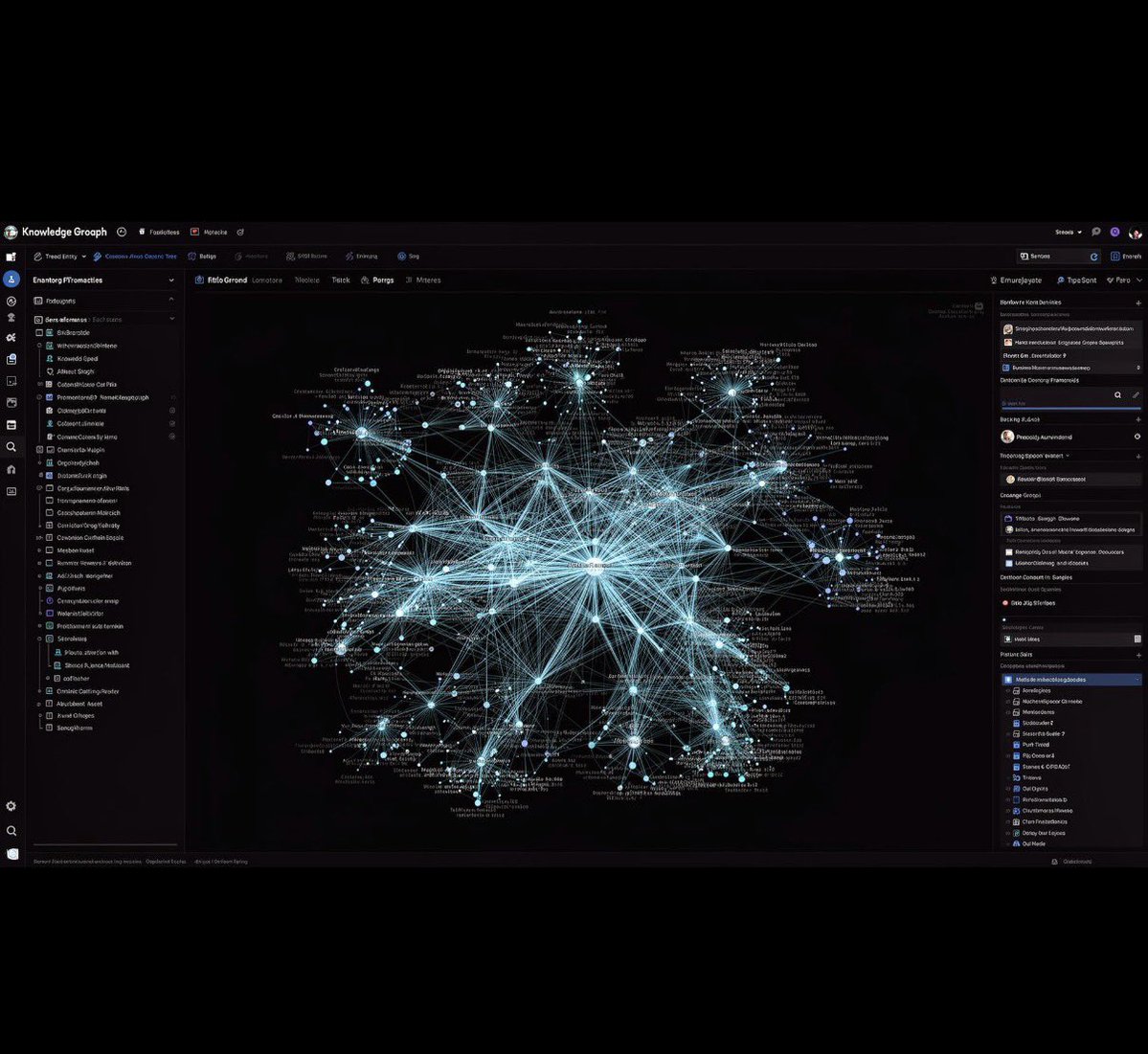
I’ve always been fascinated by the idea of an interconnected investment brain. Something akin to Obsidian, but purpose-built for investing, where companies, industries, themes, mental models, investment hypotheses and evidence exist within a continuously evolving knowledge graph.
I’ve actually started experimenting with a prototype of this concept, which I’m calling Labyrinth.
Imagine discovering something material about one business and being able to trace its implications across an entire network of companies, assumptions and investment theses. Rather than research existing in isolated notes, PDFs and spreadsheets, knowledge becomes interconnected, cumulative and increasingly useful.
Now combine that with probabilistic modelling.
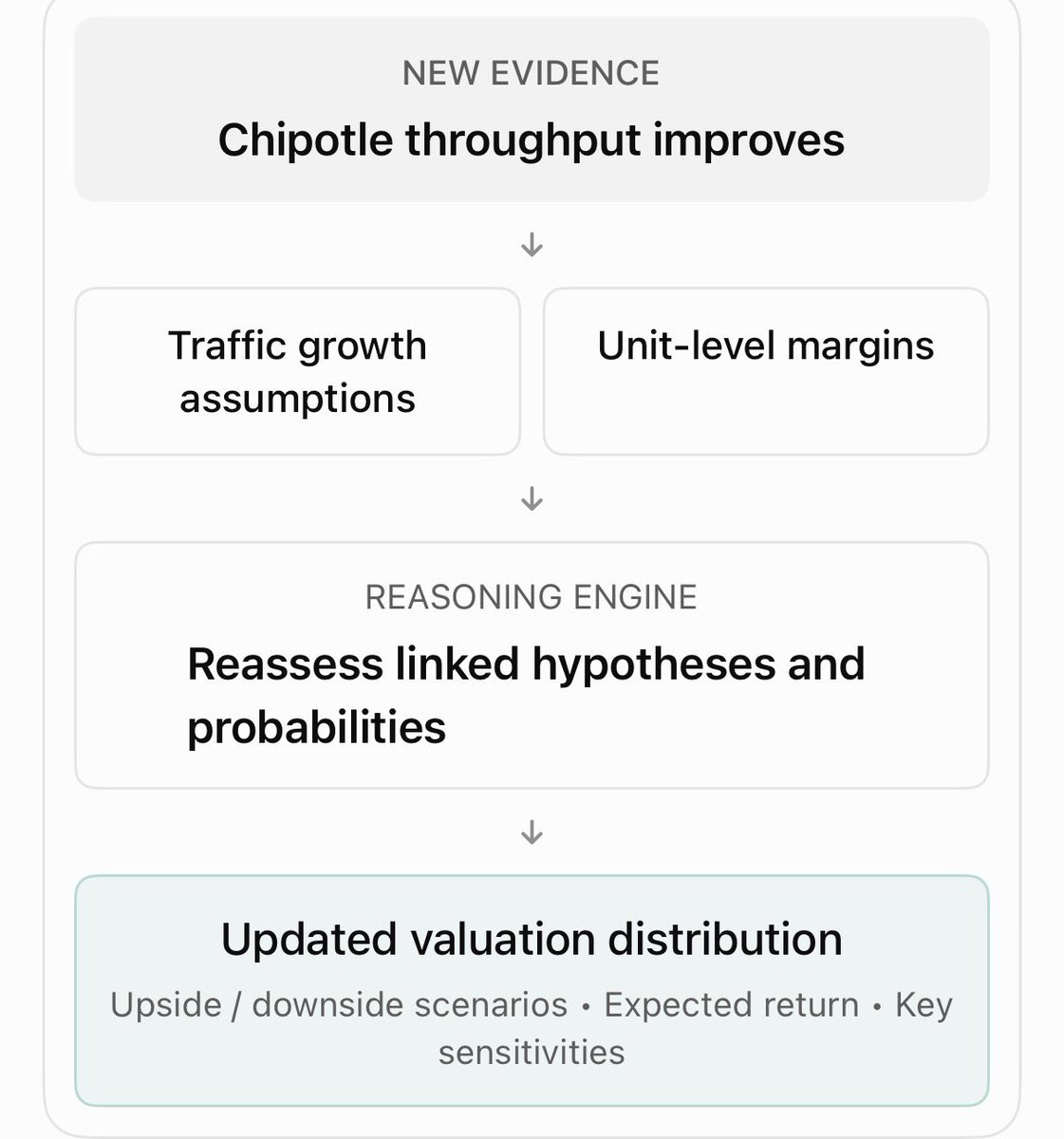
Instead of a financial model producing a single target price based on point estimates, imagine one that represents a distribution of possible outcomes, understands the dependencies between assumptions and updates those probabilities as new evidence emerges.
The analyst’s role shifts from manually maintaining models and processing information towards challenging assumptions, evaluating evidence and exercising judgement.
I suspect Excel will eventually become less central to the investment process, replaced by something more dynamic, interconnected and probabilistic.
Perhaps the biggest opportunity for AI in investing isn’t helping us do the same work faster.
It’s fundamentally changing how we think, connect information and make decisions under uncertainty.
Thank you @uncovered_alpha🙏. I like your idea for a knowledge system. The one further challenge that I see is where the feedback between your hypothesis and the world is quite slow or happens at different speeds (will create a bottle neck that puts a speed limit on the system…but I think this is a far more important constraint in fields where you are waiting for the results from a lab experiment than the change of a ticker symbol…excited to see what you and others come up with (unfortunately I dont have the technical skills to design such things - just a philosopher fascinated about the times we are living in)…
Few thoughts on AI in investment management and all fields where humans primarily use their conceptual/intellect ability to model/understand/predict the world (in a quantitative manner). The most serious obstacle I see to AI science at the moment is combinatorial explosion: even for a super super super computer, the search space will be too large to search without some sort of choosing-where-to-search algorhythim.
Incidentally, this is what I think humans do with our “feelings” or “intuitions”)…these are our indicators of where to jump into the unfathomably large possibility space…This is all - or most - of what I think human judgement is - where to focus attention in the search space and our emotional/valence/hedonic reactions are the pointers or metal detectors if you will of this…what would this look like in AI…I think we are already seeing it…
Im no expert, but once AI agents approach models where they can have a model of where to direct their attention- and learn how to do so based on their vastly superior working memory and analytical resources, its game over for human judgment in terms of making “better”’decisions in arena’s where we aim for the same goal (better risk adjusted investment returns for example)…the most important is that we remain the masters of choosing values - that they are OUR values…
I think society is entering a phase where what used to be rarefied philosophical questions (what is valuable, what is meaning, what is good, etc)…will be much more important for many to work through, for many have built their identity and lives on their differential intellectual or analytical ability…we are entering the age of values and qualities imo (in short: in the trinity of Truth, Beauty, and Goodness, Beauty and Goodness is about to get a much needed positive re-valuation)….
Very cool tweet @uncovered_alpha - the most serious obstacle I see is combinatorial explosion: even for a super super super computer, the search space will be too large to search without some sort of choosing-where-to-search
Incidentally, this is what I think humans do with our “feelings” or “intuitions”)…these are our indicators of where to jump into the unfathomably large possibility space…This is all - or most - of what I think human judgement is - where to focus attention in the search space and our emotional/valence/hedonic reactions are the pointers or metal detectors if you will of this…what would this look like in AI…I think we are already seeing it…
Im no expert, but once AI agents approach models where they can have a model of where to direct their attention- and learn how to do so based on their vastly superior working memory and analytical resources, its game over for human judgment in terms of making “better”’decisions in arena’s where we aim for the same goal (better risk adjusted investment returns for example)…the most important is that we remain the masters of choosing values - that they are OUR values…
I think society is entering a phase where what used to be rarefied philosophical questions (what is valuable, what is meaning, what is good, etc)…will be much more important for many to work through, for many have built their identity and lives on their differential intellectual or analytical ability…we are entering the age of values and qualities imo (in short: in the trinity of Truth, Beauty, and Goodness, Beauty and Goodness is about to get a much needed positive re-valuation)….
Very important post @nealkhosla
As a reesult, I think much more government regulation incoming - the only player with enough power to counter this force…theres no putting the genie back in the bottle - when the power imbalance between consumers and producers stretch to breaking point, the producers (who are also the consumers in that they will have to pay wages etc from lower bargaining power) will respond: the only effective response I can see (as it is a collective action problem of note) is to come together in force, and the only actor that fits that bill is government (the Leviathan is about to be unleashed against Skynet in a big way)
@SimonPB@Sixty60_Tweets Two best businesses in SA is Capitec and Shoprite - also moving into CPI’s space to a degree (from the bottom), Capitec moving upwards and out towards business (very good strategy and operational nous in each (I wouldn’t want compete with Peter Engelbrecht in operations…
100%: I haven't looked into the research, but I suspect one of the major reasons people don't have children is not some XYZ reason regarding the psychology of the most recent generations...in the words of Jerry Maguire - show me the money...to have children and to give them a decent life is simply too expensive...so in a way it is exactly the opposite of what I have seen some suggest: it not that people are more selfish these days or whatever, it is that they know they can't give a child a decent life, so they love them enough not to have them...
It's a good week to be a centre-left kinda dude.
I believe that billionaires should be allowed to exist. Extreme talent and risk-taking should be rewarded.
I also believe that ordinary people with ordinary talents should be able to live a good life if they do honest work. It's completely absurd that people can't afford to have children, or to have basic healthcare.
These concepts aren't mutually exclusive unless you have idiots in power from either the far left or the far right.
(2) And suppose you were an investor buying an apartment in a high rise building in Cape Town, or a firm considering renting office space? What do you think is the most beautiful building in Cape Town? How much of a premium would you be willing to pay to acquire or rent in this kind of building versus the average?
(1) Suppose you were a real estate developer specialising in high-rise buildings or scyscrapers. And let's focus on Cape Town's CBD for the moment. Which high-rise building in Cape Town do you rate as the most beautiful? And all else equal, which building do you think made the most money for its investors?
Would you rather have built the most beautiful building or the most profitable? Would you ever rate beauty as more important than money in your project decision? Would your decision change if you only had one project left in your career?