BriaCell Therapeutics Corporation:
Understanding the Science Behind a Promising Cancer Therapy
Overview
Treating cancer is hard. This is an obvious statement, but it always bears repeating. This is primarily because cancer has numerous defensive mechanisms to suppress and evade detection or attack by the patient’s immune system. An immunotherapy seeks to use substances to overcome these defense mechanisms and activate the patient’s own immune system to kill the tumors.
BriaCell Therapeutics Corp. is preparing to initiate a pivotal registration study for their lead candidate, Bria-IMT, which is being used in combination with a checkpoint inhibitor as an immunotherapy for metastatic breast cancer patients. These are patients who have failed multiple prior treatments and have very few, if any, options remaining. While earlier trials have been very encouraging and demonstrated both safety and efficacy, the future of this novel therapy hinges on the results of this upcoming clinical trial. The trial design has already been approved by the FDA and, if successful, is expected to lead to full (rather than conditional) approval.
Checkpoint Inhibitors
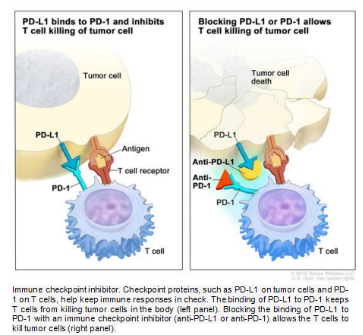
An immune system checkpoint is like a safety switch. It is a way that healthy, normal cells can signal to T-cells that they are friendly and safe, despite appearing like the enemy.
When a T-cell encounters another cell, the T-cell evaluates the proteins on the surface of the cell to determine if it is safe and healthy, or if it is cancerous or otherwise unhealthy. A protein that causes an immune response is called an antigen. Sometimes, the antigens on a cancer cell are also expressed by healthy cells. This is when the friendly cells can express a special protein which signals to the T-cell that it is a healthy cell, even though it shares these antigens with the cancer cells. These safety proteins are the immune checkpoints.
Unfortunately, cancer cells have the ability to hijack this mechanism and produce the same checkpoint proteins, fooling the immune system into leaving them alone. The purpose of a checkpoint inhibitor is to prevent the cancer from using these proteins to evade the T-cells. Because this is one of cancer’s most potent defenses, many immunological approaches now include the use of a companion checkpoint inhibitor. BriaCell is currently using Incyte’s PD-1 inhibitor (Zynyz) with their Bria-IMT therapy.
Antigen Targets
Once the checkpoint inhibitor “releases the brakes” on the immune system, an immunological approach must then jump-start the immune system to target the tumors that were previously off-limits to the T-cells. This is most commonly achieved by introducing antigens into the system that are shared by (or exclusive to) the cancer to be destroyed. Approaches vary widely on which antigens are used, and how they are delivered. The challenge here is that, once again, cancer has a defense.
If T-cells attack cancerous cells based on a specific antigen being expressed, cancer has the ability in many cases to down-regulate and limit the expression of that protein. This is called antigenic drift. In other cases, cancer can completely cease the expression, which is known as antigenic shift. Each of these mechanisms can help the cancer to evade attack.
In order to combat this defense mechanism, immunotherapies will often target multiple antigens at once. Others may target one protein that can’t be completely shed by the cancer, because it is necessary for the cancer to grow. The hard part is choosing the right ones. The other difficulty is that most therapies are unable to target more than a handful, or even one single molecule.
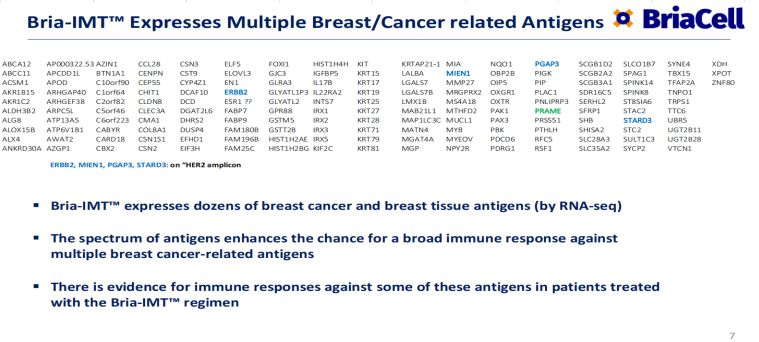
BriaCell’s novel approach with Bria-IMT starts with an irradiated, engineered, whole cancer cell. This is key to the approach because, while the cell can no longer replicate, it retains original characteristics, including the ability to express dozens and dozens of tumor-specific and tumor-associated antigens. This not only produces a very broad immune response, it is far more difficult for the cancer to evade.
Cytokines
In simple terms, a cytokine is another protein secreted by certain cells, which plays an integral role in signaling and controlling the development of other cells. Once the immune system is “jump started”, the next goal is to “step on the gas”, and the cytokines are how it is accomplished. One of these, Granulocyte-macrophage colony-stimulating factor (GM-CSF), has long been of interest because of its ability to accelerate the development of Dendritic cells and boost their own ability to present antigens to the T-cells.
Conversely, within the very immediate area of the tumor (the tumor microenvironment), GM-CSF has also been shown to cause pro-tumor and anti-immune effects. In fact, early trials using systemic injection of GM-CSF proved to be quite toxic. The trick is to use the right amount in the right place.
BriaCell’s engineered cancer cells express this powerful cytokine in a controlled and predictable way. Because the cells are injected into the skin (intradermal injection), the therapy is able to harness the significant benefits of boosting the immune response, without entering the tumor microenvironment and inducing immunosuppressive effects.
HLA Matching
Human leukocyte antigen (HLA) typing has long been used to match patients and donors for transplant compatibility. HLA are another set of proteins found on most cells in your body. Your immune system uses these markers to recognize which cells belong in your body and which do not.
Each person’s HLA types are hereditary, and primarily consist of a set of three types (called a haplotype) from each parent. Each haplotype includes one “A” type, one “B” type and one “DRB” type. There are other types, but they are mostly irrelevant to this discussion. Among the primary types, there are some that are very common among patients, and some that are more rare. This is greatly influenced by geography and race, due to the hereditary aspect.
One of the barriers to introducing an engineered cancer cell to the immune system to induce an immune response is that the T-cells could then attack the engineered cells, rather than the cancer. Because BriaCell’s IMT therapy uses a whole cancer cell, it also retains the HLA types from the original donor patient. Their earlier studies have shown that patients who share HLA types with the donor patient had a better response to the treatment. This makes sense because T-cells are more likely to accept (and act on) antigens presented by a cell that “belongs”, than one that doesn’t.
Interestingly, it has also been proven that having some mismatched HLA types can help induce an immune response, without compromising the benefits of the matched types. Thus, having some of both is ideal and this is the basis for future cell lines.
Tying It Together
BriaCell’s novel approach brings the long-held promise of whole cell immunotherapy closer to reality for desperate cancer patients.
The engineered, whole cancer cell expresses a broad range of antigens to produce a robust and lasting immune response. Engineering the cells to express GM-CSF further boosts the immune response by attracting Dendritic cells and accelerating their ability to process and present antigens to T-cells. This mechanism of action, in combination with a checkpoint inhibitor, has shown an ability to shrink tumors and improve quality of life while extending both progression-free and overall survival among the hardest-to-treat cohort of breast cancer patients. Those who happen to match the donor cell’s HLA types are even more likely to respond to treatment.
The exciting nature of this therapy is that the whole cancer cell is a wonderfully accommodating platform to engineer more expressions and improve the therapy. BriaCell’s next-generation of immunotherapies already in development (Bria-OTS) have some of the original HLA types removed, and then replaced with those that are most common among the population. This will provide at least one HLA match and “personalized” therapy for 99% of the population, ensuring each patient benefits from the improved response. A simple saliva test determines the appropriate formulation to use.
In addition, these new cell lines have been further engineered to express a battery of cytokines and costimulatory molecules (in addition to GM-CSF), to maximize the immune system’s ability to fight the cancer.
Finally, BriaCell’s recently issued patent protects using any whole cancer cell in combination with GM-CSF and any of the most common HLA types. This is an effective barrier to those chasing from behind, because it includes any cancer type. Other cytokines can be used, but GM-CSF is among the most potent and studied cytokines available. One could also try different HLA types, but all the most common ones are protected from being used with the whole cancer cell and GM-CSF.
Conclusion
It is important to have an understanding of the intellectual property one invests in, and I hope this provides some insight into BriaCell’s novel approach. The idea of using whole cancer cells to induce an immune response is not new, but BriaCell is clearly leading the way to finally bring this promising immunotherapy to patients in desperate need. While the impending registration study is of great importance, the future seems even brighter as they develop and expand this novel platform of therapies to treat numerous solid-tumor cancers.
#BriaCell #BCTX #BreastCancer #NotGoodEnoughforSeekingAlpha
@IAmFromDenverCO The most overrated coach in the league made the dumbest decision of the playoffs. The team did enough to win, if he only takes the easy FG. The loss is 100% on the head coach.
More than anything, I appreciate when my friends and loved ones show patience and understanding, allowing me to always know they are there and that they support me, but never pry or try to help make things better. Don't be offended if I just don't feel like talking or socializing.
Anyway, that's how I'd prefer people talk to/treat me during a rough patch.
@Mengu09@CCalcano In 1995 I traded four of each dual land from Revised edition for a black lotus and three moxes (Jet, Ruby and Emerald). I still wonder who got the better deal (no, I don't have the cards anymore).
@interesting_aIl Back in the late '80s, I used to play pool with "Rippin' Rick Reese" in Ft. Collins, CO (a world champion and footbag hall of famer). Was a cool dude. His skills and innovations were off the charts.
@AJamesMcCarthy Pretty sure this is the most widely talked-about photo in the world right now. Congrats on an epic accomplishment! Your passion has led you to the summit.
Very cool!
Many years ago, I took my wife out to dinner for her birthday. We had moved to Grand Junction, Colorado and were spending the weekend visiting friends and family in Loveland.
I told my wife to splurge, and we did. Appetizers, multiple dishes to try, desserts and a couple cocktails. At the end, the waitress said our meal was paid for.
Turns out, there was a woman seated across the aisle that recognized my wife from over ten years earlier. She had been kicked out by her abusive husband in the middle of the night, in December, with two small kids. My wife worked at the gas station, and this woman needed gas money to get somewhere safe, and food for the kids, so my wife gave her $20 (all she had).
Turns out, that was her lowest point, and over time she managed to rebuild her life and was now living comfortably while owning two businesses. She just happened to be in town for one day, visiting a client.
It was amazing to me that she still recognized my wife instantly, after all those years, but that's the impact when you care enough to extend a hand to those in need. They don't forget.
@LePapillonBlu2 Actually, in order to ensure no one "feels bad", Colorado gives free lunches to every student, including those with parents who earn 5x my income (or more).
In a recent analysis of phase III trials for metastatic breast cancer in the US, I reviewed every study on https://t.co/JPybecoCm9 that was active (but no longer recruiting), currently recruiting or not yet recruiting.
After filtering out a few irrelevant trials (aspirin regimens, exercise and mental health, etc.) I was left with just 81 relevant, P3 trials investigating therapeutic interventions. That's it.
Of those, 75% were based on already-approved drugs, jockeying for new positions in sequencing or new patient groups. There were only 20 trials investigating 14 new therapies, seeking their first approval in MBC. Sadly, of those 14, six are new selective estrogen degraders/modulators, three are new kinase inhibitors, and three are new antibody-drug conjugates. New drugs, same old strategies.
That leaves just two US, P3 trials that are actually looking at a new path for these patients with unmet medical needs: (BriaCell's cellular vaccine and Immutep's LAG3 checkpoint inhibitor/HLA class II agonist).
More life-saving/extending breakthroughs will require less redundancy and more support for truly novel approaches.
$BCTX @BriaCell $IMMP @Immutep
Just completed the four-course specialization "Fundamentals of Immunology" from Rice University on Coursera. I'm not going to say it was easy, because it wasn't. Learning takes effort, but the rewards can be very gratifying.
Dare to challenge yourself with something difficult.
Sheep just follow the herd, and biotech is full of sheep. What you really need is a smart dog to get the sheep moving in the right direction.
Dr. Ichim's spirit animal is a Border Collie.
Waking up people from #coma by targeting senescent cells.
My latest paper ....please share this new way of addressing this terrible condition.
Go #senovax ! Go #Immortabio
https://t.co/DPC8TCYTPl
@exosome@DocpalFrancesc2 Well, I also enjoy research and contemplation. If you ever want a highly-motivated grunt with a passion to contribute, feel free to reach out.
Clearly, there are patient-specific neoantigens, in addition to the numerous "classical" antigens we see across many patients with the same cancer type.
Post-translational modifications may represent another great target for immunotherapy, as they tend to be more specific than the common, classical types, but not as patient-specific as neoantigens. More like having a specific eye-color.
Then again, we have the very real issue of some HLA-types being better suited to present specific antigens to T-cells, and how to capitalize on that, and overcome the barriers it presents.
Of course, you already knew that. 😉
The pen is mightier than the sword.
That's why Charlie Kirk is dead, and why he will live on for generations. We either learn to debate respectfully, or we cease to exist as a nation.
Truly heartbroken over how far we have fallen.