About 94% of moth species need leaf litter or soil to survive the winter. It would be pretty messed up for them to wake up in a trash bag at the dump next spring.
Luna moths and swallowtails overwinter as cocoons in the leaves. Firefly larvae live down there for one to two years before you ever see them. Bumblebee queens, ladybugs, spiders, salamanders, and toads all overwinter in leaf litter.
When you send your leaves to the dump, you remove the habitat they need.
Rake them off the lawn if you have to. Grass can die under a thick mat of leaves. Then dump them under the trees, in garden beds, along your fence line, or somewhere out of the way.
Avoid shredding them if you can. A mulching mower also mulches all the little friends getting ready to overwinter in your leaves.
Yard waste is a huge share of what goes to landfills every fall. This would be a good year to start opting out of that.
If you're in North America, leave the non-native daffodil and tulip bulbs on the shelf. Plant these native early spring flowers instead, and plant them now.
Daffodils and tulips are from Europe and Asia, and the heavily hybridized ones sold in bins offer little to no usable pollen or nectar for most native bees. They bloom, they look great, and nothing local participates.
Native spring ephemerals do the opposite. They come up in the narrow window after the ground thaws and before the trees leaf out, which is exactly when native bees are emerging and starving. The timing isn't a coincidence, it's a relationship.
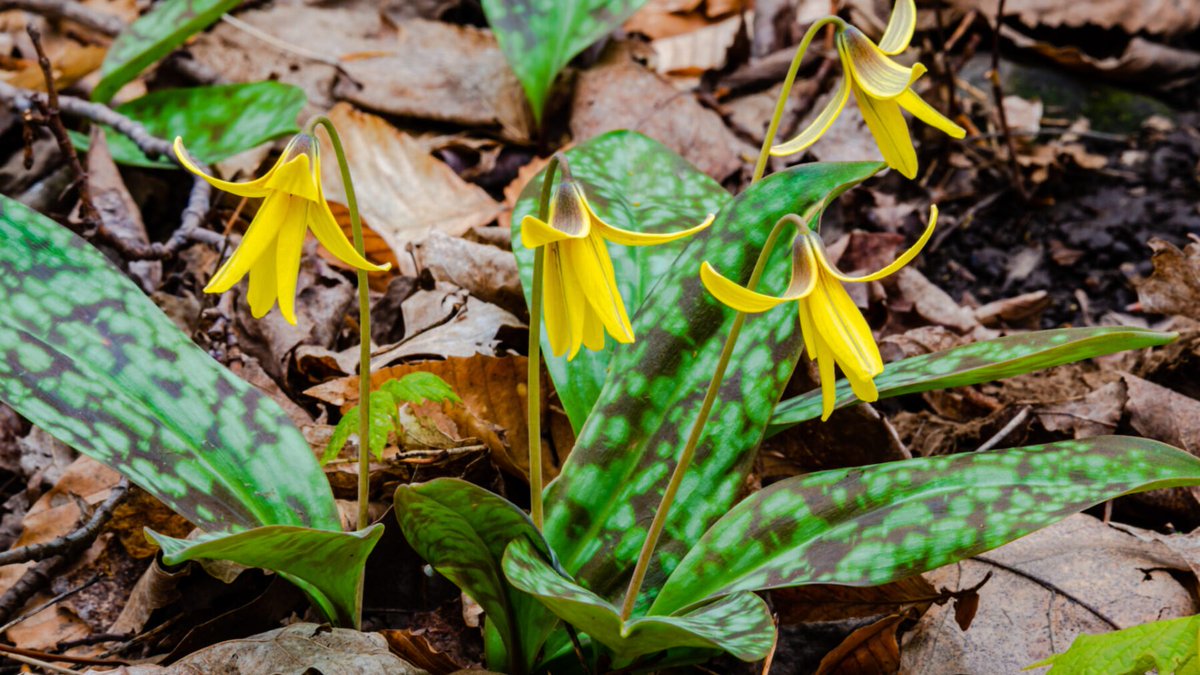
1. Trout lily. Mottled leaves, small yellow nodding flower. It has its own specialist bee, Andrena erythronii, that feeds on almost nothing else. Colonies of this flower can be over 100 years old, sometimes older than the trees above them.
2. Virginia bluebells. Pink buds opening to true blue. Works for bumblebees, long-tongued bees, butterflies, hummingbird moths and hummingbirds.
3. Dutchman's breeches. Weird little white flowers shaped like pants on a line. A critical early food source for bumblebee queens coming out of hibernation.
Honorable Mentions: Bloodroot, trillium, bellwort, spring beauty, shooting star. All the same high impact on native wildlife.
Fall is the window for planting them. These ship bare-root while dormant and this is when they want to go in the ground. Plant them in shade or part shade with decent organic soil, then mulch with four to six inches of clean straw.
They go dormant by midsummer and vanish, so mark where they are and interplant with ferns or woodland asters to fill the gap.
Then leave them alone to do their thing. They'll still be there in fifty years.
Everyone knows Made in China, but almost nobody talks about the city that actually taught the world how to make porcelain.
In Jingdezhen, they still do things the old way.
A single piece can go through 72 different hands.
They beat the clay from local stone, then throw, trim, paint, glaze, and fire it just like they did for the imperial courts back in the Song, Ming, and Qing dynasties.
The quality is insane, the best in the world IMHO, but the painting is what gets me.
It's all done completely freehand. No stencils or transfers or whatever... They're painting entire landscapes, palaces, bridges, pine trees, etc. on curved surfaces so tight you can barely fit your hand inside.
That's real craft!!
A snake ate every Guam kingfisher left in the wild. Two years ago, nine were set free on an island with no snakes. All nine are still alive and well.
The brown tree snake arrived on Guam in military cargo after World War II. With no predators to stop it, it ate its way through the island's forest birds, most of which vanished entirely. By the late 1980s, biologists caught the last 29 Guam kingfishers and moved them into captivity.
For nearly four decades, the species existed only in zoos. In September 2024, nine captive-bred birds were released on Palmyra Atoll, a string of islets in the middle of the Pacific that had been cleared of rats and has never had brown tree snakes.
Biologists expected to lose about half of them. To their surprise, they lost none.
Within a year, pairs had claimed territories, dug nest cavities into trees and laid more than 10 eggs, the first wild eggs for the species in almost 40 years. None hatched, which is normal for first-time parents. Another group of nine is set to join them in late 2026 or early 2027. The goal is 30 breeding pairs.
Guam itself is still off-limits for reintroduction. The snakes are fewer there but not entirely gone.
But the Guam kingfisher teaches us that extinct in the wild doesn't have to mean forever. All you need is 40 years and a snake-free island.
Lake Tahoe apparently has a serial tree poisoner.
No, seriously.
People are horrible sometimes.
Since 2022, someone has deliberately poisoned 28 trees at Burnt Cedar Beach.
At least 10 have died.
Some were more than 100 years old.
Whoever is doing this has drilled holes near the roots and introduced chemicals. In earlier cases, diesel fuel was used.
Now there’s a $147,000 reward for information leading to an arrest and successful prosecution.
Investigators haven’t established a motive, although one possibility they’ve considered is that removing the trees could improve views of the lake from nearby properties.
Imagine destroying trees that took a century to grow because they might be blocking your view.
I hope they find the pricks doing this.
The other day, I was in my backyard when my neighbor, who lives behind us, came to the fence to meet me for the first time. It turned out that one of our trees had fallen and damaged her fence, and she asked if we could fix it.
I told her it wouldn’t be a problem, and I would take care of it. She was so relieved and told me that her husband of 48 years had passed away just two weeks ago. She didn’t know what to do. I immediately felt for her because I understand the pain of losing a loved one.
I fixed the fence, and a few days later, she texted me asking if I could help with some other things around her house. I said I’d come over to see what needed to be done. She just needed her gutters cleaned, both inside and out, so I told her I could do that too.
Life has been really stressful for us lately, but today helped me see things in a new light. It gave us the chance to help someone who is really going through a tough time.
While we were cleaning her gutters, she wanted to pay us, but I told her we wanted to do it for free. I explained about "Brighten a Day"—how it’s our chance to give back, and that our payment would be a photo with her, which she happily agreed to.
When we got home, I went to take my phone out of my pocket and found money inside. She had slipped it in there when I wasn’t looking—like a ninja! I didn’t even feel it! 😂
I hope that we all can try to look beyond our own struggles and help those who might be having a harder time. It just might help you more than you think.
@BGatesIsaPyscho Yep. I was just thinking about exactly this clip the other day. Clearly human forms. Reminds me of Pompeii.
No one would talk about it on camera.
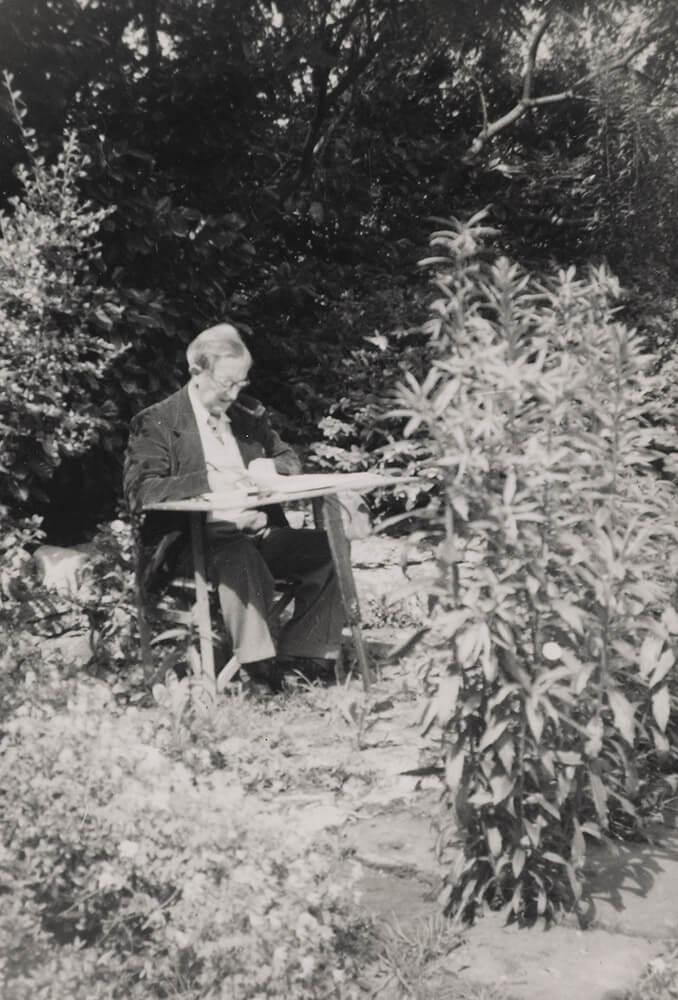
Tolkien, the original Hobbit, writing in his garden.
Happy Hobbit Day!
“I am in fact a Hobbit (in all but size). I like gardens, trees and unmechanized farmlands; I smoke a pipe, and like good plain food (unrefrigerated), but detest French cooking; I like, and even dare to wear in these dull days, ornamental waistcoats. I am fond of mushrooms (out of a field); have a very simple sense of humour (which even my appreciative critics find tiresome); I go to bed late and get up late (when possible). I do not travel much.”
- Letter 213
An Illinois couple turned their entire property into a forest. From satellite view it looks like a solid green square. The trees block wind, kill noise, and create their own microclimate inside.
Two trees. Native across most of North America. Absolute biodiversity hotspots. And you can put both in the ground right now.
First: oaks. Around 900 species of caterpillar use oak trees in the US, more than any other plant genus. Caterpillars are what birds feed their young. A chickadee pair needs somewhere between 6,000 and 9,000 of them to raise one brood. No oaks, no caterpillars, no baby birds.
Then there's the acorns. Deer, turkey, jays, woodpeckers, squirrels, bears, wood ducks. And oaks live for centuries, so one tree is a multi-generation decision.
There's a native oak for almost everywhere: white, bur, willow, live, swamp white, blackjack. Ask what's local at your garden center.
Second: willows. Roughly 450 caterpillar species are supported by willows, second only to oak, but it does a slightly different job than the oak tree.. Willows leaf out early, which makes them one of the first real food sources of the year for emerging insects. Male willows are a critical early pollen source for bumblebee queens coming out of hibernation, weeks before most flowers have gotten going.
Willows also hold streambanks together like nothing else, and beavers build with them.
Black willow, pussy willow, and sandbar willow are all good native trees to choose from. Skip the weeping willow, which is an ornamental from China.
Fall is the better time to plant either one. Roots keep growing after the leaves drop, so the tree spends months establishing before it has to hold up a canopy in July heat. Nurseries are discounting stock right now.
Pro tip: buy small. A smaller tree establishes faster and usually outgrows a bigger one within a few years.
When we look at an oak, a sequoia, or a balsa tree in the Amazon rainforest, we're looking at solidified carbon and oxygen.
Trees do not obtain structural mass from the soil; it comes out of thin air. Plants are built almost entirely from atmospheric gases—living, complex architectures of carbon, oxygen and sunlight. No wonder that as children, we hug them, play and climb in them, or wander through their woods, hearing them sighing in the wind.
Around 90% to 95% of a tree's dry weight is carbon and oxygen, pulled directly from atmospheric carbon dioxide. Most people assume trees draw their body from the earth, yet the soil volume beneath a canopy remains unchanged as a sapling matures into a giant.
Roots do not consume dirt to build branches; large trees leave no gaping holes in the ground. Instead, the root network is a mechanical anchor to hold the heavy tree structure upright, while absorbing water and a tiny fraction of soil minerals—nitrogen, phosphorus, and potassium. These are their biological multivitamins, accounting for less than 5% of final dry mass.
Through photosynthesis, sunlight breaks apart carbon dioxide and water molecules. The plant releases oxygen back into the atmosphere and chains the remaining carbon and oxygen into glucose molecules, forming complex structural polymers like cellulose and lignin.
Across the globe, an estimated 3 trillion trees hold roughly 500 billion cubic meters of wood. Every forest on Earth is in reality solidified atmosphere—hundreds of billions of tons of air trapped, structured and given physical form by living plants.
Mankind owes its survival to these friendly giants of the natural world.
A century ago, one in every four big trees in the eastern forests of America was a chestnut, and every autumn the country under them ate for free.
The American chestnut was a giant, a hundred feet tall, and there were close to four billion of them from Maine to the Deep South. Each autumn they dropped a carpet of sweet nuts so thick you raked it up by the sackful. Families roasted them all winter. Hogs and cattle were turned loose in the woods to fatten on them for nothing. Turkey, deer and bear lived off the same mast. The timber, straight and rot-proof, built the barns, the fence posts and the furniture. One tree fed the people, fattened the livestock, carried the wildlife through winter, then built the house.
Then in 1904 a blight arrived on imported Asian chestnut stock, spotted first on the trees at the Bronx Zoo. It moved through the forest at fifty miles a year, and by the 1940s it had killed close to four billion trees, nearly every mature chestnut on the continent. One of the worst ecological catastrophes in the country's history.
Here is the part that should stop you. The tree is not quite dead. The old roots still send up shoots, year after year, that the blight cuts down before they grow tall enough to fruit. A century on, the stumps are still trying, and still failing.
A free harvest that fed a continent every autumn for thousands of years, gone in forty, and still reaching for a sky it will never reach again.
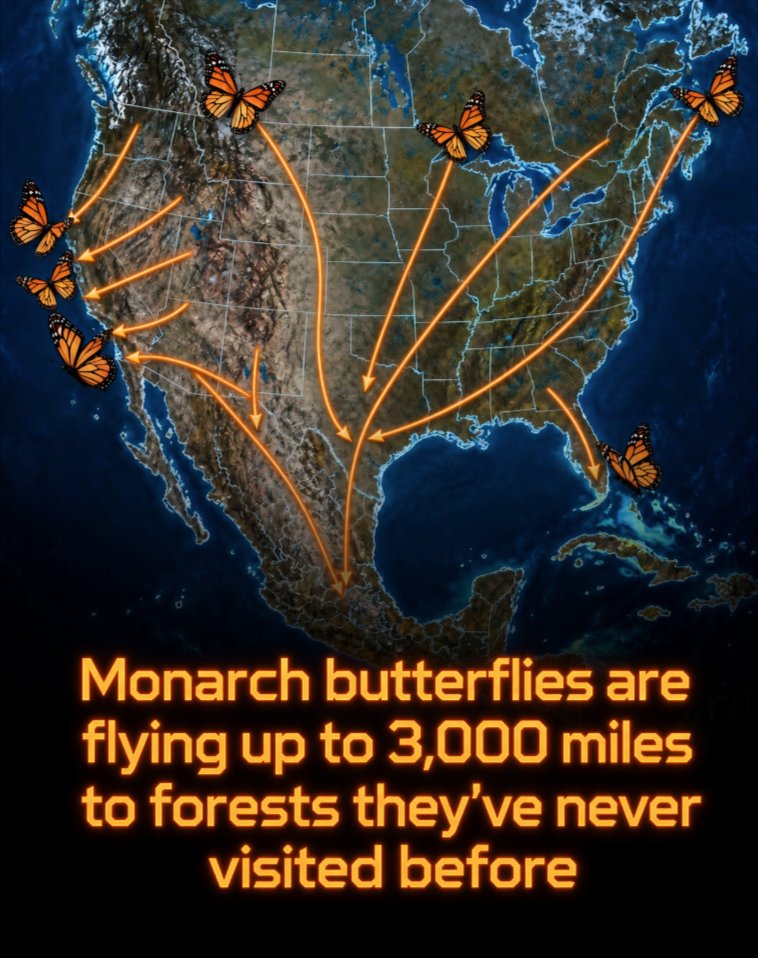
Monarch butterflies are travelling south on a journey of as much as 3,000 miles, heading toward the forests where their ancestors spent the winter even though the individuals making the flight have never taken that route themselves.
The autumn migration is now under way across North America, and some eastern monarchs cover up to 3,000 miles, or 4,800 kilometres, to reach the mountain forests of central Mexico, while most monarchs east of the Rocky Mountains aim for Mexico’s oyamel fir woods and many western monarchs pass the winter in sheltered groves along the California coast.
The insects on this flight belong to a long-lived migratory super generation that can live for up to nine months and come through winter before starting north again in spring, whereas earlier generations typically survive only two to six weeks as adults, and the southbound travellers are several generations removed from the butterflies that last occupied those wintering grounds.
The journey depends on both fuel and weather, since nectar supplies energy while favourable winds and rising air currents help them cover long distances without constant flapping, so that during the day they stop at flowers to feed and at night they may gather in sheltered trees, forming temporary roosts that hold hundreds or even thousands of butterflies.
Peak migration generally moves through the central United States during September and farther south through October, and many eastern monarchs reach central Mexico from late October into November, although weather can shift the timing.
To spot them, look for late-blooming flowers in parks, gardens and meadows on sunny days, and near sunset or early morning watch for clusters resting in trees, while leaving native autumn flowers standing and avoiding pesticides can help provide safer stopovers, native milkweed supporting the next generation by feeding caterpillars and nectar fuelling the migrating adults.