There are two ways AI progress could go very badly and that we must avoid.
First, we could lose control of the future to AI. This is unacceptable; we are unapologetically on Team Humanity, and AI must always serve people. To ensure that, we need ways to ensure that alignment and safety techniques stay ahead of progress in model capabilities.
Second, we could end up in a world with too much concentration of power. If an extraordinarily powerful AI is used by one person or company to impress their worldview onto everyone else, the results could be extremely dystopian.
Avoiding these two threats requires walking a narrow middle path; for example, one country could gain too much power. Another example is one lab ending up with too much power.
We Must Pace the Frontier: I’ve written a new essay on why the AI industry should slow down, with a three-part plan for doing so.
Anthropic is unilaterally committing to the first of these steps. We’ll provide third-party evaluators with permanent, employee-level access to our systems, so that they can verify adherence to our safety measures, report on incidents, and assess models’ alignment during training.
You can read the full post here: https://t.co/OGyPb7yaYt
This post should do wonders for your confidence as a designer.
An entire team at Google Design looked at this, approved it, and proudly shared it with the world.
The bar is so much lower than you think.
Introducing Grok Bot, now in early beta.
Bots are AI teammates that do real work for you. They sign in to your tools, use them just like you do, and come back with finished work.
I don't know who needs to hear this but I disappeared for four days and everything was right where I left it.
Everything feels like it's moving too fast to step away for even a day. It's not. The timeline's still arguing about the same stuff.
Take the break!
Today, we’re launching Reve 2.0, the best 4K image model in the world.
We invented a new way to generate and edit any image using precise layouts. For the first time, it’s possible to create images you can touch.
How to build a standout brand in 2026 ✨
I’m working on a YouTube video where I show my full process of building a brand identity from scratch - how I use Midjourney to create an awesome style, what tools I use, and the coolest part, how to build your own tools with AI and vibe coding to create unique textures, effects, and animations no one else has.
If this sounds like something you’d watch, share it and drop a kind word below. 👇
Introducing FAUNA. The creative agent built for people whose ideas deserve better.
Describe what you want to make. It builds the workflow on the canvas in front of you. Redirect it, push it further, tell it what to avoid. Your vision drives everything.
My dear front-end developers (and anyone who’s interested in the future of interfaces):
I have crawled through depths of hell to bring you, for the foreseeable years, one of the more important foundational pieces of UI engineering (if not in implementation then certainly at least in concept):
Fast, accurate and comprehensive userland text measurement algorithm in pure TypeScript, usable for laying out entire web pages without CSS, bypassing DOM measurements and reflow
When companies stop listening to their designer, they stop caring about design.
When they stop caring about design, they stop caring about their product.
Design isn’t a nice to have, it’s a necessity. Listen to your designers. We’re more than pretty pictures.
We built TLDW (too long, didn't watch), a tool that helps you learn from long YouTube videos better & faster.
AI video summaries are solving the wrong problem.
You don't need a generic text summary of a 1-hour video. You need the 5 minutes that actually change how you think.
TLDW finds those moments for you.
Demo 👇 Try now at: tldw dot us
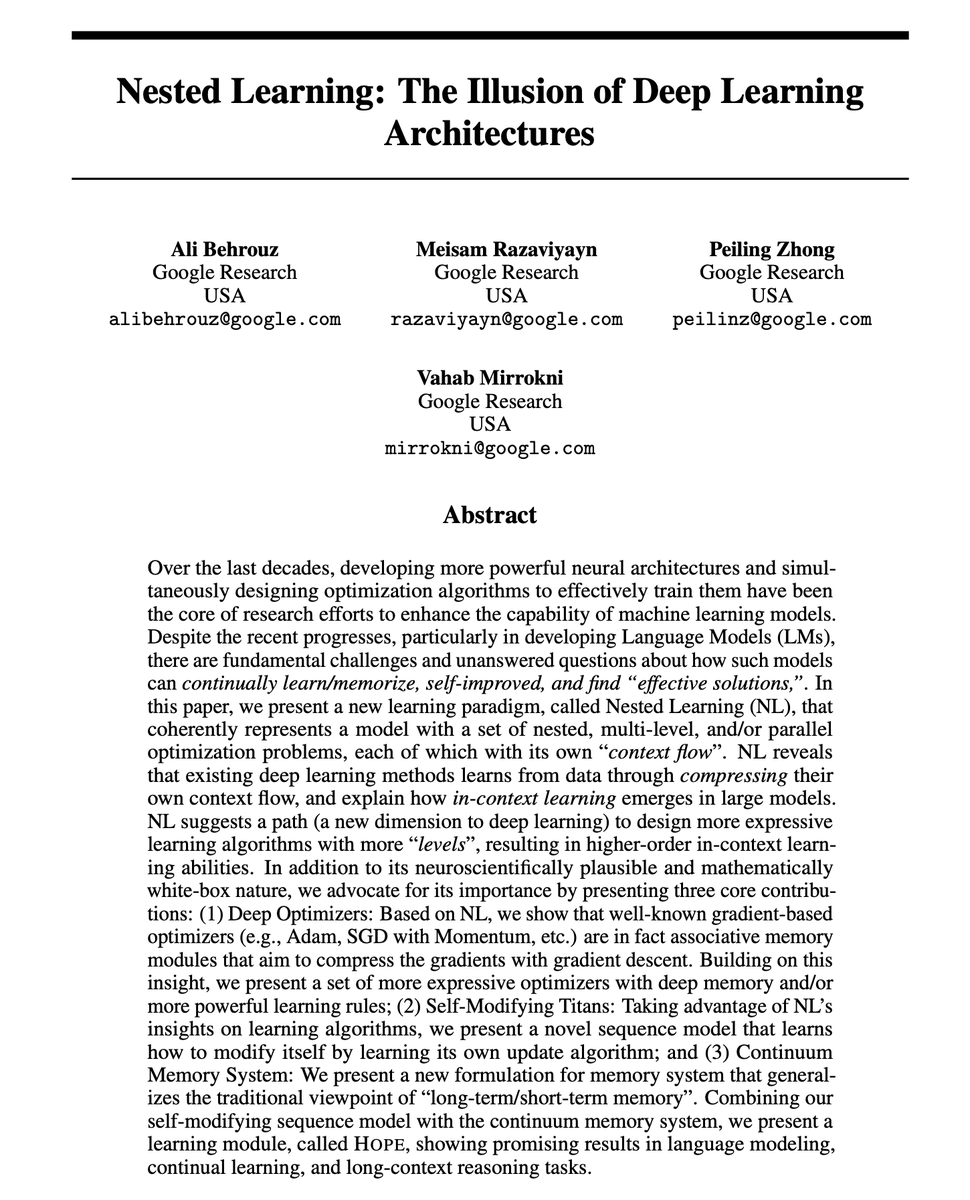
Google just dropped "Attention is all you need (V2)"
This paper could solve AI's biggest problem:
Catastrophic forgetting.
When AI models learn something new, they tend to forget what they previously learned. Humans don't work this way, and now Google Research has a solution.
Nested Learning.
This is a new machine learning paradigm that treats models as a system of interconnected optimization problems running at different speeds - just like how our brain processes information.
Here's why this matters:
LLMs don't learn from experiences; they remain limited to what they learned during training. They can't learn or improve over time without losing previous knowledge.
Nested Learning changes this by viewing the model's architecture and training algorithm as the same thing - just different "levels" of optimization.
The paper introduces Hope, a proof-of-concept architecture that demonstrates this approach:
↳ Hope outperforms modern recurrent models on language modeling tasks
↳ It handles long-context memory better than state-of-the-art models
↳ It achieves this through "continuum memory systems" that update at different frequencies
This is similar to how our brain manages short-term and long-term memory simultaneously.
We might finally be closing the gap between AI and the human brain's ability to continually learn.
I've shared link to the paper in the next tweet!
"Designers are cooked, Gemini 3 took their jobs"
Gemini is making basic design more accessible and if anything it's a lead generation machine.
More founders can build MVPs. More products get launched. More companies raise seed rounds.
Then they approach Series A and realize templates don't close enterprise deals. That's when they hire professional design help.
AI handles the entry level.
We handle everything after product-market fit.