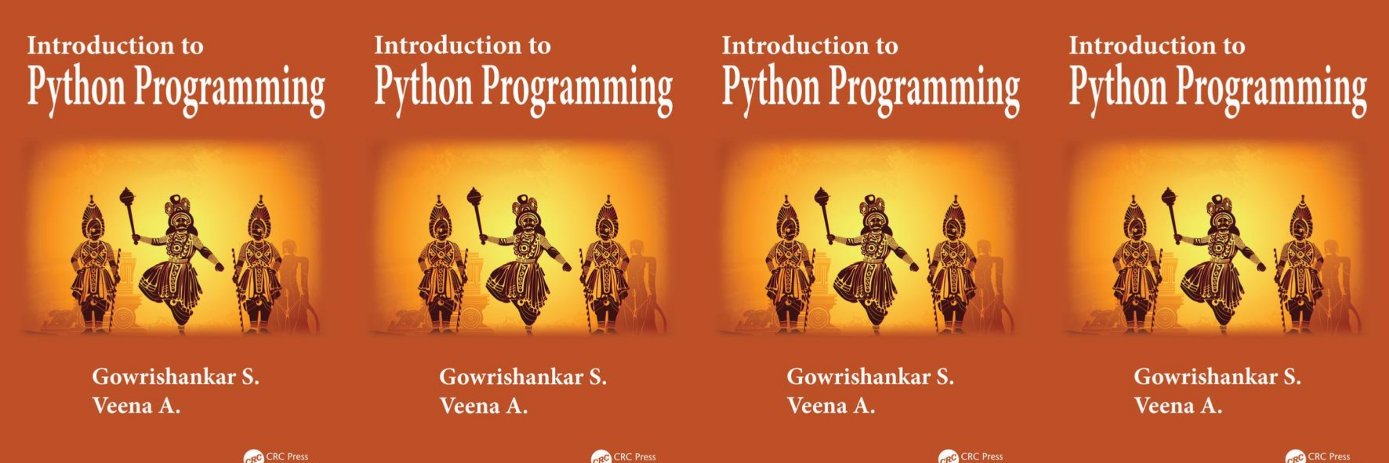
Professor, Department of Computer Science and Engineering, Dr.Ambedkar Institute of Technology. Author of "Introduction to Python Programming". #python
Our book, "Introduction to Python Programming", authored by me and my colleague Mrs. Veena A and published by @CRCPress is available in the Indian market. @CRC_Engineering#python#programming#book
https://t.co/NeOZEh0Ryj
Beyond the ancient🕉️
The ancient Gangeshwar Mahadev Temple in Diu is believed to have been built by the Pandavas themselves. The 5 ShivLingas of the temple are placed in a manner that 'Jal Abhishek' happens every minute. Divine
After a certain age, your parents slowly become your children.
They ask simple questions, repeat stories, and depend on your patience the way you once depended on theirs. Very few understand this role reversal. What looks like innocence or inconvenience is really time coming full circle. Don’t correct them harshly. Don’t rush them. Care for them the way they once protected you. This is not a burden. It is repayment, quietly wrapped as love.
Leaving Meta and PyTorch
I'm stepping down from PyTorch and leaving Meta on November 17th.
tl;dr: Didn't want to be doing PyTorch forever, seemed like the perfect time to transition right after I got back from a long leave and the project built itself around me.
Eleven years at Meta. Nearly all my professional life. Making many friends for life. Almost eight years leading PyTorch, taking it from nothing to 90%+ adoption in AI. Walking away from this was one of the hardest things I've ever done. But I'm leaving with a full heart.
PyTorch handles exascale training now. It powers foundation models that are redefining intelligence. It's in production at virtually every major AI company. It's taught in classrooms from MIT to rural India. The tools I dreamed about making accessible? They are. The barrier to entry I wanted to lower? It's almost gone.
To be clear, there’s so much more to do. As long as AI evolves at a breakneck pace, PyTorch will continue to play catch up. Obsessing over the yet-to-come sometimes makes us forget how much we’ve already done.
To everyone who built this with me—who believed research should be joyful, that tools should be elegant, that open source changes everything—thank you. This wasn't my journey. It was ours.
What's next for me? Something small. Something new. Something I don't fully understand yet. Something uncomfortable. I could have moved to something else inside Meta. But I needed to know what's out there. I needed to do something small again. I couldn't live with the counterfactual regret of never trying something outside Meta.
It's very hard to leave. I probably have one of the AI industry’s most leveraged seats, I lead the software layer that powers the entire AI industry. Every major AI company and hardware vendor are on a speed dial. This kind of power is really hard to give up. But curiosity ultimately won out in my head.
Keep making AI delicious and accessible. I'll be watching. Probably filing issues. Definitely staying involved.
Is PyTorch going to be okay?
I don't want to be doing PyTorch forever. I don't want to be like Guido or Linus— bound to a single thing for decades. Last November, coinciding with the birth of my daughter, I started planning my exit with Aparna. My goal was to leave PyTorch in a good and stable place.
By this August, during the second half of my parental leave, I knew: Edward, Suo, Alban, Greg, John, Joe and Jana were ready. The team faced hard people, product, technical and organizational problems and didn’t feel the need to lean back on me to solve these for them (unlike in the past). The product story they crafted for the PyTorch Conference was coherent—really coherent. The things I'd flagged red were turning healthy. The project didn't need me anymore. Unlike 2020-2022 (when I stepped down to go do robotics and came back when Lin, Dima and Dwarak left), I have strong confidence that this time PyTorch is truly resilient. The most aligned culture carriers of PyTorch – Greg, Alban, Ed, Jason and Joe are at the decision table now, and people with strong value alignment – Suo, John and Jana have joined them at the table. And there’s a long list of equally value-aligned people willing to sit at the table should any of these people leave. There are many little things that make up my confidence on the people – John worked on Julia and open-source for a very long time (in fact we hacked a Torch.jl in 2015), Suo has been the strongest systems builder and strategic partner I’ve had for the past two years, and Jana worked on resilient core systems for a very long time, I’ve had long technical and organizational discussions with her over the past few months that give me confidence. And the product lineup and execution in 2025 should be sufficient evidence for any remaining doubt.
I’m confident that this band of PyTorchers are going to do exceptionally well. PyTorch might change in flavor because I no longer impose my own taste from the top, but I’m confident that the values are going to stay intact and the product is going to be awesome.
My time at Meta
The early years of FAIR were absolutely magical. I was part of a small family of absolutely brilliant people building state-of-the-art AI out in the open. From working on GANs with Emily Denton, Rob Fergus, Leon Bottou, Martin Arjovsky and the (now legendary) Alec Radford to building Starcraft bots with Gabriel Synnaeve, to building the first FAIR Cluster with Howard Mansell, to working on object detection with Adam Lerer and Piotr Dollar, to building PyTorch. It was more fun than I can describe in words. 2015 and 2016 were probably the most productive and professionally enjoyable years of my life. I’ll probably romanticize this period of my life forever.
When I joined FAIR, I had massive impostor syndrome, and the first 3 months were very very difficult. I can’t credit Andrew Tulloch enough for being the most thoughtful, kind and welcoming mentor, without whom I wouldn’t have made it. I’m so damn bullish for Meta just from the fact that he’s back.
---
My time on PyTorch was special.
I loved every part of building it—designing it, managing it, being the PM, TL, comms lead, doc engineer, release engineer, squashing bugs, growth hacking, turning it into a coherent product with hundreds of people, transitioning it to industry stakeholdership – the whole nine yards.
To the core PyTorch team at Meta: the engineers, researchers, open-source maintainers, docs writers, CI infrastructure folks, hardware partners, the community builders. To the hundreds more inside and outside Meta—thank you. You turned a library into a movement.
There are too many people to credit and thank, but I can't not mention Adam Paszke, Sam Gross, Greg Chanan, Joe Spisak, Alban Desmaison, Edward Yang, Richard Zou, Tongzhou Wang, Francisco Massa, Luca Antiga, Andreas Köpf, Zach DeVito, Zeming Lin, Adam Lerer, Howard Mansell and Natalia Gimelshein. And Schrep. They made the launch happen. And so many more people became centrally important later: Lu Fang, Xiaodong Wang, Junjie Bai, Nikita Shulga, Horace He, Mark Saroufim, Jason Ansel, Dmytro Dzhulgakov, Yangqing Jia, Geeta Chauhan, Will Constable, Briah Hirsh, Jane Xu, Mario Lezcano, Piotr Balecki, Yinghai Lu, Less Wright, Andrew Tulloch, Bruce Lin, Woo Kim, Helen Suk, Chris Gottbrath, Peng Wu, Joe Isaacson, Eli Uriegas, Tristan Rice, Yanan Cao, Elias Ellison, Animesh Jain, Peter Noordhuis, Tianyu Liu, Yifu Wang, Lin Qiao and hundreds more. It’s criminal of me to not take the space to list out everyone else I should be mentioning here. PyTorch is nothing without its people ❤️.
The most joyful moments of building PyTorch was meeting users eager to share their happiness, love and feedback. I remember a grad student coming to me at Neurips 2017, in a slurring emotional voice he said he’d been trying to make progress on his research for 3 years but within 3 months of using PyTorch he made so much progress that he was ready to graduate. That moment made it tangible that what we do matters, a lot, to a lot of people, even if you don't constantly hear from them. I do miss the intimacy of the PyTorch community, with a 300 person conference that felt like an extended family gathering, but I feel that’s a small price to pay considering the scale of impact PyTorch is truly having today – yes the Conference is now 3,000 people where market-moving deals get brokered, but it’s helping orders of magnitude more people to do their best AI work. I miss the intimacy, but I'm proud of that growth.
---
To Mark Zuckerberg and Mike Schroepfer, who believed that open-sourcing is fundamentally important and is a sound business strategy. This is so hard to understand for most people within the course of business, but we’ve run lock-step on this strategy without ever having to discuss it. Without you two, neither FAIR nor PyTorch would’ve happened. And those mean so much to me.
To Yann LeCun and Rob Fergus, for building the magical early FAIR that I so revere.
To Aparna Ramani, a leader that I find so rare at Meta in her ability to hold a really high bar for the org, technically brilliant with the span to discuss deep infra systems and industry-strategy within the same conversation and for being an absolute execution-machine! I’ve learned so much from you.
To Santosh, Kaushik, Delia, Oldham and Ben for being so welcoming to Infra. For someone coming over from FAIR with a wildly different culture, you all made me feel at home and made me part of the family, and thank you for that.
To all my managers who've championed me through the PSC video game – Serkan, Howard, Jerome, Abhijit, Yoram, Joelle, Aparna and Damien – I owe you a lifetime of drinks.
---
Signing off for now.
—Soumith
Maybe a hot take, but what about the following advice to the next gen:
Don't get an AI degree; the curriculum will be outdated before you graduate. Instead, study math, stats, or physics as your foundation, and stay current with AI through code-focused books, blogs, and papers.
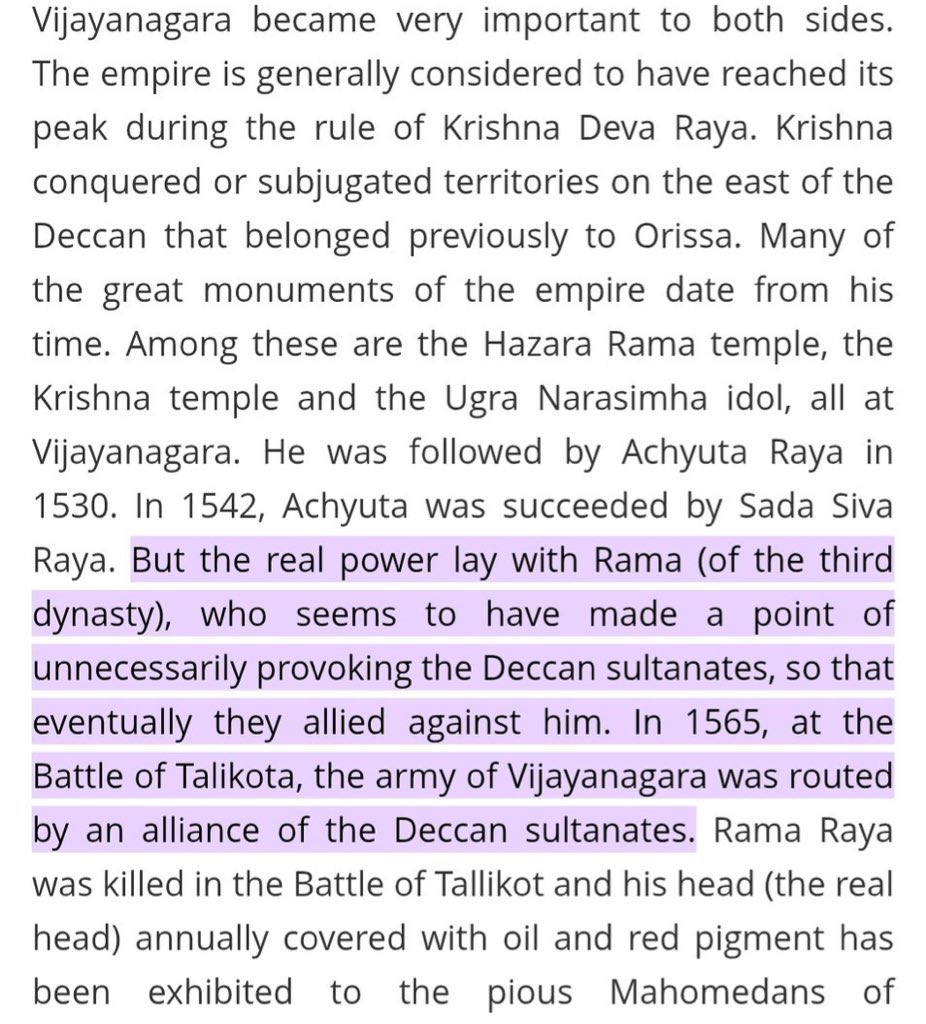
Why does the government website (Vijaynagar district website) blame the Vijaynagara king for the Battle of Talikota, saying he unnecessarily provoked the Deccan sultanates???
Who writes for this website, and how did the government allow it??!!
In actual history: The Muslim kings grouped together to finish off the Hindu dynasty of Vijaynagara and the only provocation was the fact that Vijayanagara was a non-Muslim state.
Check the last line- Rama Raya’s head was exhibited to the pious mahomedans , as if the writer is almost celebrating the k!ll!
If anyone is aware of handles of the relevant government here on this issue, please do tag them🙏
▪️CMOS sensors ✅ this covers digital cameras & camera phones
▪️ 3G ❌ never world-leading here; we’re on 6G now
▪️ hybrid cars ❌ incremental only; like winning in feature phones while losing smartphones
▪️ Batteries ❌ actually *lost a formerly world-leading position
▪️ Service robots 🤔 Is this a significant industry outside Japan? I’d have argued more for industrial robots ✅ here although it was already world-leading in the 80s and companies like Fanuc are no longer global-leading on industry 4.0
▪️ High-performance ceramics ❌ incremental
Meanwhile since the 80s, Japan has ceded formerly world-leading positions in shipbuilding, consumer electronics, semiconductors and others. It’s about to lose its leading position in carmaking, the biggest sector of all.
While missing out on the really significant new industries of the last 30 years.
This doesn’t sound like a win for its industrial policy execution, and speaks to deeper structural issues at play.
The problem with computer science is anyone and everyone can talk about computer science without knowing anything about computer science
#computerscience
Heads up: Microsoft Office, like many companies in recent months, has slyly turned on an “opt-out” feature that scrapes your Word and Excel documents to train its internal AI systems. This setting is turned on by default, and you have to manually uncheck a box in order to opt out. If you are a writer who uses MS Word to write any proprietary content (blog posts, novels, or any work you intend to protect with copyright and/or sell), you’re going to want to turn this feature off immediately.
My kid asks me: Daddy, should I be a programmer like u?
I answered: no, kiddo, learn real-world skills. By the time you're 25, coding will be an obsolete profession.
But, I wonder if physical labor will last for long.
The progress in AI + Robotics makes me smoke🧵:
Most of the ORS in Indian pharmacies are FAKE! 🚨
These fake ORS packets have dangerously high sugar and very low sodium, which can lead to serious health issues like brain swelling, and many kids have been admitted to the ICU because of it.
Here’s how you can spot the REAL ORS:
1) Real ORS has "based on WHO recommendation" on the front.
2)Fake ORS is classified as food and has the FSSAI sign. Real ORS won't have this sign.
We need pharmacies to stop selling these fake products and push regulatory bodies to take action! 💪
Share this with your friends and family to spread awareness. Let’s make sure everyone knows the difference and stays safe!
Is the scientific paper a fraud? Peter Medawar (Nobel Prize winner) suggested that publications are overly structured and formal, giving only a sanitized version of the discovery without revealing the thought process that actually led to it.