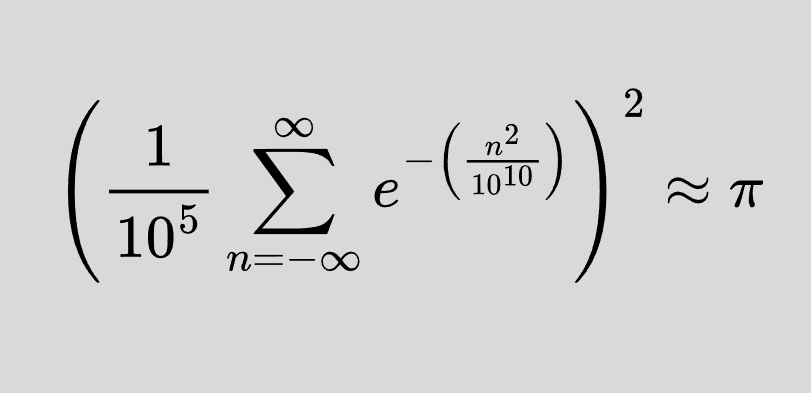
I wonder if there approximate coincidences that show up in physics. Formulas where pi shows up but it’s technically wrong but approximately correct and also could make sense for a theoretic reason that is actually incorrect.
The following little-known formula yields the correct decimal digits of π to an astonishing 42 billion places; however, it is not an exact formula for π. In other words, it is only a very high-precision approximation. The symbol ≈ denotes an approximation
(Borwein and Borwein, Strange Series and High Precision Fraud, 1992).
The following little-known formula yields the correct decimal digits of π to an astonishing 42 billion places; however, it is not an exact formula for π. In other words, it is only a very high-precision approximation. The symbol ≈ denotes an approximation
(Borwein and Borwein, Strange Series and High Precision Fraud, 1992).
Here's a "theorem" in the complex variables section proved by sorry: "If g is complex differentiable at every point with Re z \geq 0, then g is complex differentiable everywhere." This is then used in the proof of another theorem in Lecture21.lean. All of this is marked as a "pass".
Here's a "theorem" in the complex variables section proved by sorry: "If g is complex differentiable at every point with Re z \geq 0, then g is complex differentiable everywhere." This is then used in the proof of another theorem in Lecture21.lean. All of this is marked as a "pass".
it’s tempting to look back at certain moments in history and think, god, there was so much low-hanging fruit then.
people are going to look back at this moment the same way.
@chi_t_williams The UD result feels like a tenure worthy result at a good university. The new applications lend credence to one of the bigger awards— since it is opening up more and more new terrain.
There's a LOT going on in AI for math right now, partly (but not fully) inspired by the OpenAI result last week, where a model disproved a longstanding, pretty famous conjecture. Little of the general discussion has tried to explain the math tho, so I did!
https://t.co/MQpAFK81XU
@chi_t_williams I think so, yes. The Unit Distance result did not make a new theory but it did apply an old heavy duty theory to a big problem— which now seems to port well to other big problems, too.