I've lead intentional and evolutionary architectures for Digital Products using IoT, microservices, and serverless computing to large companies around the world
New Loop Library skill feature: Lazy Loops! (aka Discover)
Discover will look through your codebase and chat threads to find potential loops it will design for you.
https://t.co/qnfoRqkk72
/grill-me skill by @mattpocockuk is really straight to the point. I've used it to review two codebases and it went really deep in each of them and helped me to discover many hidden issues 👀
This is a real treasure: https://t.co/lFrhKnjzFE
10 GITHUB REPOS THAT SCRAPE THE ENTIRE INTERNET FOR YOU
Bookmark every single one. Each one pulls clean data off any website on earth, the kind of access companies sell behind a sales call and a contract.
1. https://t.co/yjhB8qsY2r
Point it at any website and it crawls every page, renders the JavaScript, and hands back clean structured data an AI can read instantly. It crossed 130K stars and landed in GitHub's top 100 repos. The scraping backbone half the AI startups quietly run on, open for anyone.
2. https://t.co/H8tTZjwd7O
The #1 trending crawler on GitHub. Turns any site into clean, LLM-ready markdown, faster than the paid services and with no API key, no account, no per-page fee. A dev built it in days after getting fed up paying $16 for a gated scraper. 51K stars. Apache 2.0.
3. https://t.co/xgLQDLB4HL
An AI agent that drives a real browser like a human, clicking, scrolling, logging in, filling forms, and pulling data off sites it has never seen before. Two ETH Zurich researchers built it and it hit 95K stars in about a year. The thing that scrapes pages no simple crawler can reach. MIT.
4. https://t.co/bBDy50sR9R
The full professional scraping framework, with rotating proxies, automatic retries, browser fingerprint spoofing, and queue management, all the machinery that keeps you from getting blocked. The exact stack scraping companies charge thousands to operate, handed to you for free.
5. https://t.co/nKhjeJxe1F
The original industrial-strength scraper that has quietly powered data teams for over a decade. Crawl millions of pages, extract anything, export it clean. Battle-tested at a scale most paid tools never reach, and free the entire time.
6. https://t.co/0NeYEdAWDt
Microsoft's own tool that converts any file or web page, PDFs, Office docs, HTML, images, into clean markdown an AI can actually use. The messy-data-to-clean-data step companies build whole pipelines around, open-sourced by Microsoft itself.
7. https://t.co/vyKqqy18Pi
A stealth scraper built to stay invisible, adapting automatically when a site changes its layout and slipping past the bot detection that stops everything else. The cat-and-mouse layer that anti-scraping vendors sell as a premium feature, free and open.
8. https://t.co/o9TuMdEQ1l
Mirror and control any Android phone from your computer to pull data and automate apps that have no website at all. The bridge into mobile-only platforms that most scrapers can't touch. 130K+ stars. Apache 2.0.
9. https://t.co/24FQISv92x
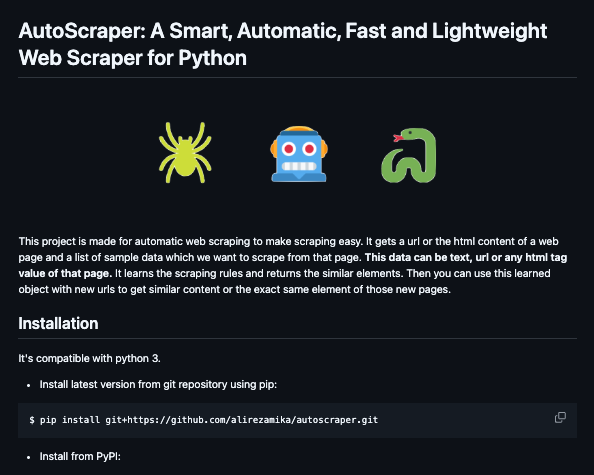
Show it one example of what you want and it figures out the pattern and scrapes the rest of the site automatically. No selectors, no code to maintain. The "just get me this data" button, in a few lines of Python.
10. https://t.co/BgL79bWL89
A version of curl that perfectly mimics a real browser's fingerprint, so the requests sneaking past every defense look exactly like a human with Chrome open. The lowest-level trick the expensive scraping APIs are quietly built on top of.
Companies sell this access for $2,000 a month. The source code is right here.
As an AI Engineer. Please learn
>Harness engineering, not just prompt engineering
>Context engineering, not just long prompts
>Prompt caching vs. semantic caching tradeoffs
>KV cache management, eviction, reuse, and memory pressure at scale
>Prefill vs. decode latency and why they optimize differently
>Continuous batching, paged attention, and throughput optimization
>Speculative decoding vs. quantization vs. distillation tradeoffs
>INT8, INT4, FP8, AWQ, GPTQ, and when quantization hurts quality
>Structured output failures, schema validation, repair loops, and fallback chains
>Function calling reliability, tool contracts, argument validation, and idempotency
>Agent guardrails, loop budgets, tool budgets, and termination conditions
>Model routing, graceful fallback logic, and degraded-mode UX
>RAG architecture: chunking, embeddings, hybrid search, reranking, and freshness
>Retrieval evals: recall, precision, grounding, attribution, and citation quality
>Evals: golden sets, regression tests, adversarial tests, LLM-as-judge, and human evals
>LLM observability as a first-class discipline: traces, spans, tokens, latency, errors, and drift
>Cost attribution per feature, workflow, tenant, and user journey not just per model
>Safety engineering: prompt injection defense, data leakage prevention, and permission boundaries
>Multi-tenant isolation, cache safety, and cross-user context contamination prevention
>Fine-tuning vs. in-context learning vs. RAG vs. distillation and when each is the wrong tool
>Latency, quality, cost, and reliability tradeoffs across the full inference stack
>Production failure modes: hallucinated tool calls, malformed JSON, stale retrieval, runaway agents, and silent eval regressions
ANTHROPIC JUST DROPPED A ZERO TRUST PLAYBOOK FOR AI AGENTS
and it's not theory it's architecture
frontier AI compresses vulnerability-to-exploit timelines from months to hours
your agents face threats traditional access controls were never built to handle:
▫️ prompt injection through external data sources
▫️ tool poisoning via MCP server metadata
▫️ memory-based privilege retention across sessions
▫️ multi-agent pivot attacks
the framework breaks it into 3 tiers: Foundation, Enterprise, Advanced
https://t.co/uDuO9cq25H
20 GitHub repos to elevate your AI engineering career (save this):
1 OpenClaw
↳ Runs a personal AI agent locally that can browse, plan & take actions on your device.
2 TensorFlow
↳ Provides a production-ready framework to build, train & deploy machine learning models at scale.
3 AutoGPT
↳ Automates multi-step tasks by chaining LLM reasoning into autonomous agents.
4 n8n
↳ Automates workflows with a visual builder that integrates APIs, data & AI tools.
5 Ollama
↳ Runs open LLMs locally with simple commands & optimized performance.
6 Stable Diffusion WebUI
↳ Generates images locally with a powerful UI for Stable Diffusion models.
7 Hugging Face Transformers
↳ Offers thousands of pretrained models for NLP, vision & multimodal AI tasks.
8 Langflow
↳ Builds & tests LLM pipelines visually using a drag-and-drop interface.
9 Dify
↳ Creates production-ready AI apps with built-in orchestration, prompts & APIs.
10 LangChain
↳ Orchestrates LLM workflows, tools, memory & agents in applications.
11 Open WebUI
↳ Delivers a self-hosted ChatGPT-style interface with local & API model support.
12 DeepSeek-V3
↳ Provides a high-performance open-weight LLM optimized for reasoning and coding.
13 PyTorch
↳ Builds & trains deep learning models with flexible, research-friendly APIs.
14 Gemini CLI
↳ Interacts with Google’s Gemini models directly from the command line.
15 llama cpp
↳ Runs LLaMA-style models efficiently on CPUs & local hardware.
16 Whisper
↳ Transcribes & translates speech with high accuracy using deep learning.
17 ComfyUI
↳ Designs advanced image generation workflows using node-based pipelines.
18 CrewAI
↳ Coordinates multiple AI agents to collaborate on complex tasks.
19 RAGFlow
↳ Implements retrieval-augmented generation pipelines for enterprise search & QA.
20 Claude Code
↳ Assists coding with deep repository understanding & agent-style workflows.
What else should make this list?
💾 Save this for later & RT to help other software engineers learn AI.
👤 Follow @systemdesignone + turn on notifications.