Sylvia Plath's fig tree is an unwillingness to grieve, an unwillingness to accept certain paths as permanently closed
this is the same dynamic as Peter Pan syndrome: a refusal grow up, because then certain experiences are no longer available
the cure: a practice of grief
La cantidad de videos que circulan con insultos, burlas y agresiones hacia los argentinos es increíble, y ahí es donde me pregunto, ¿por qué no salen a repudiar estos comportamientos violentos y xenófobos cuando los argentinos somos los destinatarios?
Viralicen esto también, porque, si de verdad se condena la xenofobia, debería condenarse sin importar quién sea la víctima o quién la cometa.
Pero claro, cuando es contra Argentina, pareciera que para muchos deja de importar.
in a few months a big journalist like coffeezilla will publish an investigation about the smearing campaign about argentina, how they paid accounts and manipulated the algorithm, and everybody is going to act like they weren’t actively participating and engaging in violent speech
When students use ChatGPT to “translate” novels written in modern English, the problem is no longer AI itself.
The problem is that they’ve been taught that reading is just an act of retrieving information rather than a transformative intellectual experience.
I love Plato's allegory of the cave, because he's so clearly searching for television as an example, but it won't be invented for thousands of years, so he has to basically invent the concept of a projector (light source + shadow puppets) just for his hypothetical to work.
The rucking community has been carrying weighted vests for cardio and strength. Turns out the hidden benefit is metabolic: it tricks your skeleton into maintaining energy expenditure during fat loss.
A new International Journal of Obesity study tested weighted vests during caloric restriction—not for the workout, but to preserve the gravitational loading signal that regulates metabolism. The results revealed something the fitness industry has been missing.
Researchers recruited 18 older adults with obesity and osteoarthritis for a 6-month weight loss trial. Half followed the diet alone. The other half wore a weighted vest for up to 10 hours daily while following the same diet.
The vest weight increased weekly to replace the weight being lost—up to 15% of baseline body weight. Participants wore it during their most active hours, averaging 6.6 hours per day with about 6 kilograms in the vest. No formal exercise program was involved.
Both groups lost similar amounts of weight during the 6-month intervention. The weighted vest group lost 11.2 kg. The diet-only group lost 10.3 kg. About one-quarter of the loss in both groups came from lean mass.
Then researchers tracked what happened 18 months after the intervention ended—no contact, no protocol, just long-term follow-up to see how much weight participants regained.
The weighted vest group regained approximately half of the lost weight. They were still 4.8 kg lighter than baseline at 24 months. The diet-only group regained all of it. They returned to baseline weight plus 0.9 kg.
The metabolic mechanism appeared in resting metabolic rate changes during the weight loss phase.
Resting metabolic rate declined by 16 kcal/day in the weighted vest group during the 6-month intervention. It declined by 237 kcal/day in the diet-only group. That's a 221 kcal/day difference in metabolic adaptation to the same amount of weight loss.
The smaller the metabolic rate crash during weight loss, the less weight participants regained during follow-up. Change in resting metabolic rate was inversely correlated with subsequent weight regain—preserving metabolism during the loss phase predicted better maintenance during the years after.
This fits the gravitostat hypothesis: osteocytes in the lower extremities sense gravitational loading from body weight and send signals to the brain that regulate appetite and fat storage. When body weight drops, the system detects reduced loading and responds by lowering metabolic rate and increasing hunger to restore the lost weight.
Wearing a weighted vest during weight loss may preserve the gravitational loading signal even as fat mass declines—tricking the osteocyte sensors into maintaining energy expenditure instead of triggering compensatory metabolic suppression.
The mechanism remains speculative. The study was small—only 18 participants completed 24-month follow-up. The weighted vest group had better metabolic outcomes, but the between-group difference in weight regain didn't reach statistical significance.
Lean mass loss was similar in both groups during the intervention, so the vest didn't preserve muscle. But the vest group remained 1.84 kg lower in lean mass at 24 months while the diet-only group returned to baseline lean mass—suggesting the sustained weight difference came primarily from fat mass.
The gravitostat model has been tested mostly in animal studies. Human data showing that increasing gravitational load produces small but measurable fat loss over weeks exists, but this is among the first studies examining whether maintaining load during intentional weight loss affects long-term regain.
If confirmed in larger trials, the implications are straightforward: metabolic adaptation to caloric restriction may be partly driven by reduced skeletal loading rather than energy deficit alone. Preserving that loading signal during weight loss could prevent the metabolic suppression that makes long-term maintenance so difficult.
The clinical application doesn't require new drugs or complex protocols. It's a weighted vest worn during normal daily activity—the intervention preserves resting metabolic rate without requiring participants to increase energy expenditure through structured training.
Most weight loss interventions focus on creating an energy deficit and accepting the metabolic consequences. This study suggests an alternative: preserve the gravitational signal that regulates energy balance and let metabolic rate adaptation take care of itself.
The decisions about how to structure a weight loss phase may need to account for skeletal loading as a distinct biological variable—not just calorie balance and macronutrient composition, but whether the body's weight-sensing system interprets the intervention as true weight loss or maintained loading with reduced fat mass.
Weight regain after caloric restriction isn't a character flaw. It's a predictable response to reduced resting metabolic rate. And if that reduction can be prevented by maintaining gravitational load during the loss phase, we've been overlooking a mechanical intervention that addresses one of the core biological drivers of regain.
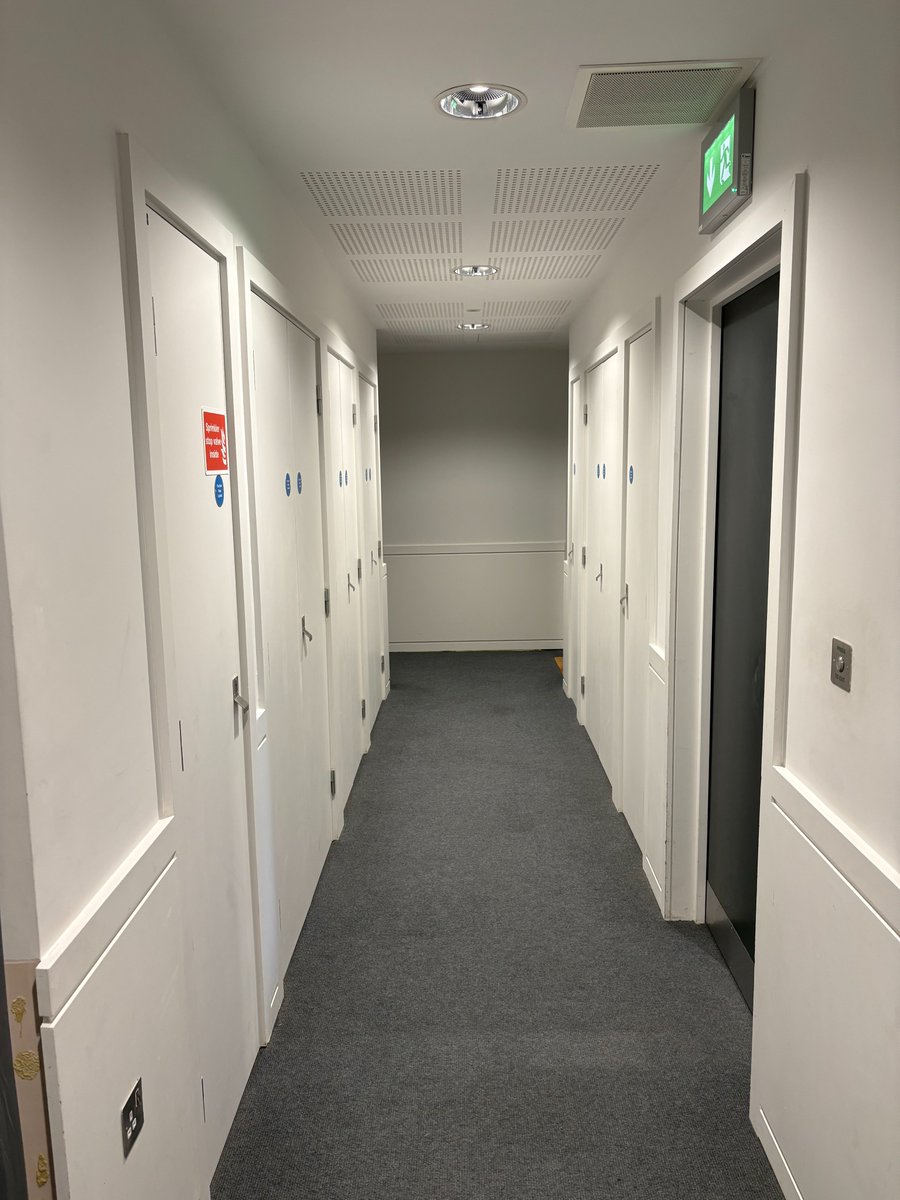
The second photo is from a "stunning" and "beautifully presented" new apartment building in London.
Backrooms (and similar films/shows like Severance) prove that the way we design most interiors is genuinely frightening and bad for our psychological health.
Grey carpets, grey chairs, plain walls, plain furniture, square ceiling tiles, and bright lights are not good for our humanity.
But what's strange is that these bland environments (and similar bland commercial/public spaces) are actually "better" from a certain point of view.
Everything here is supposedly "cheaper" than the alternatives and also better for maintenance (i.e. less work to maintain).
In other words, bland design is more "cost-effective", and because being "cost-effective" is what we value most... this is what we end up building everywhere, even though nobody particularly wants it.
If these places had warmer colours, maybe even some pattern, cornices, mouldings round the doors etc. then they would be more expensive, but they'd also be less damaging to our psychological health.
What makes people less stressed and less anxious is obviously better in the long-run, but it's harder to put on a spreadsheet and therefore it isn't usually factored in.
And so "more expensive" or "harder to maintain" aren't absolutes so much as expressions of priority; the initial cost of material is lower (e.g. standard pure white paint or standard LEDs) but the long-term cost to human joy, peace of mind, and happiness is way higher.
To put all of that another way: the only reason an aesthetic is disconcerting/frightening in films is because they're disconcerting/frightening in real life, and yet we keep using those aesthetics to design the world we're all actually living in!
In shadow work, there’s an idea that every virtue or way of being has its own shadow.
Kindness has the shadow of people pleasing.
Niceness has the shadow of repressed anger, and so on.
But it’s equally true that every dark trait points to a source of light.
As an example, let’s take a look at jealousy.
We normally think of jealousy as simply a bad energy that we should straightforwardly uproot from our psyche.
But really, jealousy is a close cousin to compassion.
Jealous people actually care a lot about other people.
They are very sensitive to what is going on in other people’s lives.
They feel other people’s successes and joys very strongly.
They are very good at noticing when good things are happening to other people.
The misalignment is just that they want fewer good things in other people’s lives rather than more.
But the pre-existing sensitivity they have to other people’s happiness is actually a great asset for developing compassion.
They already have all the feeling, sensitivity and attunement to others in place.
They simply need to channel it towards wanting more good things for others rather than less.
It’s why it can be a mistake to simply develop an attitude of shame or rejection towards our seemingly darker emotions.
Almost always, there is a beauty to the energy of the emotion that simply needs to be excavated, rehabilitated and redirected.
In my experience, there is actually no emotion that doesn’t have light latent within it.
Anger, hatred, shame, fear, confusion - all of them have light nested within them.
Actually, the very concept of a shadow implies a source of light that is being blocked.
Indeed the shape of any shadow gives us a clue as to where the light source is.
Likewise in our internal psyche, we can think of our dark emotions simply as places inside us where our light is getting blocked.
Our task then is not to somehow annihilate our shadows but rather to bring them sufficiently into awareness that they point us towards the light.