Science is like assembling a mosaic: each person contributes a few small, unique pieces. Some refine one piece until its flawless, others discover entire fragments that seamlessly interlock, and sometimes a giant steps back, discerns a new structure and enables the completion of large sections of the puzzle
and made predictions for upcoming TolTEC survey on 50m LMT telescope. Using the large suite of FLAMINGO project, we also discuss the effect of various galaxy formation prescriptions and cosmologies. Thank you Celeste and Antonio.
Link: https://t.co/HmCi87n62K
Happy to share 😊 our paper on the modelling of submillimeter galaxies (SMGs) in state-of-the-art cosmological simulations (EAGLE, IllustrisTNG, and FLAMINGO). We tested various models to robustly model submillimeter flux in large-volume simulations.
GALAH DR4 is now public! 10 years of observations, 995 nights (incl. rainy/snowy/cloudy ones), 32 elements (incl. nitrogen), 0.92 Mio. stars, 1.09 Mio. spectra, thanks to an amazing group of observers, engineers, and astronomers. Paper: https://t.co/ns5LWbJ88h with links to data.
What do we learn from this map?The galaxy distribution tracks the subtle imprint of baryon acoustic oscillations (BAO), initial pressure waves frozen in after the universe became transparent. This provides a standard ruler at different cosmic epochs. 2/10
🎬Credit: @ClaireLamman
Apart from observations, collaboration aims to utilise cosmological simulations to understand large scale clustering and galaxy formation in depth.
Link: https://t.co/66MUF29boB
Happy to share my first paper from newly joined ODIN collaboration to understand the galaxy formation from their birthplace i.e. proto-cluster using LAEs (Lyman Alpha Emitters) and LABs (Lyman Alpha Blobs).
Unique. That’s what you are.
Not a star, not a planet — a brown dwarf is an object that falls in between. Within the star cluster shown below, Webb observed the tiniest, free-floating brown dwarf ever discovered. More on this record-breaking discovery: https://t.co/011SFIiRhe
The project, with a budgetary estimate of Rs 86 crore, is executed by the Indian Institute of Astrophysics (IIA) through an MoU with the University of Mysore for construction and operation.
The implementation of the @CosmosMysuru project is being carried out under the guidance of the Principal Scientific Advisor, and an advisory board co-chaired by the @PrinSciAdvGoI. (2/n)
#PhD students, don't get discouraged if your studies are too far from an immediate impact or application!
You don't have to do the science that everyone is doing today.
Instead, your today's research can become the CRUCIAL contribution to the science in the far future.
▫️
Here are some example:
1️⃣ In 1970s, Saul Teukolsky was a PhD student at Caltech and worked an entirely hypothetical problem that had no connection with reality - perturbation of black holes.
In 2016, scientists reported gravitational waves from merging black holes. After that, his old PhD work became quite popular because black holes finally became experimentally measurable objects.
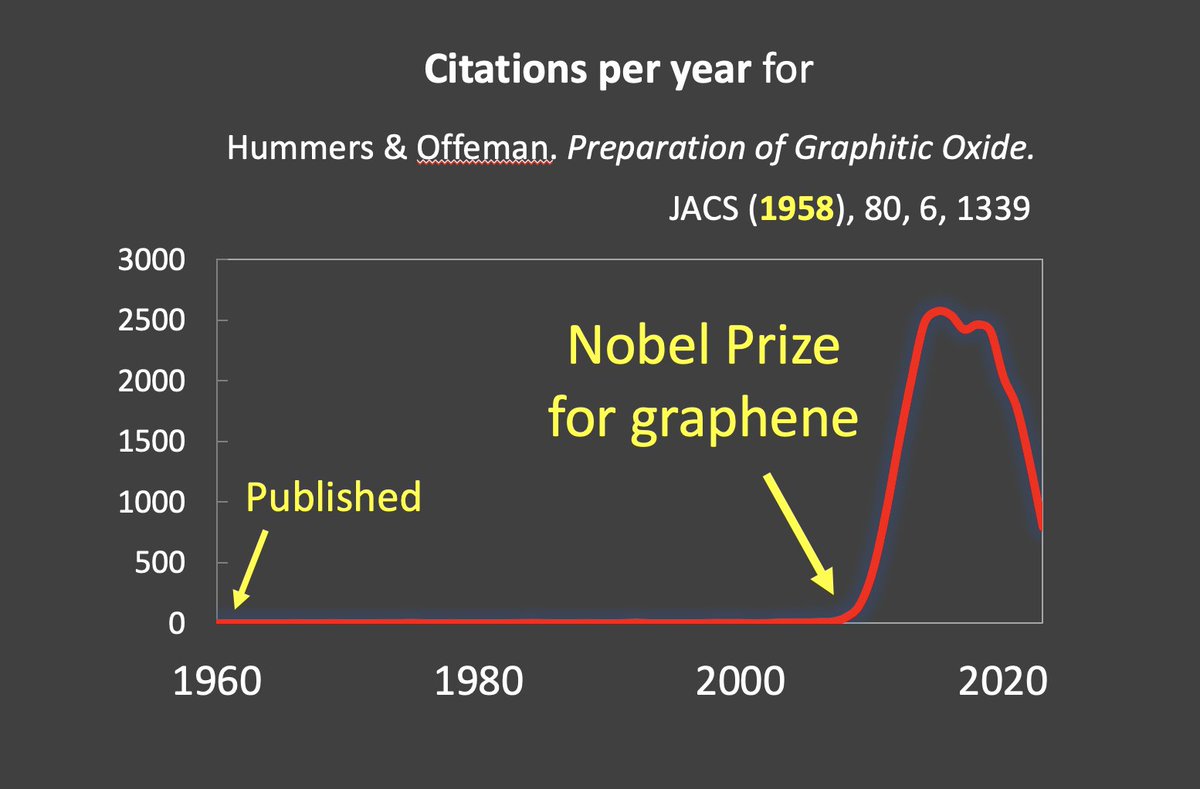
2️⃣ In 1958, Hummers published a method to prepare graphite oxide. No one seems to have been noticing it until a Nobel prize was awarded for graphene in 2010. Now, this is cited >25,000 times.
▫️
In #science, it’s pretty rare for your work to have a real immediate impact.
Impact often takes time.
This is why it’s important to be driven by curiosity.
Without curiosity, previous generations wouldn’t have made so much progress.
Exploration of the unknown, hypothetical theories and "weird" experiments from the past largely make the science of today possible.
#AcademicTwitter
We need to stop this nonsense. It started because academics are evaluated by the 'number' of papers (or 'h-index'). Evaluation must be based on one or two papers, and judge academics by their contribution in those work, novelty of their ideas and impact of the work in general.
This got me thinking. If 'gravity' is not mentioned in the question, is the work done in throwing a ball vertically upward positive or negative? I think the class 10 student is not wrong at all. Question is ambiguous, but loved the spirit of this boy.