Most people think AI runs on GPUs.
That's like saying the internet runs on browsers.
Modern AI is powered by an entire ecosystem of processors:
🧠 CPU → Coordinates everything
⚡ GPU → Trains massive models
🔷 TPU → Accelerates tensor operations
📱 NPU → Brings AI to phones & laptops
🚀 LPU → Delivers ultra-fast LLM responses
🌐 DPU → Handles networking, security & data movement
The interesting part?
Every AI breakthrough depends on ALL of them working together.
A trillion-parameter model is useless if:
• Data can't reach it fast enough
• Inference is too expensive
• Edge devices can't run it
• Infrastructure can't scale
The next AI race won't be won by the best model.
It'll be won by whoever builds the best compute stack.
Models get the headlines.
Chips run the world.
Which processor category do you think will see the biggest growth over the next 5 years? 👇
10 WAYS TO PLAY ROBOTICS IN 2026
1. $TSLA building one of the most vertically integrated humanoid stacks combining Optimus Gen 3 hardware, its in-house AI5 inference chip & same FSD-based AI brain powering its vehicle fleet.
2. $NVDA platform layer for entire robotics industry with Isaac GR00T foundation models, Cosmos world models for synthetic training data & Jetson Thor on-board compute.
3. $PLTR Foundry & Warp Speed run mission control layer for robotic & autonomous fleets by turning sensor data & machine telemetry into a single deployable operating picture.
4. $OUST leading public pure-play in 3D digital lidar where Rev8 native-color sensor line is now shipping to $GOOGL & Volvo Autonomous while being integrated directly into Nvidia Jetson robotics stack.
5. $AVGO supplies custom networking silicon, Tomahawk + Jericho switching ASICs & high-speed connectivity that move data between every robot, sensor & server in autonomy stack.
6. $AVAV, $KTOS, $AVEX & $ONDS are building the UAV drone fleets that feed into the autonomous defense networks.
7. $QCOM provides Snapdragon Ride autonomous platform & on-device AI inference SoCs that power the perception, decision & motor-control loops inside robots, drones & vehicles.
8. $SYNA Astra multimodal edge AI processors run wireless connectivity & sensing inside smart appliances, factory automation & autonomous robotic systems with Core IoT product sales growing 31% YoY.
9. $ISRG, $PRCT, $SYK & $MDT bring surgical robotics that are reshaping operating rooms.
10. $AMZN deploys hundreds of thousands of warehouse robots to move & pick goods while $SYM & $SERV build the autonomous mobile robots that power fulfillment & last-mile retail logistics.
$AMZN AWS, $MSFT Azure & $GOOGL cloud have already won scale but $ORCL is winning speed.
The real takeaway is Oracle carving out a lane where AI infrastructure meets traditional enterprise demand.
Consumer product businesses tend to have high returns on capital due to their ability to leverage brand power to charge higher prices than their competitors
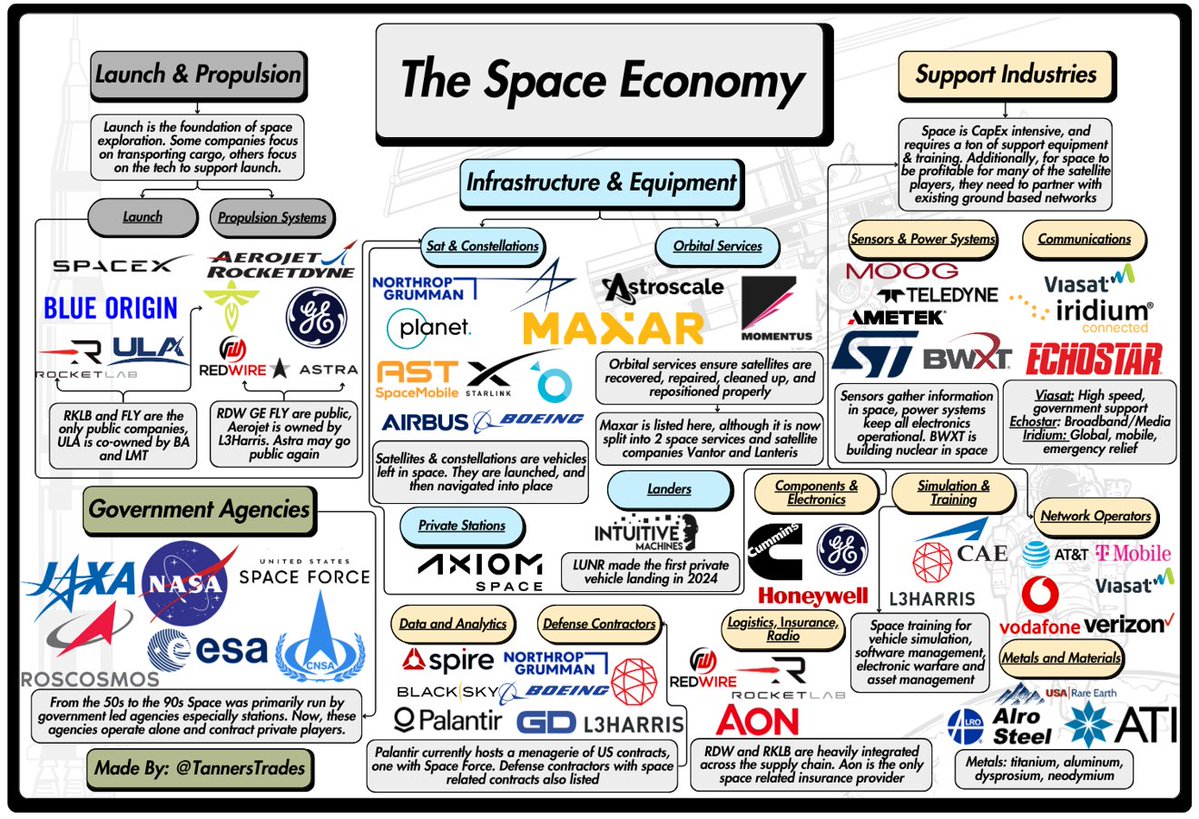
What is The Space Economy?
In the graphic below, I have laid out:
- Launch and Propulsion: $RKLB $FLY $GE SpaceX
- Satellites: $PL $ASTS $BA $MNTS
- Components: $CMI $HON
- Data Analytics: $BKSY $PLTR $SPIR
- Materials: $USAR $ATI
- Comms: $VSAT $IRDM $SATS
- Networks: $VZ $T $TMUS
- Defense: $NOC $LMT $LHX
- Sensors & Power: $MOG.A $STI $BWXT $TDY
If you enjoyed, be sure to bookmark this for later use!
I just updated the Dividendology Covered Call ETF Database.
It provides in depth data on 65+ covered call ETFs.
You can download it for free here: https://t.co/3HmU6uGwAA
JPM published a table with the 27 themes that they intend to invest their $1.5 trillion over the coming years. Which line item would make a viable new ETF? It wouldn't be the first time WisdomTree launched a product from crowdsourced feedback. Thanks to all for engaging.
Q3 earnings season kicks off this week with Wall Street analysts unusually optimistic, projecting 8% S&P 500 EPS growth. The tech sector is expected to lead with +20% growth, fueled by AI. All eyes are on big bank reports for clues on dealmaking and credit health. @ChristineLShort's full Q3 preview: https://t.co/xbfuw6gRMK #Earnings #Investing #StockMarket #Economy
The Q3 earnings season kicks it into high gear next week with 1k+ companies set to report. After some initial commentary this week from the banks we'll see what the first round of tech names have to offer. Watch for: $NFLX, $TSLA, $BRK, $SAP, $GE, $KO, $TMUS, $PM, $RTX, $TMO, $T, $LRCX, $GEV, $TXN, $BSX and many more. #earnings #tech #mag7 #investing #trading #stockmarket #stocks
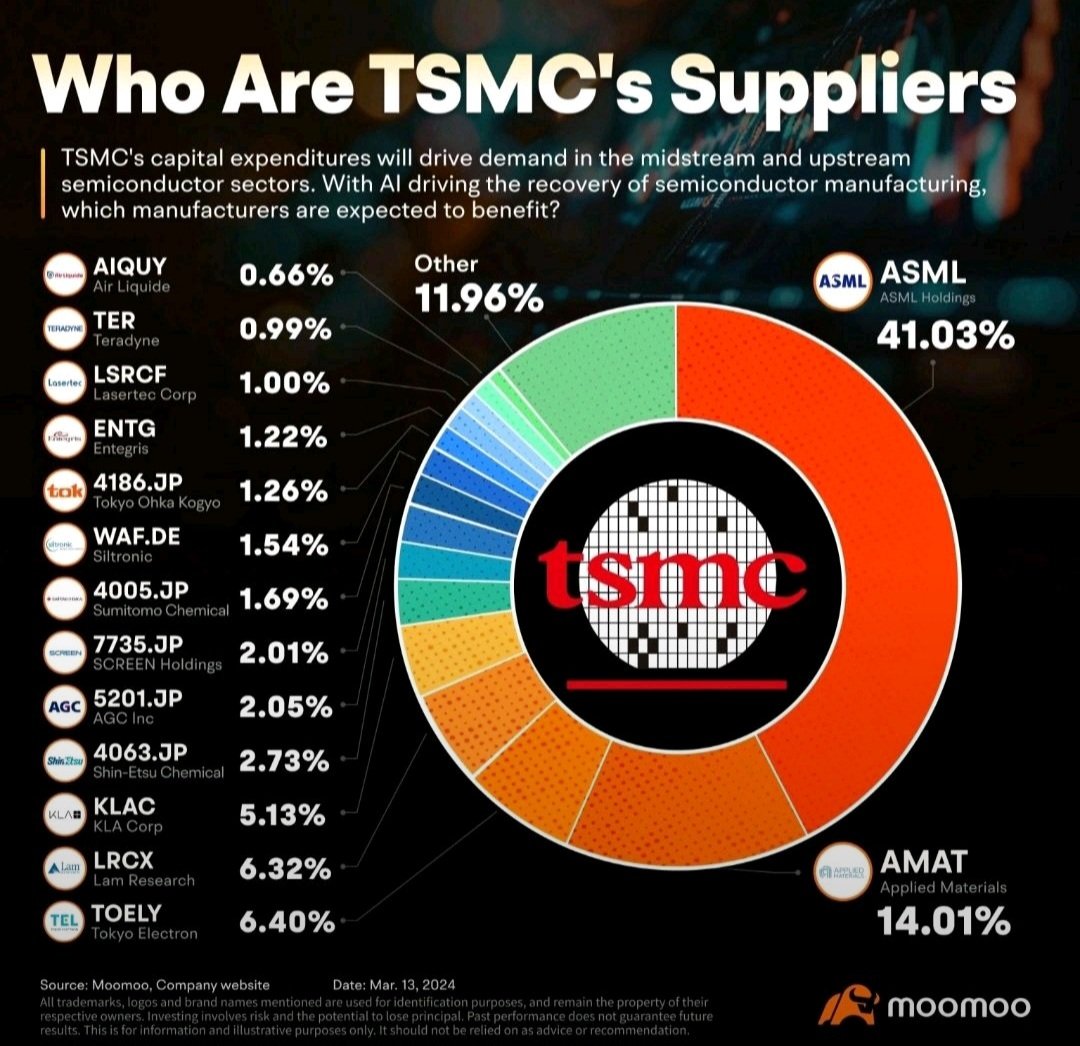
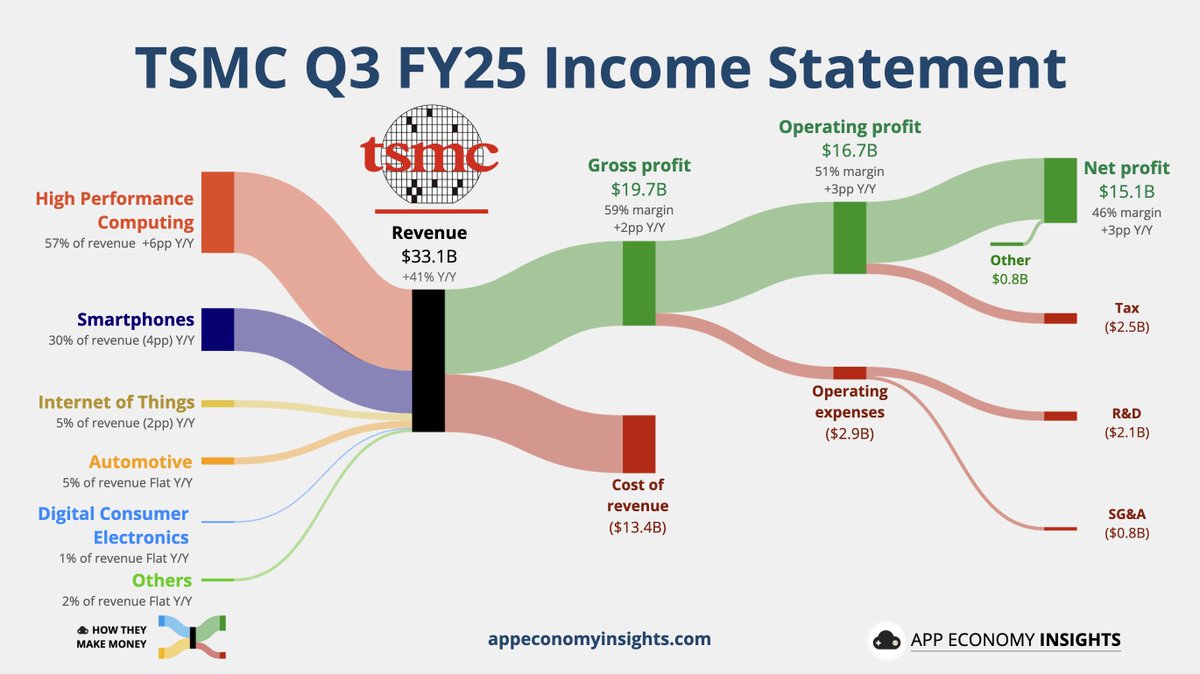
Taiwan Semiconductor $TSM, the world's largest contract chip manufacturer, reported record Q3 net profit of $14.76 billion, soaring 39.1% year-over-year.
It also raised its full-year sales growth forecast, citing strong AI-driven demand.
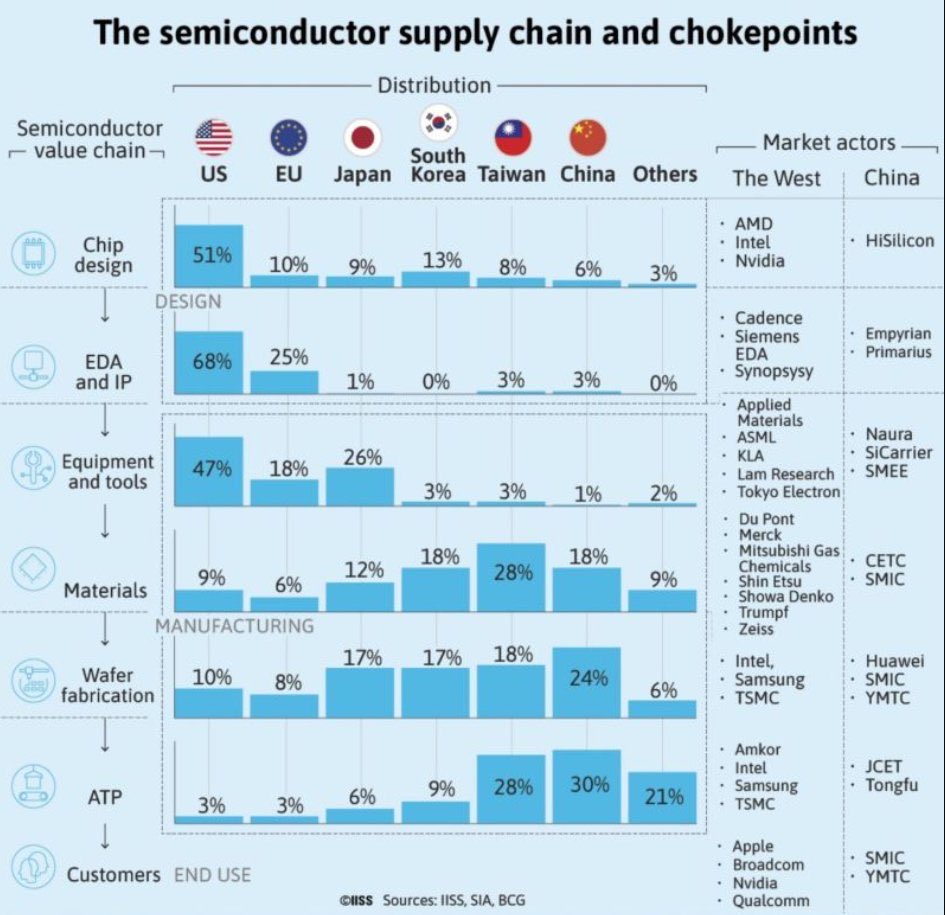
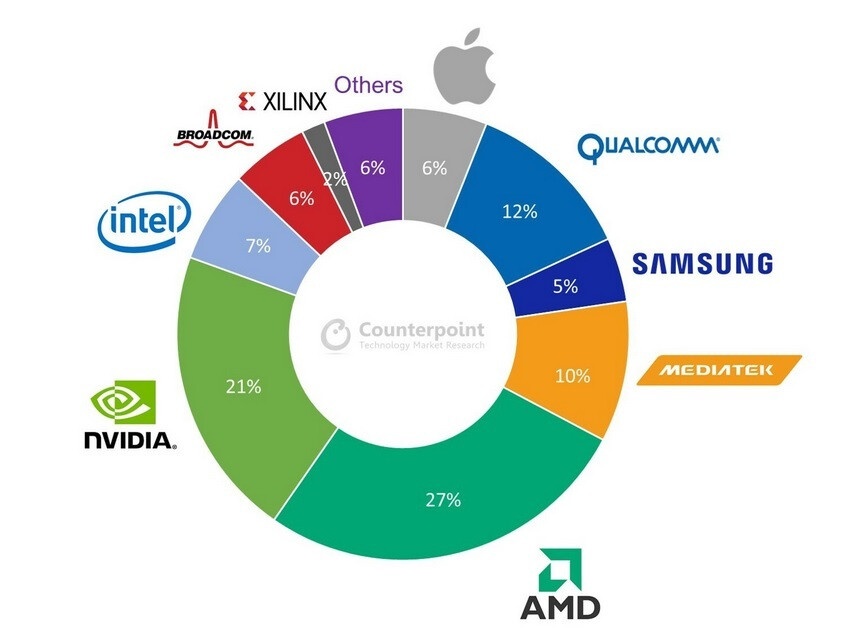
Taiwan Semi's main customers include AMD $AMD, Nvidia $NVDA, Qualcomm $QCOM, Intel $INTC, Apple $AAPL, and Broadcom $AVGO.
Cybersecurity Is Quietly Becoming the Most Powerful Growth Story in Tech
The global cybersecurity market is now estimated between $225B–$300B for 2024–2025, making it one of the largest and fastest-growing segments in all of technology. According to Gartner, end-user security and risk management spending will hit $212B in 2025, up ~15% YoY.
But here’s the question: can gross margins stay resilient as vendors chase more use cases and offer more bundled deals?
Analysts expect revenue growth in FY 2026 from $NET (+26%), $RBRK (+26%), $CRWD (+22%), $S (+21%), $ZS (+20%), and $CYBR (+19%).
Mid-tier expectations are set for $PANW (+13%), $FTNT (+12%), $OKTA (+9%).
Lower growth forecasts include $GEN (+5%), $CSCO (+5%), and $FFIV (+11%) are still growing, but at a slower pace.
The next wave of growth may come from structural shifts—cloud-native dev, DevSecOps, and AI-first security architecture. Identity is quickly becoming the control plane, with IAM, PAM, CIAM, and phishing-resistant auth forming the backbone of modern security infrastructure.
Next, we’ll break down valuations relative to growth expectations, highlight key product differentiation, and evaluate strategic advantages of the fastest-growing players shaping the next wave of cybersecurity leadership.
A short 🧵👇