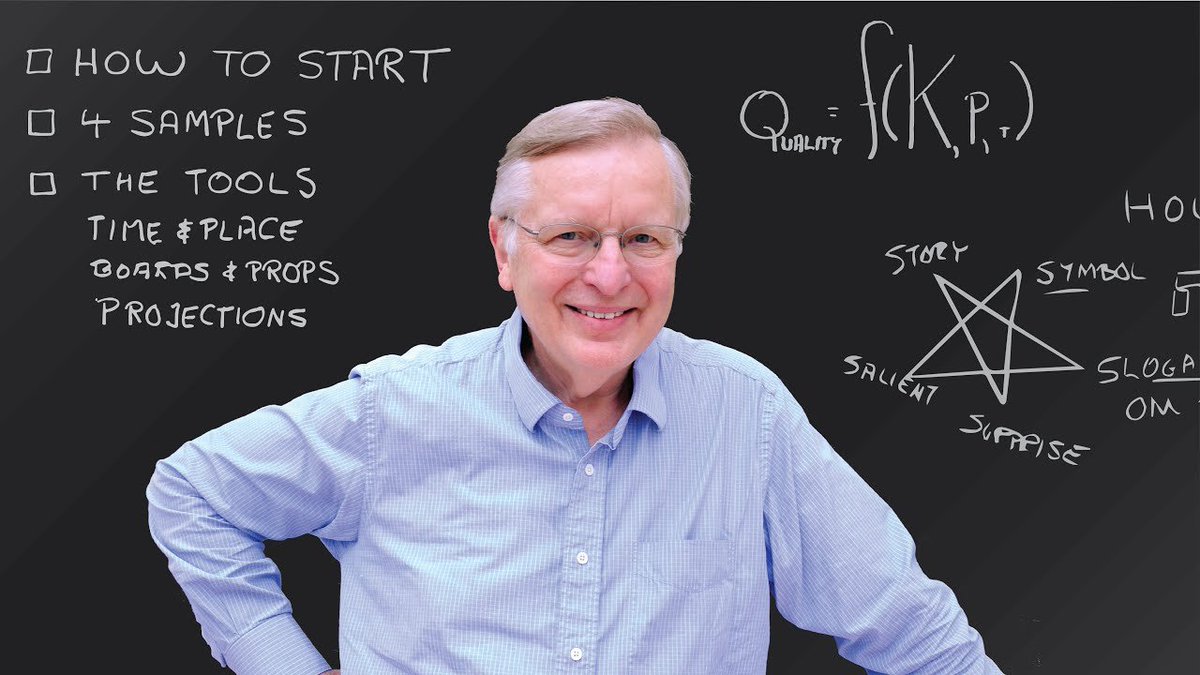
A MIT professor taught the same lecture every January for 40 years, and every single time it was standing room only.
I watched it at 2am and it completely rewired how I think about communication.
His name was Patrick Winston. The lecture is called "How to Speak."
His opening line hit like a truck: your success in life will be determined largely by your ability to speak, your ability to write, and the quality of your ideas in that order.
Not your GPA. Not your pedigree. Not your IQ. How you speak is what separates people who get heard from people who get ignored.
Here's the framework he drilled into MIT students for four decades.
He said never start with a joke. Start by telling people exactly what they're going to learn. Prime the pump before you pour anything in. He called it the "empowerment promise" give people a reason to stay in their seats within the first 60 seconds.
Then he broke down the 5S rule for making ideas stick: Symbol, Slogan, Surprise, Salient, and Story. Every idea worth remembering hits at least three of these.
The part that floored me was his "near miss" technique. Don't just show what's right show what almost looks right but isn't. That contrast is when the brain actually locks something in permanently.
His final rule before any big talk: end with a contribution, not a summary. Don't recap what you said. Tell people what you gave them that they didn't have before they walked in.
I've used this framework in pitches, interviews, and presentations ever since watching it, and the results are not subtle.
Patrick Winston passed away in 2019, but this lecture is still free on MIT OpenCourseWare. One hour, watched by millions, and it costs absolutely nothing.
The most important class MIT ever put on the internet isn't about code or math. It's about how to make people actually listen to you.
Not just Anthropic.
Here are 10 AI companies offering free courses to master AI for $0.00:
1. OpenAI: https://t.co/vZfOZi1HAJ
2. Google: https://t.co/NNWRJ8IkML
3. Microsoft: https://t.co/vcLLEglZAS
4. NVIDIA: https://t.co/Oo87jDmYmN
5. DeepLearningAI: https://t.co/Bq3F0djPCf
6. Meta: https://t.co/E04sIRM89Z
7. AWS: https://t.co/1yIbeAiO4D
8. IBM: https://t.co/lC4g3QrQuQ
9. Hugging Face: https://t.co/04y9Xvq3Mu
10. Stanford: https://t.co/ybkRhG2v8I
Most people pay for AI courses.
But the real ones are actually free.
Mark Cuban just pronounced software dead, and the implications will destroy industries before most people understand what happened.
Cuban: “Software is dead because everything’s going to be customized to your unique utilization.”
Rigid SaaS dies. Businesses stop bending to static tools. AI molds around needs in real time.
Value chain shatters. Decade of value going to generalist builders ends. Transfers to customizers who translate capability into advantage.
Next trillion comes from customized intelligence sold to “33 million companies” too small for giants to service.
Software-as-a-Service over. Service-as-Software owns everything.
Cuban: “33 million companies aren’t going to have AI budgets, aren’t going to have AI experts.”
Problems exist. Data exists. The bridge doesn’t.
Cuban: “Learn all you can about AI but learn more on how to implement them in companies.”
Market bifurcates into builders and integrators. Integrators capture value builders can’t touch.
Cuban: “Every single job available for kids coming out of school because every single company needs that.”
Technical translator becomes the only role that matters. Contextualizing AI for specific use cases becomes more valuable than building AI itself.
Learn “the difference between Sora and Veo” and “how to customize a model” and you modernize any legacy business’s economics faster than they can process.
Alpha isn’t the model. Alpha is applying it to contexts nobody else understood well enough to solve. There are 33 million businesses waiting for that person who doesn’t exist yet.
To be very, very clear: I didn’t write this to scare people.
I just think it’s our duty (those of us in the AI space) to share what we’re seeing so people at least have a sense of what may be happening.
Even if there’s a small chance things play out like I, and many others, expect, people have the right to know in advance so they can at least spend a little time thinking about it and preparing.
This has gone way more viral than I ever possibly imagined… and the reaction to it is much more extreme than I expected.
It’s very possible we will be entering a very weird, new world in the coming years (or we may not!) and I think it’s important that people spend at least a little time thinking about what this might mean for them, and how they should prepare.
If nothing else, I’m glad this article got people talking about this stuff.
Turnkey Vinyl Record Collection ~400–450 LPs + 2 Vintage Turntables
Asking $1,200 OBO sold as a complete bundle
8 organized crates with heavy-duty tubs included.
Turntables power on and function buyer will need to install new needles/cartridges (inexpensive and widely available
Satisfaction does not come from eliminating struggle. It comes from engaging with it.
Satisfaction is often misunderstood. It is not the pleasure of avoiding effort. It is the deeper joy that comes after working toward something that matters. It is the feeling we get when we accomplish a goal that required patience, sacrifice, and sometimes real discomfort.
Humans are unusual in this way. We are built to take on challenges. We lean into effort because the reward that follows feels more meaningful. When we try to remove every difficulty from our lives, we unintentionally reduce our capacity for satisfaction.
Modern culture makes it easy to assume that anything uncomfortable should be stopped. But discomfort is not always a danger signal. Often, it is simply part of the process that helps us grow and makes the achievement itself feel worthwhile.
Think back to school. An A earned through shortcuts does not feel the same as an A earned through hard work. One gives you a moment of pleasure. The other gives you pride and a sense of progress. The same pattern shows up again and again in adult life. The goals that shape us most usually require effort and persistence.
Struggle, when directed toward something meaningful, is not an obstacle to satisfaction. It is the path to it.
"The most important thing in the next 3-4 years is data centers in space.
In every way, data centers in space, from a first principles perspective, are superior to data centers on earth.
In space, you can keep a satellite in the sun 24 hours a day. The sun is 30% more intense, which results in six times more irradiance than on Earth. So you don't need a battery.
The cooling in these data centers is incredibly complicated. Space cooling is free. You just put a radiator on the dark side of the satellite.
The only thing faster than a laser going through a fiber optic cable is a laser going through absolute vacuum. Link satellites with lasers, and you have a faster and more coherent network than any data center on Earth."
https://t.co/fvu0FbjsUh
This, and escalating powerful, badass, talented people, towards achieving their goals, and reaching for their dreams,... is why I have dredged through the hardships that I have, perhaps. Escaping the B.S. and the potholes that mess with alignment, and hel
Today Mark Zuckerberg admitted in writing that the Biden Admin pressured Facebook to censor Covid-19 content.
Here is Mayorkas lying about it under oath in 2022. 100% absolutely committing perjury. When is Mayorkas going to prison?
In his letter, Zuckerberg acknowledges that senior officials from the Biden Administration, including the White House, repeatedly pressured Meta to censor certain COVID-19-related content, such as humor and satire. This admission is troubling for several reasons. First, it suggests that Meta's content moderation policies may not be entirely based on objective criteria or community standards but can be swayed by external governmental pressures. The decision to remove or demote content under governmental urging could undermine the platform's claim to neutrality and fairness, leading to concerns over censorship and the suppression of free speech.
Moreover, Zuckerberg's regret that Meta was not more outspoken against these pressures points to an internal conflict within the company about how to handle government demands. If Meta, one of the world's largest social media platforms, is willing to modify its content policies in response to government pressure, this sets a dangerous precedent for other tech companies. It also raises fears about the erosion of a free and open internet, where information flows without undue influence from powerful entities.