Introducing In-Context Module discovery (ICM): interpretable gene modules for comparing cell states across datasets. ICM is the latest advance for our virtual cell modelling framework: Parthenon.
ICM learns from primary human cells across 66 datasets and adapts its modules to new contexts without retraining.
In microglia, ICM recovers known state signatures, reveals unexpected cellular features in experimental models, and helps explain why a specific perturbation strongly shifts gene expression in one model and barely in another.
This gives biologists better tools choose perturbations and design better in vitro experiments.
Introducing Pleiades-Neuron: a new model that can identify neuronal cell-free DNA in blood, achieving a part-per-million threshold.
When neurons die, they release fragments of DNA into the bloodstream but at extremely low concentrations.
Our model distinguishes neuron-derived cell-free DNA at levels as low as one part-per-million. It is 4.4× more sensitive than existing methods, and in early tests across patient samples demonstrated utility across a number of brain-related conditions.
Performance improved as we scaled the size of our training corpus. It also improved with model size, with no plateau yet based on probing experiments up to 7B parameters.
This could enable simple blood tests for earlier detection, prognostic monitoring, and treatment response determination in diseases of and injuries to the brain.
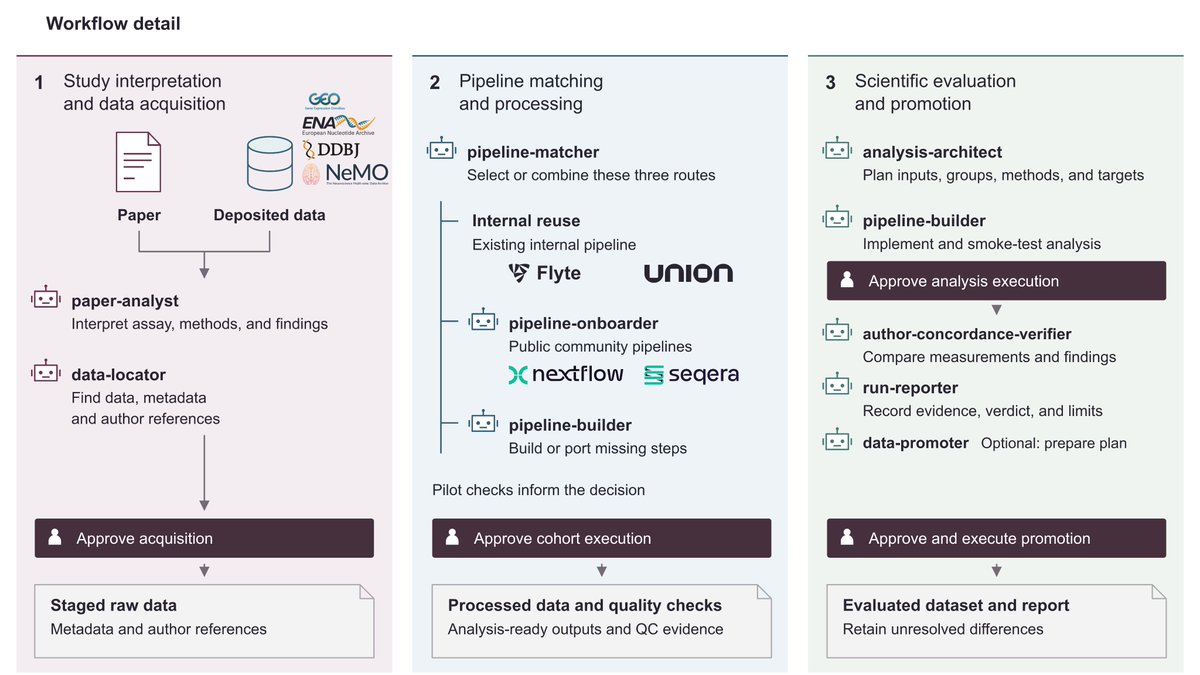
Published biology can take weeks or months to turn into usable training data and new evals.
Our Prima Daedalus agents do it up to 10× faster, and 89% lower estimated cost. They reproduce papers, beat published results, and find previously overlooked biology.
We are excited to announce that @nvidia has committed to an investment in @PrimaMente.
Built upon years of close collaboration, this investment deepens our partnership and strengthens our ambition to tackle complex diseases.
Neurodegenerative diseases such as Alzheimer’s, Parkinson’s, and ALS remain among medicine’s greatest unmet needs. Making real progress requires global coordination around data, foundation models, and experimental and clinical validation.
We are grateful to @nvidia for their commitment and look forward to deepening our partnership as we pursue breakthrough discoveries for these diseases, and beyond.
@evoclock@PrimaMente Yeah bespoke pipeline and methods were the biggest issue second to differing annotations and references. We enforce consistency across same assay works and technologies so we can use these in our pre training datasets. However this change adds some divergence against authors
@VictorAkinode@PrimaMente Indeed, in our setup every intervention logged into a database and rule set in place. So far our interventions are divided into about 8 categories. We have plans to open source this DB in the future as we update the system.
We'll open-source Prima Daedalus very soon!
Read the full technical piece here: https://t.co/dy0JrrUvO7
Work by @GanbatJay and @fmmartinz, with thanks to @union_ai, @SeqeraLabs and @nebiusai for the infrastructure behind it.
This is the first of several deep dives into how we build at @PrimaMente. More soon.
Silico, the platform for ambitious AI research, is publicly available today.
AI is advancing fast. The tools to understand it need to advance even faster. Silico lets you interpret and train your models at frontier scale.
Learn more + get access 🧵
1/ Today we announce Pleiades, a series of epigenetic foundation models (90M→7B params) trained on 1.9T tokens of human methylation & genomic data. Pleiades accurately models epigenetics for genomic track prediction, generation & neurodegenerative disease detection from cfDNA, outperforming previous pure DNA baselines.
Our customer @PrimaMente is using Nebius to train Pleiades, the first foundation model based on the chemical language of DNA methylation — with variants of 90M, 600M and 7B and pre-training on 1.9T tokens.
At @NVIDIA#GTCParis and @VivaTech, co-founder @ravi_sola shared more.