It's not you, it's the platform. I've been taking a break from Twitter/X. You can follow me at https://t.co/zEUSrt3frW for unfiltered stuff, https://t.co/lx05EC1yWk for brags, or https://t.co/aqyRyNJW7L
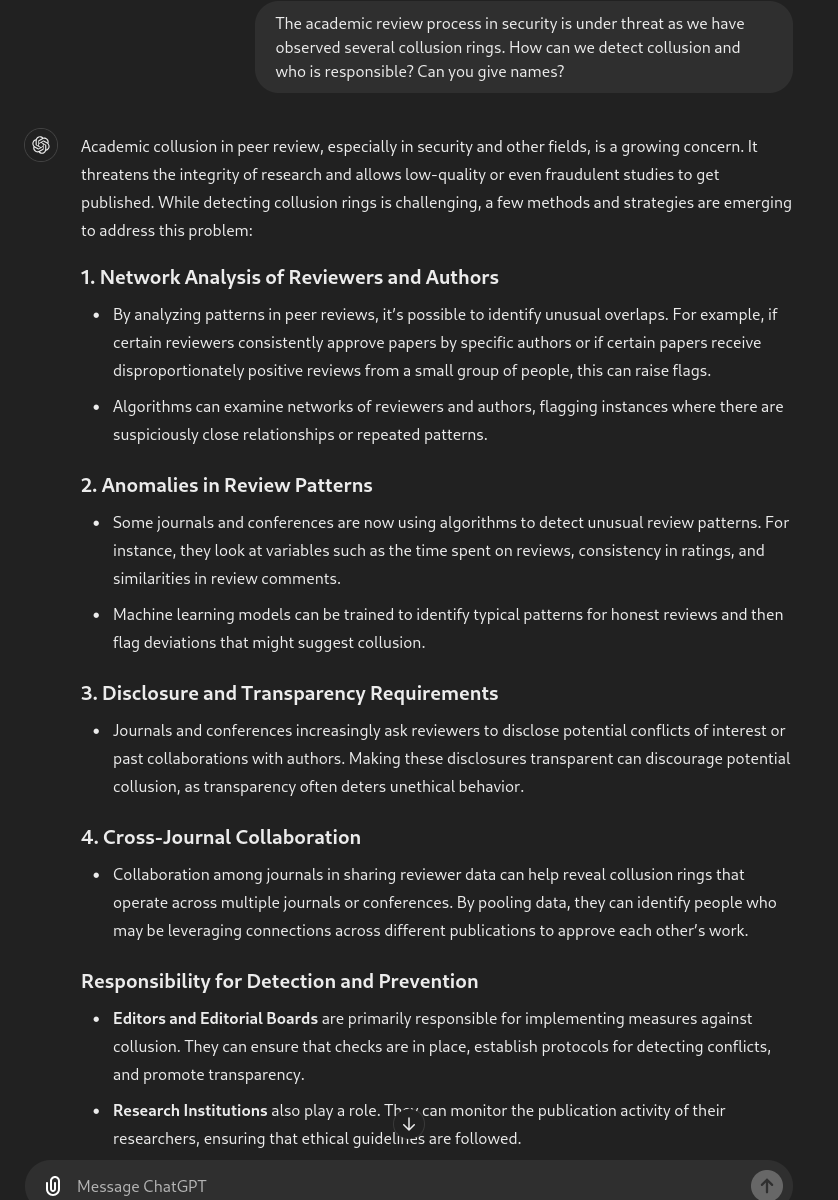
@thegrugq@TheOfficialACM ChatGPT tells me to run algorithms and machine learning to detect collusion and other malicious review patterns but it refuses to give me names. ChatGPT is not snitching!
The review process is under threat and we must make it resilient against adversarial attacks. Proud to be part of @TheOfficialACM PROTECT where we'll look into securing academic reviewing https://t.co/zWBSv0GjYn
@bsdaemon My guess is that you can almost fully automate the generation of test cases and mock environments. That's already saving a lot of time and could map to the 1/4 of new code.
I'd argue the opposite. General purpose grey box fuzzing research is complete as it is no longer feasible to distinguish between optimizations and over-fitting. Per-target optimizations should be left as an engineering exercise.
Are general-purpose fuzzing research dead? Our answer is probably no. Check our new fuzzer work FOX.
The awesome fuzzer @aflplusplus is already super-powerful and quite an effective baseline in academics and industry. But there is still room to improve upon. We introduce FOX (CCS 2024), a new general-purpose fuzzer. We formulate the fuzzing as a scholastic online control problem and advance the performance of AFL++ by up to 26.45% in real-world standalone programs and 6.59% in FuzzBench programs. Check our talk at CCS'24 @acm_ccs, fuzzing session 1, Oct 16th, 1:30 PM – 3:00 PM, at Grand Ballroom Salon F.
Paper: https://t.co/rBYhV92elA
Code: https://t.co/m5rp242Kwz
@is_eqv That's the issue: papers get accepted if they improve over AFL++ in the first 24hrs on existing benchmarks. I.e., they over-fit. Then throw in a few MITRE-assigned CVEs to round off the research paper. Long term, these papers will not improve that status quo (much)
@is_eqv Another beef I have is that we only evaluate the first 24hrs, so or benchmarks only measure the warmup performance while in industry there are large corpora that are fuzzed exhaustively. Most other benchmarks in systems exclude the warmup phase...
Who's around for @acm_ccs? Come say hi if you want to talk about software security, fuzzing, or compartmentalization, just to rant about academia, or grab a Swiss chocolate that I brought along!
Mail from this morning: "we kindly ask you to submit this letter by 15th August 2024 (17:00 CET) at the very latest." BRB, just getting my Delorean's flux compensator warmed up 🏎️🔥