You can generate really good synthesized summaries on very modest hardware. Good enough for pretty much any business operations that don't need code generation.
The most underrated thing in AI right now is that “good enough” local intelligence has arrived.
Gemma 4 12B on a 16GB laptop covers everything everything normal users need.
Unlimited, free forever, and completely offline.
@blockiosaurus@redacted_noah If there's a published onchain IDL you can save a template for any admin singleton functions via the TX builder. Just put the program address into the builder and it will load up the expected ix interface.
Onboard views from Starship and Super Heavy V3, which are equipped with upgraded cameras capable of streaming 4K video through every phase of flight via @Starlink
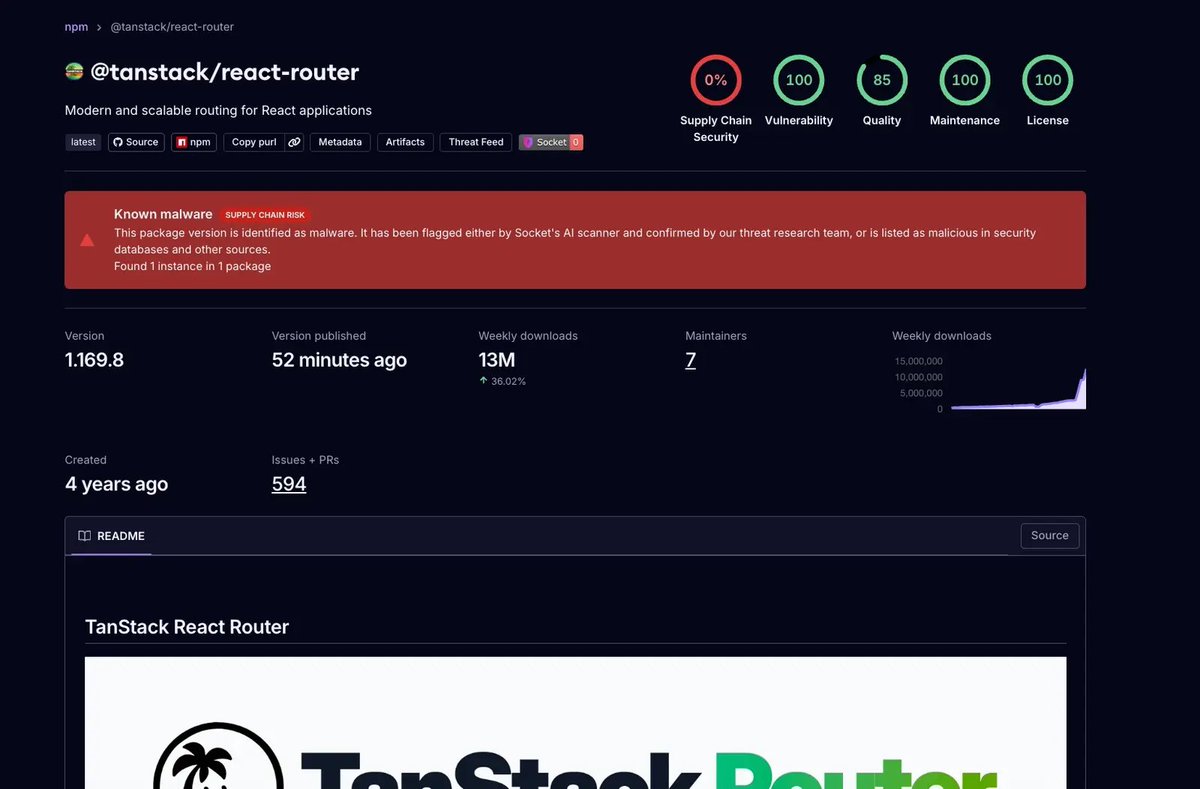
🚨 BREAKING: 84 TanStack npm packages were compromised in an ongoing Mini Shai-Hulud supply chain attack, adding suspected CI credential-stealing malware.
Socket flagged every malicious version within six minutes of publication. This is a developing story.
BREAKING: @anza_xyz Head of Research @TheWattenhofer and his co-authors have received the 2026 Dijkstra Prize in Distributed Computing for their 2011 paper “Distributed Verification and Hardness of Distributed Approximation.”
Every time I see a team celebrating their new "shared module," I remember this lesson.
Reuse is a dangerous form of coupling.
They found the same logic in two places and did what good engineers do: put it in one place and called it a win. Clean, responsible, textbook.
Six months later, someone needs to change it.
Suddenly, a small update for one team's requirements breaks three services, blocks two releases, and triggers an emergency meeting between people who've never talked to each other before.
This is the cost nobody preaches about.
DRY is one of those principles that feels unquestionably right until you apply it across team boundaries. The moment you share a module between domains, you're not just sharing code. You're creating a dependency that nobody owns and everyone resents.
Before you reuse, ask:
Will this change often?
Does it belong to one domain?
Are the consumers truly aligned in purpose?
Will one team’s change surprise another team?
If the answer to any of these is "I'm not sure," stop. Duplicate it.
I know how that sounds. It feels lazy. It feels like the thing a junior developer does before they know better. But here's what nobody wants to say out loud: two independent implementations you control are almost always cheaper than one shared one serving masters with different goals.
Duplication is a local problem. Coupling is an organizational problem.
One of them you can fix in an afternoon. The other requires a meeting with five teams and someone's manager.
Reuse isn't free. Treat it like the trade-off it is.
"We've never had a bank account ourselves. We've operated on our own infrastructure and stablecoins for the last five years."
You'd be surprised how few stablecoin companies can actually say that.
@GarrettHarper_, Head of BD at @altitude / @multisig:
"In the fintech space, everyone is building toward the same thing. They're all building on top of a bank, or they're trying to become a bank themselves. We're taking the complete opposite approach."
"If you build on a programmable onchain account and have stablecoins as a first-class asset, that is how you enable faster speeds, better access, and automation in the long run."
When we met @SimkinStepan and team in November 2022 they told us they don't use banking rails. Now, with @altitude, your business doesn't have to either. Congrats!