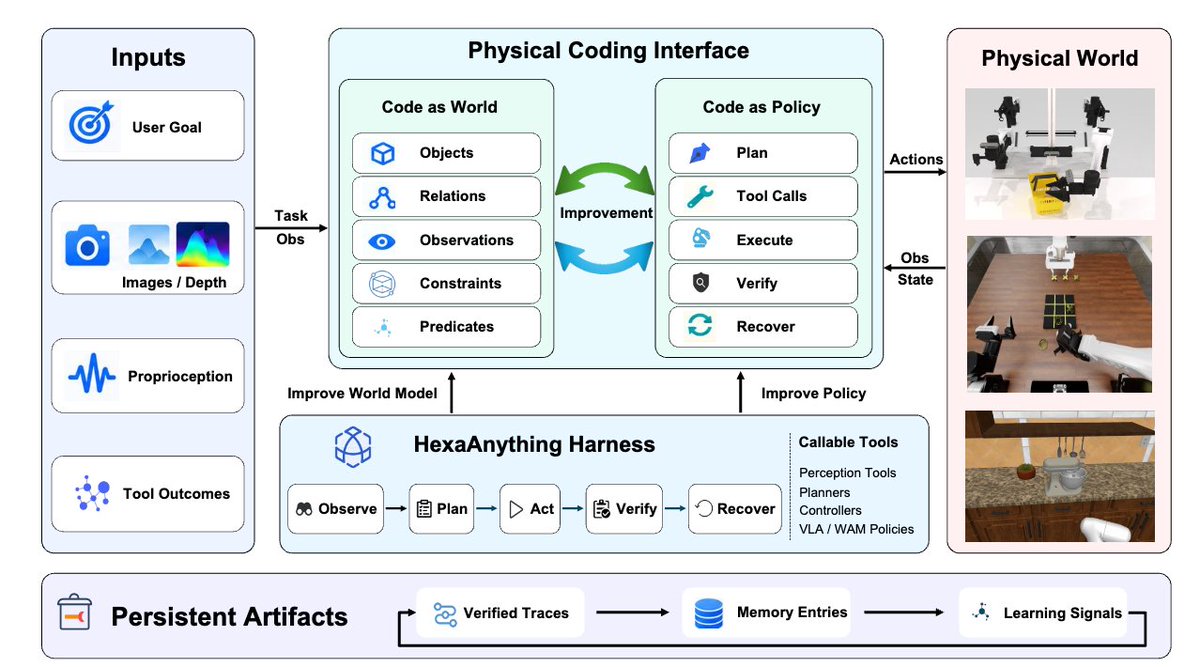
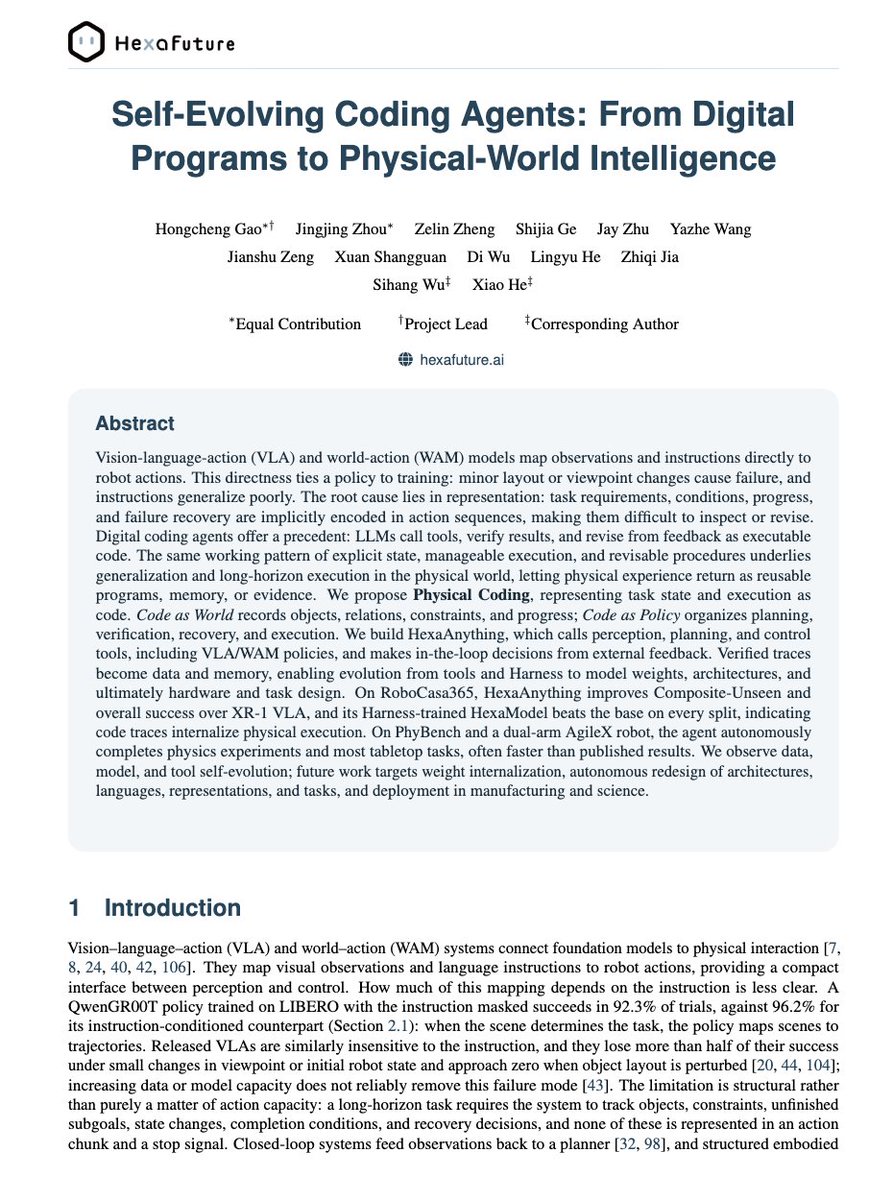
We introduce Physical Coding: agents represent physical-world state and execution policies as code, verify and recover explicitly, and turn validated traces into reusable artifacts for self-evolving physical intelligence.
Our paper: https://t.co/9CUwlAsJ0c
We introduce Physical Coding: agents represent physical-world state and execution policies as code, verify and recover explicitly, and turn validated traces into reusable artifacts for self-evolving physical intelligence.
Our paper: https://t.co/9CUwlAsJ0c
We introduce Physical Coding: agents represent physical-world state and execution policies as code, verify and recover explicitly, and turn validated traces into reusable artifacts for self-evolving physical intelligence.
Our paper: https://t.co/9CUwlAsJ0c
SpatialWorld reveals how poorly multimodal agents reason in 3D space
760 human-annotated tasks across 8 simulators, from kitchens to city streets.
Even GPT-5 only solves 17.4% of them.
We introduce SpatialWorld, a unified benchmark designed specifically for evaluating the interactive spatial understanding of multimodal agents in complex real-world tasks.
Call for Papers: 2nd Workshop on Test-Time Scaling for Computer Vision (ViSCALE) at CVPR 2026! @CVPR
📢 Focus this year: test-time scaling in vision, spatial reasoning, world models, embodied intelligence, and safety.
📅 Deadline: March 10, 2026
🔗 https://t.co/c8pwUum5lP
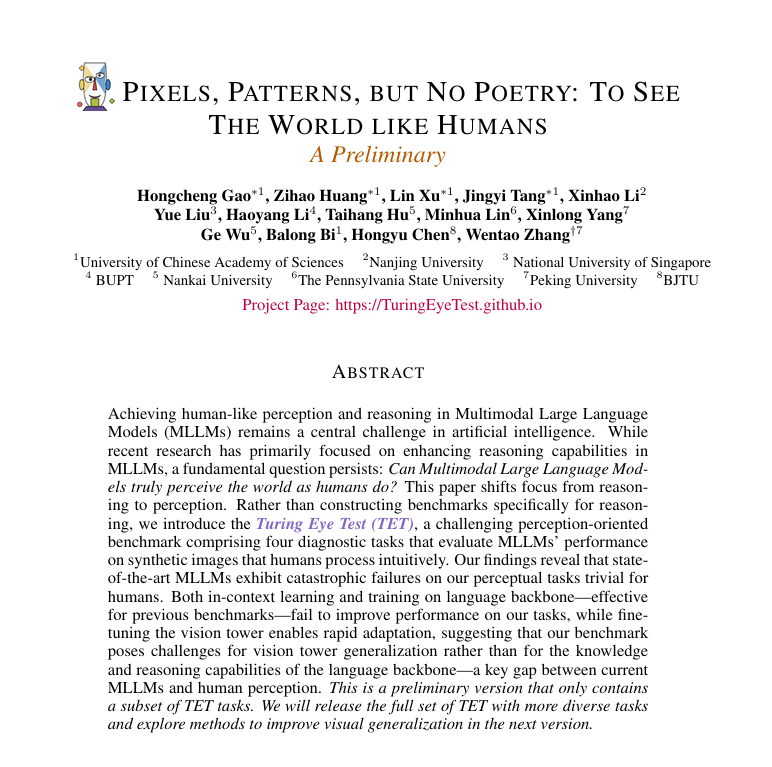
Pixels, Patterns, but No Poetry: To See The World like Humans
Author's Explanation:
https://t.co/bZzSPNBuiX
Overview:
This work introduces the Turing Eye Test (TET), a perception-focused benchmark using synthetic images, to show that state-of-the-art MLLMs exhibit catastrophic failures on tasks trivial for humans.
These performance issues are identified as a failure of vision tower generalization, since only fine-tuning the vision component enables rapid adaptation while adjustments to the language backbone prove ineffective.
Paper:
https://t.co/CeEdtV5yxz
Do models actually "see" the world like humans do?
A recent study from @UCAS1978 and collaborators shows that (surprisingly!) even top AI multimodal models fail at simple visual tasks.
➡️ Researchers shifted focus from reasoning to perception and built a new benchmark - the Turing Eye Test (TET).
TET is about basic visual perception, including tasks that humans can easily solve:
- Finding hidden text inside scenic images
- Reading 3D-style captchas
- Recognizing parts of Chinese characters
- Interpreting color-blindness test charts
But why do AI models fail? There are 3 main issues:
▪️ The models often can’t focus on the right parts of the image.
▪️ Fine-tuning of the vision part is essential for enhancing MLLMs' perception.
▪️ Some tasks, like hidden text, improve with downscaling. This hints that models struggle with how they chop up images.
Overall, these findings point to where multimodal LLMs still need work.
@hantmango We currently have a working solution that finetunes the vision tower with reinforcement learning and it’s already yielding some gains; the updates will be rolled into v2.
Can MLLMs truly see the world like humans? 👁️
We conduct a preliminary study using our benchmark TET 🎯, and found that nearly every SOTA (Claude-4, Gemini, o1, etc.) scores ≈ 0 % on some perception tasks that humans solve effortlessly, revealing a fundamental perceptual gap.