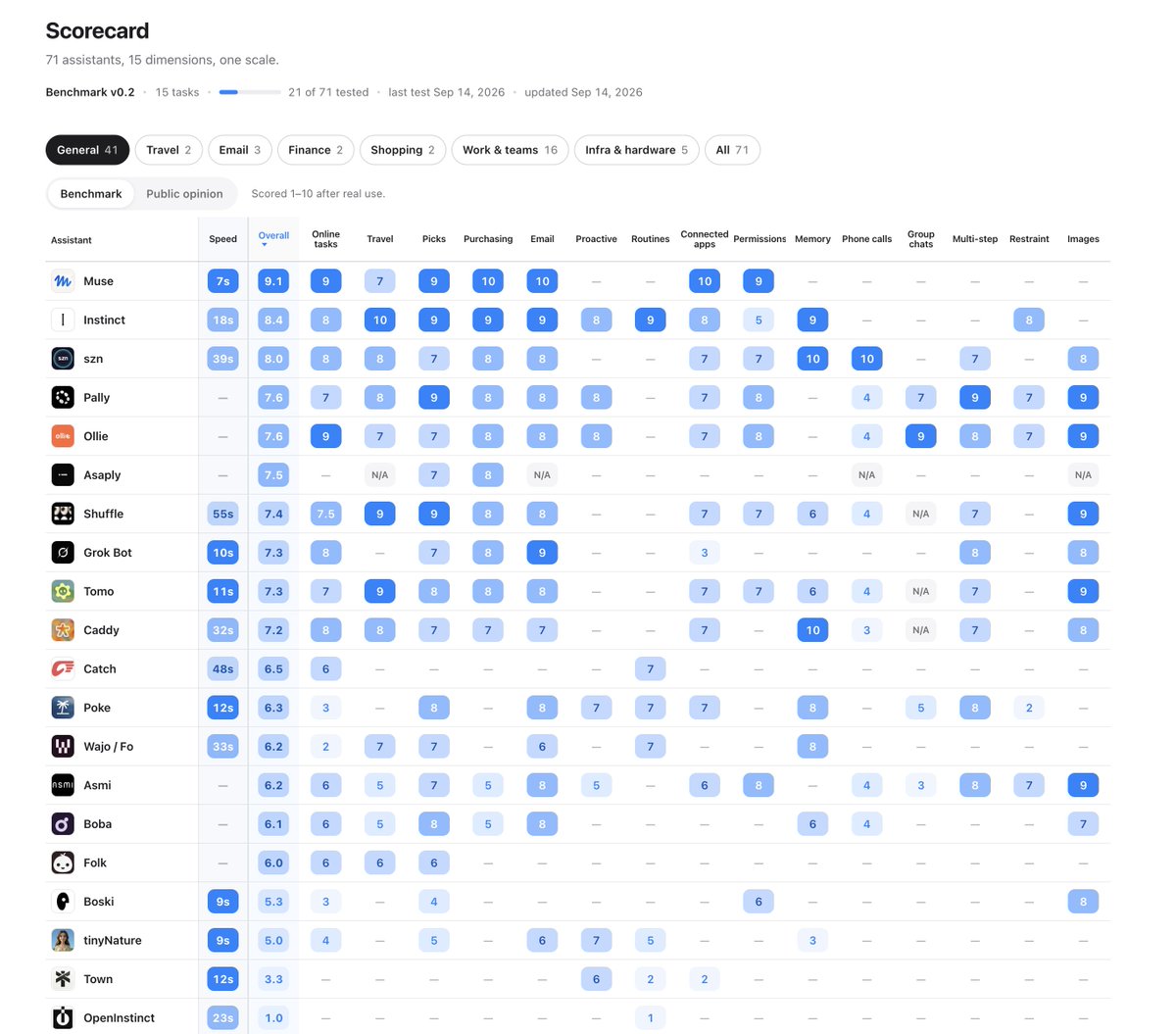
AI is making creativity more valuable than ever before and..
we have 3 years of data to prove it.
Introducing the Creative Intelligence 2026 report from @contralabs.
Full report: https://t.co/wy5rIlWMjU
.@OpenRouter co-founder Alex Atallah on the "everyone is building the same thing" take:
"This reminds me of this tweet I saw... Everybody's building an agent loop with notifications, third-party connectors, context management, memory, sandboxes, agentic web search, an always-on agent on top."
"This product is showing up everywhere. It is showing up everywhere, but these are just the new table-stakes primitives."
"A 2005 version of that tweet would be: 'Oh, everybody's building the same thing. A database, a users table, a sign-in page, a sign-up page, a profile page, a logout page. Everything's the same.'"
"There's like a lot of differentiation really. There's table-stakes needs for AI just like there's table-stakes needs for the web."
@alexatallah@amasad
We asked our PMs what they’re bringing to Global Fintech Fest this year. 🎙️
AI that can finally make real-life transactions, safely.
UPI that drives real revenue for businesses and banks.
And commerce that knows no borders.
This is just the beginning. See the intelligence commerce runs on at @GffFintechfest.
Learn more: https://t.co/DPXlzUSg1b
Taking a loan has never been easier. There is almost no friction between wanting something and borrowing to pay for it.
The problem is that income is limited, while the list of things we want is endless. And often, it isn’t even the purchase we want as much as the momentary thrill of buying it.
We are taught how to earn and save, but learning how to spend is just as important. When an impulse purchase becomes an EMI, you are committing future income even before it hits your account. The excitement of spending fades in days, but the debt stays for years.
Borrowing to invest in a home, education, or business makes sense. Borrowing for lifestyle consumption locks you into a loop that leaves no breathing room when an emergency hits.
In this video, @Zero1ByZerodha looks at why household debt in India is rising, how to assess whether your debt is manageable, and practical ways to pay it down.
Congratulations to @PrateekLearnapp, @swati_learnapp, and the team on crossing 800,000 subscribers.
"People overemphasize the aesthetic part of what taste.
Paul Graham clearly has great taste and wears cargo shorts.
There is an aesthetic part to it, but there's also a systems thinking part of it, there's a 'where are we going' part of it, there's a 'how to present this to users' part of it.
A lot of what it is is about a wider context. That I think is actually the real taste question."
@ajambrosino
Zooming out on Satya Nadella’s recent essay on the future of the firm in an AI-driven economy.
If every company eventually has access to the same frontier models, what will truly differentiate organizations?
For decades, the answer was accumulated knowledge - deep expertise built over years about customers, operations, products, and judgment. That became a durable advantage.
AI changes this dynamic. Intelligence becomes far more accessible. Expertise can be captured, retrieved, and applied at scale. Knowledge that once took years to build can now be accelerated.
At first glance, this sounds like a world where companies become more similar. Yet two organizations can see the same signals and reach different conclusions. They can adopt the same technology and still build distinct businesses.
In a world of abundant intelligence, the organizations that thrive will likely be those that best preserve and amplify their unique institutional judgment, embedding it into compounding learning systems. This sits at the heart of what Satya Nadella explores with human capital, token capital, and the learning loops that allow them to reinforce one another.
The big question this leaves us with: How will companies create lasting differentiation when raw intelligence is no longer scarce?
Founder of lululemon on what he'd tell every 25 year old:
"I'd tell them that every person in the world is an individual with a different genetic makeup and a different upbringing and the way that you're thinking is so radically different than every other person in the world and incomparable that if you have an idea and you want to move forward with it, don't worry so much about the competition because nobody will be able to replicate you and the way you think about it."
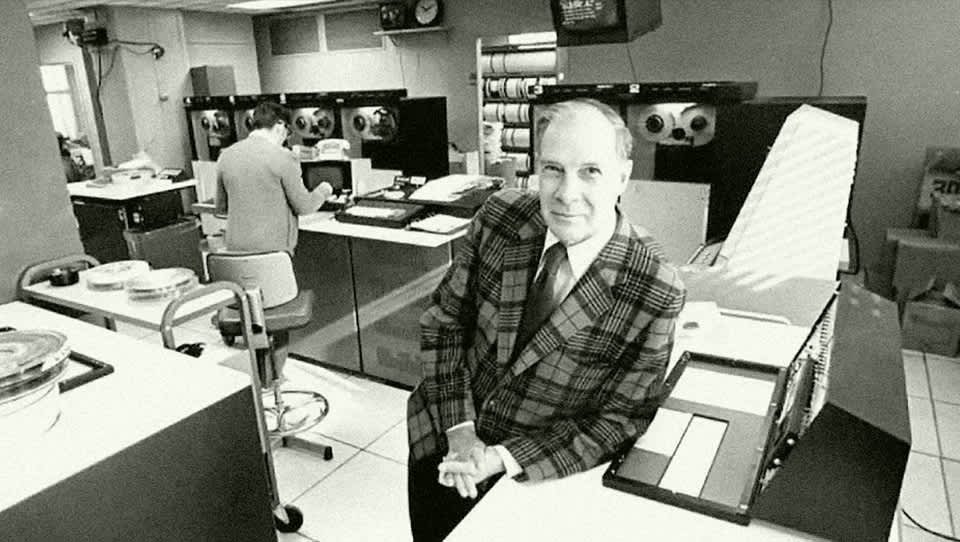
A mathematician who shared an office with Claude Shannon at Bell Labs gave one lecture in 1986 that explains why some people win Nobel Prizes and other equally smart people spend their whole lives doing forgettable work.
His name was Richard Hamming. He won the Turing Award. He invented error-correcting codes that made modern computing possible. And he spent 30 years at Bell Labs sitting in a cafeteria at lunch watching which scientists became legendary and which ones faded into nothing.
In March 1986, he walked into a Bellcore auditorium in front of 200 researchers and told them exactly what he had seen.
Here's the framework that has been quoted by every serious scientist for the last 40 years.
His opening line landed like a punch. He said most scientists he worked with at Bell Labs were just as smart as the Nobel Prize winners. Just as hardworking. Just as credentialed. And yet at the end of a 40-year career, one group had changed entire fields and the other group was forgotten by the time they retired.
He wanted to know what the difference actually was. And he said it wasn't luck. It wasn't IQ. It was a specific set of habits that almost nobody is willing to follow.
The first habit was the one that hurts the most to hear. He said most scientists deliberately avoid the most important problem in their field because the odds of failure are too high. They pick a safe adjacent problem, solve it cleanly, publish it, and move on. And because they never swing at the hard problem, they never hit it. He said if you do not work on an important problem, it is unlikely you will do important work. That is not a motivational line. That is a logical one.
The second habit was about doors. Literal doors. He noticed that the scientists at Bell Labs who kept their office doors closed got more done in the short term because they had no interruptions. But the scientists who kept their doors open got more done over a career. The open-door scientists were interrupted constantly. They also absorbed every new idea passing through the hallway. Ten years in, they were working on problems the closed-door scientists did not even know existed.
The third habit was inversion. When Bell Labs refused to give him the team of programmers he wanted, Hamming sat with the rejection for weeks. Then he flipped the question. Instead of asking for programmers to write the programs, he asked why machines could not write the programs themselves. That single inversion pushed him into the frontier of computer science. He said the pattern repeats everywhere. What looks like a defect, if you flip it correctly, becomes the exact thing that pushes you ahead of everyone else.
The fourth habit was the one that hit me the hardest. He said knowledge and productivity compound like interest. Someone who works 10 percent harder than you does not produce 10 percent more over a career. They produce twice as much. The gap doesn't add. It multiplies. And it compounds silently for years before anyone notices.
He finished the lecture with a line I have never been able to shake.
He said Pasteur's famous quote is right. Luck favors the prepared mind. But he meant it literally. You don't hope for luck. You engineer the conditions where luck can land on you. Open doors. Important problems. Inverted questions. Compounded hours. Those are not traits. Those are choices you make every single day.
The transcript has been sitting on the University of Virginia's computer science website for almost 30 years. The video is free on YouTube. Stripe Press reprinted the full lectures as a book in 2020 and Bret Victor wrote the foreword.
Hamming died in 1998. He gave his final lecture a few weeks before. He was 82.
The lecture that explains why some careers become legendary and others disappear is still free. Most people who could benefit from it will never open it.
you can now control things with your brain. literally.
we're building the most wearable BCI on the planet, with @sabi, backed by @khoslaventures@accel@initialized & @kevinweil.
we collected the world’s largest neural dataset and trained the most capable Brain Foundation Model.
then we invented a new class of biosensors powered by custom ASICs.
type without typing. click without clicking. a cap that lets your brain do the work.
we’re sabi.
Jesse Genet on Agentic Parenting
Jesse Genet joins a16z's Sarah Wang and Katherine Boyle to discuss her journey from founder to parent, how she's using agents in her household, and how AI could transform parenting for the better.
00:00 YC founder turned homeschool mom
03:00 Discovering Claude Code and agentic building
06:00 Building while homeschooling 4 kids under 5
11:00 How AI generates personalized lesson plans and logs progress
18:00 Jesse's 11-agents
27:05 Agent tech stack deep dive
33:56 How agents improve daily life
40:04 Letting kids interact with AI: values, risks, and the future of parenting
@jessegenet@KTmBoyle@sarahdingwang
Really sorry this happened to you and your family. Strong post. I thought this was thoughtful, vulnerable, and responsible—especially your acknowledgment that anxiety about AI is justified, and that the answer has to be better dialogue, not escalation. Wishing you all safety