The AI industry has a benchmarking problem.
We're letting random people on the internet decide which models are best
even for capabilities like design...
So we built something different.
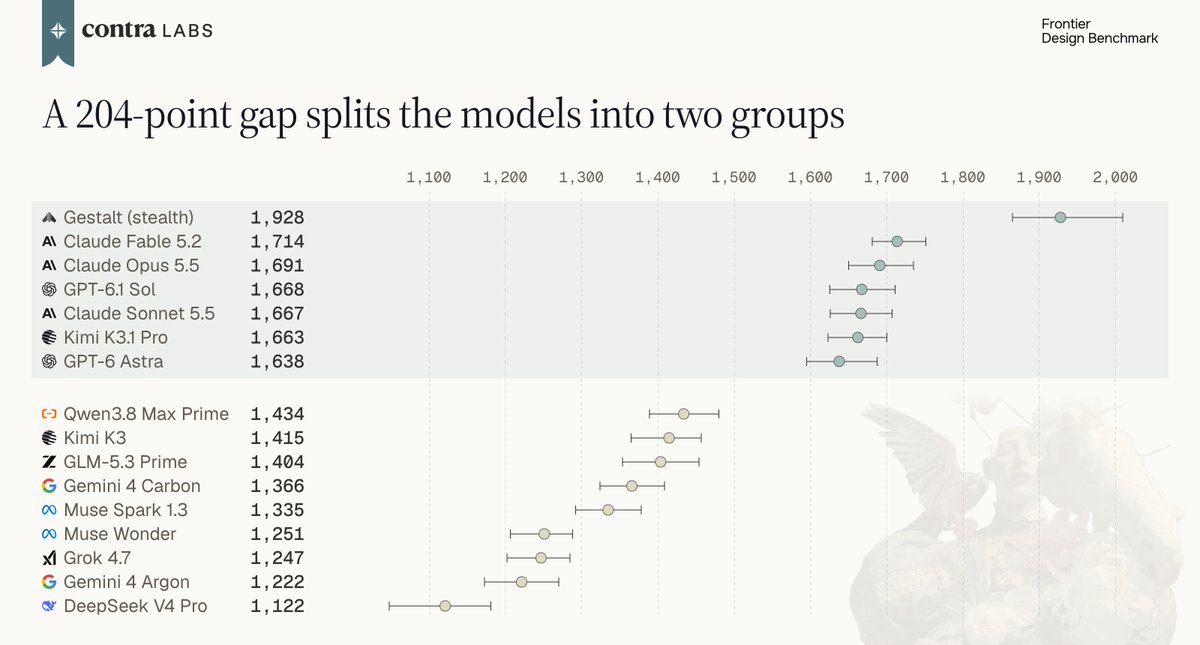
Introducing The Frontier Design Benchmark from @contralabs
https://t.co/Eiw47GSxEk
stop flexing one-shot builds. start flexing iteration craft.
models got insanely good so you could spend more time on storytelling, narrative, and making something people genuinely love using. building is solved. taste and distribution win now.
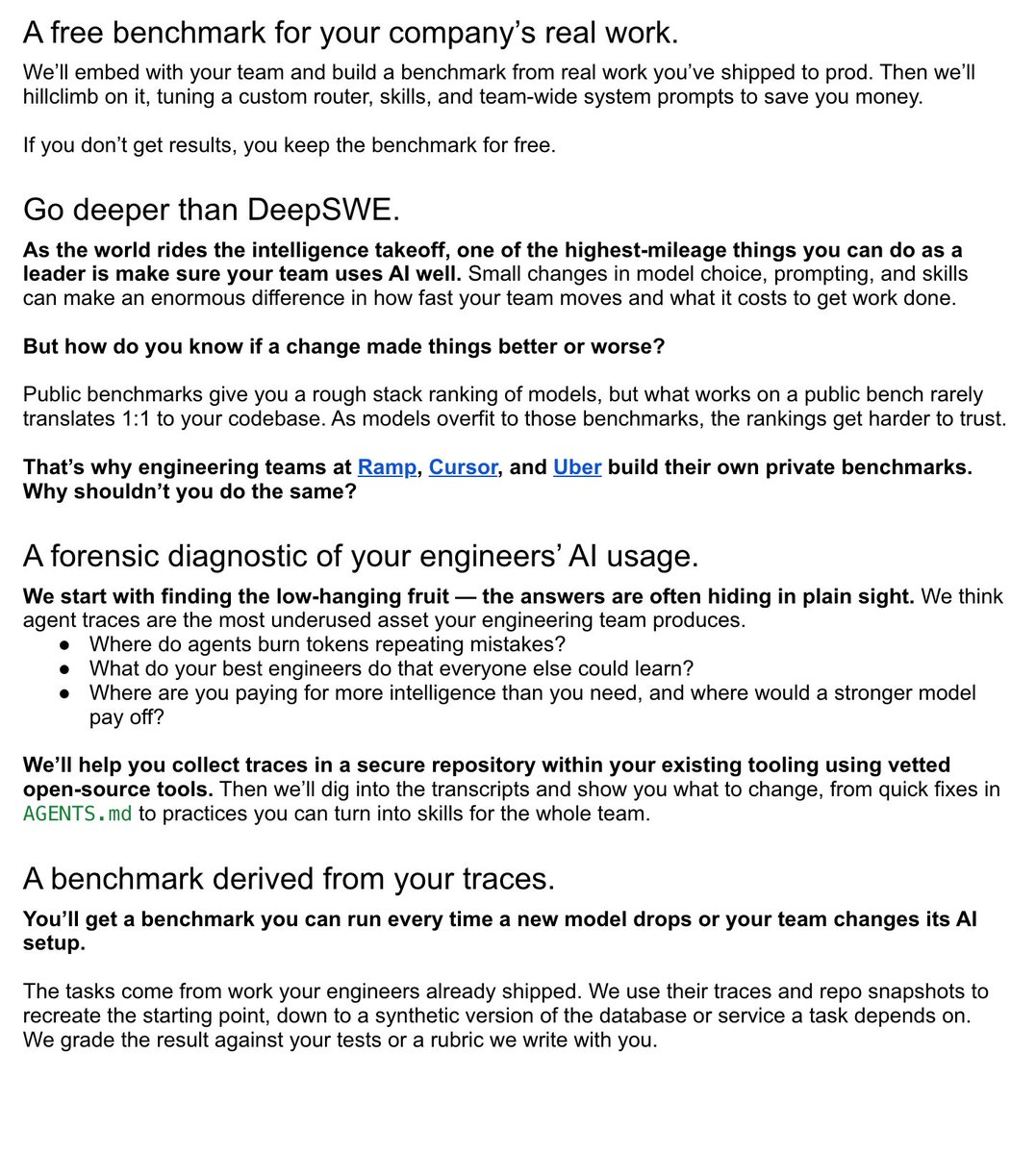
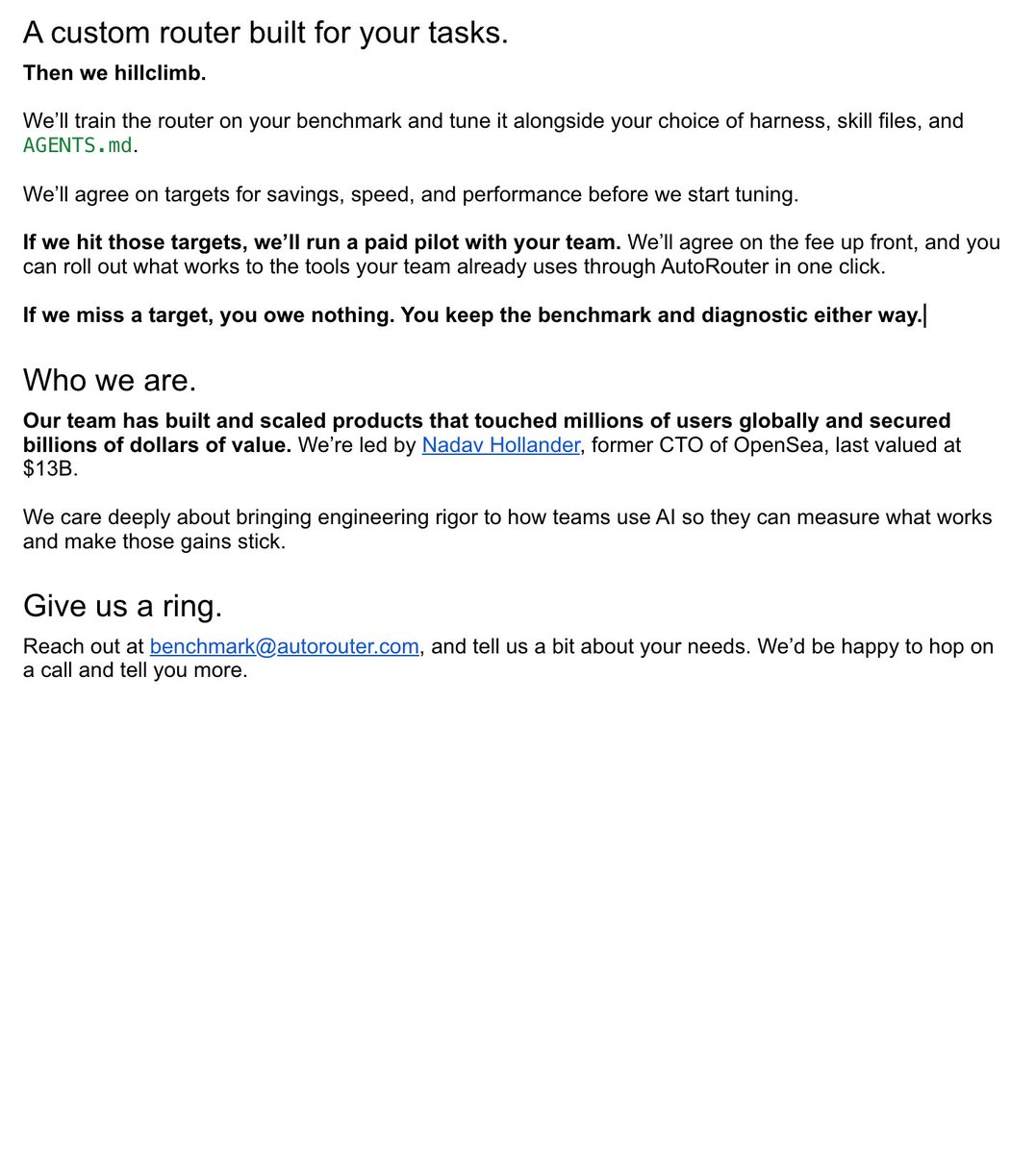
If your eng team doesn’t have an internal benchmark for evaluating models, harnesses, and skills, you’ll be behind the curve in 2027.
We’ll build you one for free. Seriously.
What changed on the FrontierPhysics leaderboard:
GPT-6.2 Astra, Gemini 4 Neon and GPT-6.2 Sol all improve on their predecessors on FrontierPhysics, but Claude Fable 5.2 still leads with a Score of 31.9.
We updated the FrontierPhysics leaderboard with seven configurations added since the paper release, including @AnthropicAI's Claude Fable 5.2, @OpenAI's GPT-6.2 Astra and GPT-6.2 Sol, and @GoogleDeepMind's Gemini 4 Neon: 33 agent configurations on 56 research tasks, 3 runs each. Score (0-100) is the rubric score of a passing run; a failed run scores 0.
Key takeaways:
➤ Claude Fable 5.2 (max) leads with a Score of 31.9: ~3x Claude Fable 5.1 (10.2) and 5.9 points above Claude Opus 5.5 (26.0). It solves the most tasks (29 of 56), but has the highest Cost per Run (~$95) and takes ~5 hours per run
➤ GPT-6.2 Astra (max) scores 24.5: 2.7 points above GPT-6 Astra (max) at less than half the Cost per Run (~$12 vs ~$27), and ~1/8 of Claude Fable 5.2's
➤ Gemini 4 Neon (high) scores 20.0: 13.5 points above Gemini 4 Argon (6.5), and 3.3 above Gemini 4 Carbon (16.7) at the same ~$10 per run
➤ GPT-6.2 Sol (max) scores 19.9: 1.5 points above GPT-6.1 Sol (18.4) at about half the Cost per Run (~$2.90 vs ~$5.30)
➤ The top is not settled: 95% intervals overlap from Claude Fable 5.2 down to GPT-6.2 Sol, and 16 of 56 tasks have no passing run from any configuration
We're starting to see models develop increasingly sophisticated design capabilities.
>Real client briefs.
>Verified professional designers.
>1,151 blind comparisons involving OpenAI models.
Huge congrats to the team at @OpenAI.
Explore the full research: https://t.co/cuOEc3cybt
Narrative Violation🚨:
We put @OpenAI's Astra 6.2 and Sol 6.2 models in front of professional designers.
They won 73% of their blind design comparisons
GPT-6.2 Astra also achieved the highest design critique scores of any model on our Frontier Design Benchmark.
More below🧵
The AI industry has a benchmarking problem.
We're letting random people on the internet decide which models are best
even for capabilities like design...
So we built something different.
Introducing The Frontier Design Benchmark from @contralabs
https://t.co/Eiw47GSxEk
The generational improvements are becoming increasingly visible.
Previous GPT models had major copy issues on more than 50% of websites.
With GPT-6.2, that number dropped to just 7.4%.
Typography sizing remains an opportunity for improvement.
Claude is really, really good at design 👀
On the Frontier Design Benchmark, professional designers voted blind on real client briefs. Of the 15 models we ran:
#1 Claude Fable 5.2
#2 Claude Opus 5.5
#4 Claude Sonnet 5.5
@AnthropicAI's Fable is within 26 Elo of the human designs.
The AI industry has a benchmarking problem.
We're letting random people on the internet decide which models are best
even for capabilities like design...
So we built something different.
Introducing The Frontier Design Benchmark from @contralabs
https://t.co/Eiw47GSxEk
Claude pages are first on 7 of the 12 briefs in our gallery. Fable has 3, Sonnet 3, Opus 1.
Congrats to the @AnthropicAI team!
Read our Frontier Design benchmark report for more details.
Full results: https://t.co/m73ppJ7Eva
My favorite part is how Claude uses the brand.
On Threatlane, Fable drew the logo's wave as four lanes a threat travels through, from email to identity to cloud. The page stays near-black with one lime accent, kept for the demo button and the signal marker.
A designer said of Sonnet's page on the same brief: "the logo wave lines turned into a hero visual."
On 86% of Claude landing pages, the logo's shapes come back elsewhere on the page. Other models: 47%.
The AI industry has a benchmarking problem.
We're letting random people on the internet decide which models are best
even for capabilities like design...
So we built something different.
Introducing The Frontier Design Benchmark from @contralabs
https://t.co/Eiw47GSxEk