@DivineEarth322@CinemaWireNews@grok Somebody modeled out an illustrative distribution waterfall for the film's revenues on LinkedIn you can find.
Typically director will get 5-10% of net profits after 1) exhibitors, 2) distributors, 3) financiers, and 4) producers recoup their expenses + a premium
Likely <$10M
A 19-year-old is doing $100k/month selling AI-generated pornstars to lonely men and the tech internet calls him "cracked"
I wrote an essay about what happens when a whole generation is told that what you build doesn't matter, only that you get a bag
https://t.co/WK6FvIer1P
I'm glad that the author of "Rent Control Is Fine, Actually" calls themself Unlearning Economics, bc it's good to just state things clearly, such as the open animosity that many left economic populists have for the field of economics and economists themselves.
Economists aren't gods, and economics isn't a divine truth, but economists are good--better than most--at something critical for making public policy: They're good at identifying tradeoffs. "Rents are too high, so freeze them" is compelling politics. But in the absence of other pro-supply policies, if you make it illegal to increase rents, landlords will stop upgrading units and convert them to condos, which reduces the supply of units for rent, reduces mobility, and drives up rents for everybody else.
The left econ populists have some clear, and clearly stated, policy ideas:
- Rents are too high, so freeze them.
- Electricity is expensive, so stop rate increases.
- Homes are too expensive, so ban institutional investors.
- Power prices are rising, so ban data center construction.
... All these policies feel like solutions because they're brisk, they name enemies, and they take on the most visible source of frustration. But they are much better as villain-naming exercises than they are as a complete public policy. On their own, each creates other problems: less housing built, less clean electricity built, abdicating energy policy by encouraging AI firms to build data centers abroad in unsavory countries with more emissions, etc.
I can't think of a single economic populist idea that wouldn't be helped with a little dose of economics, which is why it's troubling when I see the left participating in, and even celebrating, the great unlearning of economics.
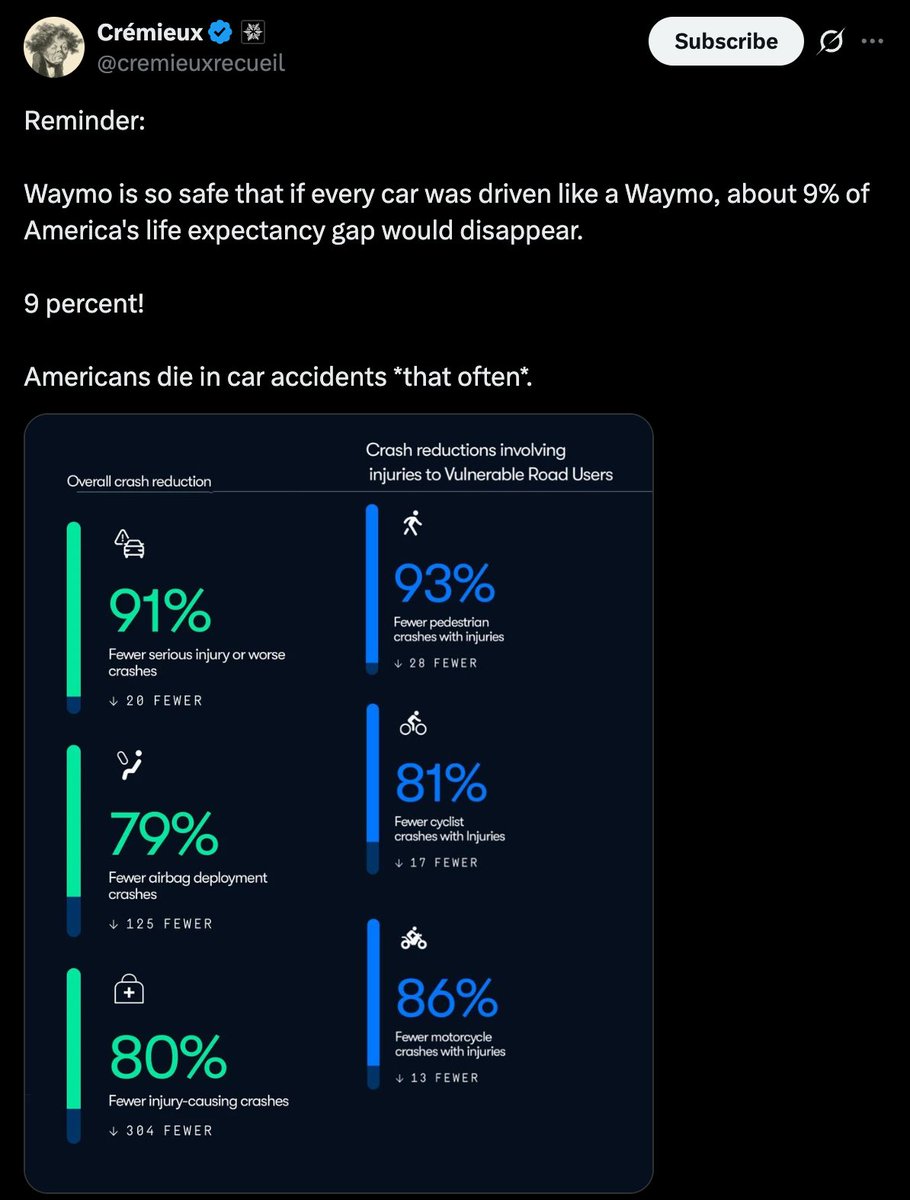
Waymo is so good at saving lives that if it were a new drug in trial, it would hit the bar for being unblinded and made immediately available to the control group for ethical reasons.
@MorePerfectUS would prefer to keep killing pedestrians.
Just to make it clear what’s going on here: the mayor of New York City is endangering human lives by slowing down the transition to self driving cars, because he has economic views that are a primitive combination of mercantilism and socialism.
In a few years, politicians have gone from wanting to ban ride-share to protect taxis to wanting to ban self-driving to protect ride-share
It is almost like the underlying instinct is to restrict all new technologies and modalities regardless of rapid consumer adoption
@krishnanrohit What if we just evaluated writing based on how good it is rather than how it was made?
We presumably should hate AI-generated text because it's bad. So if it's bad writing, let's just call it bad writing.
@ifoundanna Apparently Google or Apple (forget which one) looked at this but was worried about the socioeconomic impacts of routing people away from lower income areas or something like that
@mackaybell@films7 Studio system fell apart not by TV, but by the Paramount decree and FinSyn rules.
But yes, when TV came around film responded by "eventizing" -- but important to note indie & midbudget film was still very big.
@mackaybell@films7 Same thing happened with cinema. Art forms professionalize and build an unsustainable cost base, and if they don't modernize with new technological waves, they become increasingly irrelevant.