BREAKING: 🇺🇸 American wages have fallen to 43% of national income, the lowest since the Great Depression.
For every $1 the US economy produces, workers are getting less of it than at any point since 1929.
The rest is going to corporate profits, which are now at an all time high.
This is why the economy keeps growing but most Americans feel poorer. GDP goes up, wages go up in dollar terms, but workers are getting a smaller and smaller slice of what they actually produce.
Asset prices keep rising for the same reason.
Money that used to go to wages is now going to shareholders instead, and shareholders put it into stocks, real estate and other assets.
Fallout 5, Fallout 3 Remastered, Fallout New Vegas Remastered, Obsidian’s New Fallout game, Fallout Season 3, Fallout 3 Prequel, Fallout Celebration in DC
BREAKING: The SEC has reportedly eliminated the Pattern Day Trader rule, replacing it with a new intraday margin system.
The requirement to maintain a $25,000 balance to engage in day trading is being scrapped.
The long-threatened bankruptcy of Social Security is closing in, with just 6 years until benefits automatically cut by 25%.
That's a monthly cut of $900 for a typical American couple.
Here's how they built Social Security to fail.
This is wild:
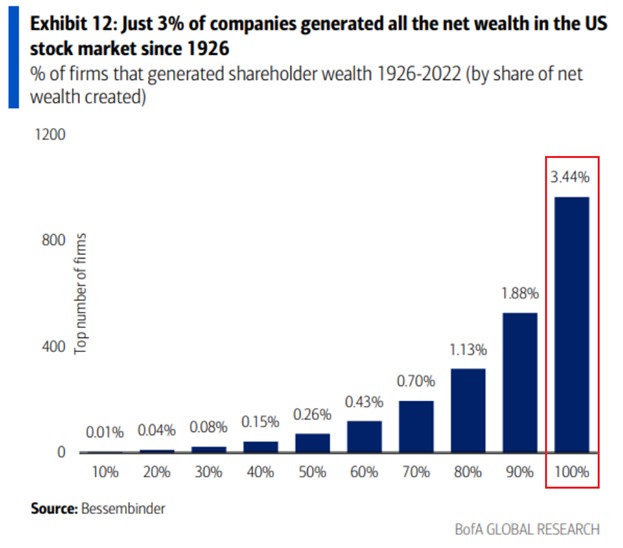
ALL net wealth in the US stock market since 1926 has been generated by just 3.44% of companies.
To put this differently, ~97% of all stocks have barely contributed to long-term shareholder wealth creation.
The top 1.88% of companies reflect 90% of total gains.
Interestingly, just 0.26% of firms have created HALF of all wealth.
This highlights the extreme concentration of stock market returns in top-performing companies.
Market wealth is heavily skewed toward a very small minority of companies.
“So you made $160 MILLION in your NBA career?”
“Yes, Dave”
“And you are now facing a federal indictment for rigging a game to make $200k…”
“That’s correct, Dave”
The stock market is incredibly hot:
Since 1975, there have only be 6 times where the S&P 500 rose +30% or more in 5 months.
2025 is one of those times.
In 100% of these cases, the S&P 500 has ended higher in the following 6 and 12 months, per Carson Research.
In fact, during such occurrences, the S&P 500 has rallied by an average of +18.1% in the following 12 months.
On top of it all, the Fed is about to begin cutting rates directly into the AI Revolution.
This week begins a new era for markets.