Many traditional Christians, particularly evangelicals, Catholics, and Protestants, condemn members of The Church of Jesus Christ of Latter-day Saints (formerly referred to as Mormons) as "not Christian" due to significant doctrinal divergences from historic Christian orthodoxy, derived from Catholic and Protestant councils, theologians and academics. These arguments often stem from LDS unique teachings, scriptures, and origins. Below is a list of the primary complaints, followed by the LDS positions (my analysis).
Rejection of Historic Christian Orthodoxy and the Need for Restoration: LDS teaches that the early Christian church became contaminated by Greek paganism and philosophy, after the apostles' deaths, the loss of revelation and authority from God, requiring a full restoration through Joseph Smith in the 19th century. This implies that traditional Christianity was corrupt and false for centuries, which directly repudiates the continuity and authority of historic Christian denominations.
LDS Position: Latter-day Saints affirm that a Great Apostasy occurred after the death of the apostles, as prophesied in scriptures like Amos 8:11-12 and 2 Thessalonians 2:3 ( Let no man deceive you by any means: for that day shall not come, except there come a falling away first, and that man of sin be revealed, the son of perdition), leading to the loss of priesthood authority from God and distortion of key doctrines. This view was substantiated by the extensive and tragic historical record of conflict, wickedness, self-dealing, politicalization, corruption, and distortion of doctrine by all of the various legacy Christian organizations, from the death of the apostles to the present. (This view does not in any way condemn the vast numbers of faithful Christians who have sought God, and tried to live His commandments and become holy, even in the face of the variety of distorted teachings and administration of legacy Christian religion.) God’s preparation for the Second Coming of Jesus Christ necessitated a restoration of authority and a cleansing of teachings, which God accomplished by direct appearances of the Father, the Son, and many angels in a series of revelations, through Joseph Smith. These began in 1820, when God and Jesus appeared to him, reestablishing the original church with apostles, prophets, and divine authority. There is a continuity of authority for all LDS priesthood holders extending to heavenly ordinations. LDS view this as a return to authentic and pure Christianity, not a rejection of Christ, and point to historical evidence of doctrinal changes in early Christianity as support.
Additional Scriptures and Open Canon: LDS accept extra-biblical texts like the Book of Mormon, Doctrine and Covenants, and Pearl of Great Price as scripture, alongside a belief that the Bible (typically the King James Version) contains errors and is not inerrant or sufficient on its own. This contrasts with the Protestant principle of *sola scriptura* (Bible alone) and the closed canon upheld by most Christians.
LDS Position: Latter-day Saints revere the Bible as the word of God but believe it is not complete or infallible due to translation errors and lost texts during the apostasy. The Cannon of the Bible consists of writings of prophets and apostles, which survived into the third century A.D. There are a number of different cannons accepted by different Christian religions, and all do not agree. The accepted cannon contains references to a number of sacred writings, which are not present in any of the current accepted cannons. None of the accepted books of scripture from which the legacy Christian cannons were compiled declare that God only told mankind the things within that book.
Additional scriptures, such as the Book of Mormon, serve as additional testaments of Jesus Christ, clarifying and supporting biblical teachings, with Christ referenced on nearly every page. In the Book of Mormon, God declares that He speaks to all peoples and commands them to write it down. Consequently, Latter-day Saints expect that there are many additional scriptures, recording God’s interactions with mankind across the world, over the centuries, which will eventually be made available to us. They maintain an open canon because God continues to reveal truth through prophets, consistent with biblical patterns, like the sequential revelation of the prophets prior to Christ, which comprise the Old Testament, and ongoing revelation in the New Testament. The truth about God has always been true, even before the scriptures were written. There are many scriptures referred to, and both the old and New Testament, which are not currently available to us. The process of canonization of the Old and New Testaments did not come from heaven, but was constructed by agreement among men. There are different scripture cannons among different legacy Christian church’s, because Christians themselves do not agree on what scriptures represent God‘s will, and which do not.
The Bible contains several passages (Deuteronomy 12:32, Proverbs 30:5-6, Revelation 22:18-19, 1 Corinthians 4:6, 2 Corinthians 4) that warn against editing, adding to, subtracting from, or otherwise modifying God's word. These are often interpreted as applying to specific sections of scripture (e.g., the Mosaic Law or the book of Revelation) but are frequently cited in discussions about the integrity of the Bible as a whole. In no case do they say that God cannot add to His words and teachings.
Rejection of the Trinity: LDS denies the legacy Christian doctrine of the Trinity (one God in three persons: Father, Son, and Holy Spirit), instead teaching that the Father, Son, and Holy Ghost are three separate beings united only in purpose. This is seen as polytheism or henotheism, not monotheism.
LDS Position: The Godhead consists of three distinct beings—God the Father, Jesus Christ, and the Holy Ghost—who are one in purpose, will, and love, but not in substance. This view aligns with the every reading of the New Testament (e.g., Jesus praying to the Father) and early Christian beliefs, before the influence of Greek philosophy was reflected in the creeds. The Nicene Trinity is seen as a post-apostolic development lacking biblical support, and Latter-day Saints reject it as a product of the apostasy while affirming monotheism in worshiping the Father through Christ.
Nature of God: LDS believe God the Father was once a mortal man who progressed to godhood, and that humans can become gods in the afterlife ("As man is, God once was; as God is, man may become"). This anthropomorphic view of God, including the existence of multiple gods, differs from the post-apostolic legacy Christian concept of an eternal, unchanging, and singular God who is distinct from creation.
LDS Position: God the Father is an embodied being with a perfected body of flesh and bone, consistent with biblical descriptions (e.g., humans created in God's image), mankind are God’s children and early Christian views before creedal changes. Jesus is the Son of God, who frequently went to quiet places to pray to Him and receive guidance from Him, and for whom, during His baptism, God the Father spoke form Heaven, and the Holy Ghost alighted in the form of a dove. The doctrine of eternal progression teaches that humans, God’s children, can become like God through Christ's atonement, but God remains supreme and unchanging in His divine attributes. References to multiple gods in scripture (e.g., Psalm 82) are interpreted as divine beings, but Latter-day Saints worship only one God, the Father, and view this as enhancing rather than diminishing His nature. This talk by Apostle Dallin H. Oaks explains this eloquently: https://t.co/xuL17SbxN6
Different Nature of Jesus Christ: The LDS Jesus is portrayed as a created spirit being, the literal firstborn son of God the Father and a heavenly mother, and the spirit brother of Lucifer and all humans. He achieved godhood through obedience and is not eternally divine or co-equal with the Father, unlike the Christian Jesus who is fully God and fully human, eternally existent as the second person of the Trinity.
LDS Position: Jesus Christ is the eternal Son of God, the Jehovah of the Old Testament, fully divine, and the Savior of the world who was with the Father from the beginning. As the firstborn spirit child of heavenly parents, He is the literal offspring in spirit but not created from nothing—He is eternal. He is co-eternal with the Father in divinity, achieved perfection through obedience, and is separate from the Father, as shown in His baptism and prayers. As the agent of the Father, He is the Creator of this world, and does God the Father’s work in bringing about the salvation of mankind. He died for the sins of mankind under God’s direction, and offers His sufferings and death to the Father as payment for the sins of those who will repent and believe in Him. This rejects creedal formulations but centers faith on Christ's life, atonement, and resurrection as the path to salvation.
Creation from Pre-Existing Matter: LDS holds that God organized the universe from eternal, pre-existing matter and intelligence rather than creating it *ex nihilo* (out of nothing), which alters the Christian understanding of God as the ultimate creator of all things.
LDS Position: The Bible does not teach creation ex nihilo, a concept that emerged in the second century under Greek philosophical influence; instead, Hebrew terms like "bara" imply organizing existing materials. Latter-day Saints believe God organized the universe from eternal matter and intelligence, as supported by scriptures (e.g., D&C 93:29) and early Christian thinkers like Justin Martyr. This does not limit God's power but reflects a biblical view where matter is co-eternal, emphasizing God's role as organizer rather than absolute originator from nothing. Modern science confirms that the observed universe is of great antiquity and is constantly destroying stars and birthing new stars.
Rejection of Ecumenical Creeds: LDS do not accept key Christian creeds like the Nicene Creed, viewing them as products of apostasy rather than authoritative summaries of biblical doctrine.
LDS Position: The creeds are non biblical, were developed in the third and fourth centuries, and represent a distortion of Christian doctrine introduced by Greek philosophy, introducing concepts like the Trinity that deviate from biblical teachings. Latter-day Saints reject them as non-scriptural and unnecessary, preferring direct revelation and the Bible's plain teachings. They affirm core Christian beliefs like Christ's divinity and atonement without creedal constraints, seeing the creeds as human inventions that distorted and corrupted primitive Christianity.
Authority of Joseph Smith as a Prophet: Critics argue that Joseph Smith is a false prophet whose revelations contradict the Bible, and following him introduces heretical teachings not found in Christianity.
LDS response: Joseph Smith was called as a modern prophet to restore lost truths and authority after a two-thousand year apostasy, similar to biblical prophets like Moses, Isaiah, Jeremiah, and Jesus who were each sent to displace apostate authoritarian religious structures. His revelations, tested by fruits and consistency with scripture, affirm Christ-centered teachings. Latter-day Saints believe in continuing revelation through living prophets, as in Amos 3:7, and view Joseph's role as fulfilling prophecies of restoration (e.g., Acts 3:19-21), not contradicting but clarifying the Bible.
Views on Salvation and Baptism: LDS salvation involves works, ordinances like temple rituals, and baptism exclusively in the LDS Church for eternal life with God. This is seen as adding requirements beyond faith in Christ alone, and non-Mormon baptisms are considered invalid.
LDS Position: Salvation comes through Jesus Christ's grace and atonement, but requires faith, repentance, baptism by proper authority, receiving the Holy Ghost, and enduring to the end—works are evidence of faith, not the source (2 Nephi 25:23). Ordinances like baptism and temple sealings are essential, as in the New Testament, and proxy baptisms for the dead (1 Corinthians 15:29) extend salvation to all. Non-LDS baptisms lack restored authority, but all can access salvation through Christ.
Pre mortal-Existence of Spirits: LDS doctrine includes the pre-mortal existence of human spirits, which is not a standard Christian belief and alters views on human origins and the soul.
LDS response: Human spirits are eternal intelligences organized by God in a pre-mortal realm, as hinted in scriptures like Jeremiah 1:5 and Job 38:7. This pre-existence explains life's purpose as a test of faith, aligning with God's plan of salvation. Spirits are not created from nothing but organized from eternal elements, consistent with teachings that intelligence "was not created or made" (D&C 93:29), enhancing understanding of human divinity without contradicting biblical creation accounts.
McConnell found unconscious of a suspected heart attack days after voting NO on the SAVE America Act.
Against his constituents.
Who really voted?
Senator for 40 years.
Everything wrong with Congress.
Congress isn’t meant to be a crooked nursing home.
Sounds like a miserable life for all involved. Imagine eating food prepared by a “wife” who is being abused by him. Probably develops a resistance to E. coli, after regularly eating feces infused into his food. How many other acts of sabotage in his life?
This is one of the most horrifying and depressing things you’ll watch today.
An Afghan woman was raped, was then charged with “adultery,” and then forced into marrying her rapist so that she and her daughter could have any place in society. She’s now stuck raising kids with him.
This isn’t ancient history. It’s how Sharia-influenced “justice” still works in places like Afghanistan and Pakistan and most other sharia dominated countries.
The West importing these values without pushback is insane.
And it keeps happening. The Muslims want to implement this very sharia law all over the West. We are simply not the same.
When I was a child, my grandfather would sometimes solemnly intone at the dinner table: "The purpose of socialism is to organize scarcity."
As a kid it sort-of didn't register in my brain as meaning anything beyond "socialism bad", but eventually when I was 12 or something, I did ask what he meant by those specific words.
And he said: socialists establish control of valuable resources and then create an artificial scarcity of these resources, so that they can then use them as a tool of control by deciding who gets and doesn't get those resources.
And I thought that was wrong. I mean, are socialists misguided? Sure. But to claim that they deliberately create scarcity as a means of political control? That seemed far-fetched.
But, of course, he was entirely correct.
Women’s sports and women’s bathrooms are both necessitated by special women’s needs.
If women do not have a special category of sports and played sports with the men, they would always be beaten and by a large margin. It’s only interesting to compete with comparable strength and other abilities. This is because of the biological fact that men, whatever they call themselves, are genetically predispositioned to be larger, and stronger.
Ditto for bathrooms. Men, whatever they call themselves, are also predispositioned to have a much stronger interest in sex than when women do. This manifest itself in in much larger preponderance of interest by men in looking, touching, and intercourse when the opportunity arises.
So women have to have protected spaces, including segregated bathrooms, and marriage with men who will protect them.
This is an intelligence test.
Opinion: Her son, the transgender plaintiff in the Supreme Court case, defeated 470 girls over 1,400 competitions. He single-handedly denied hundreds of girls the chance to compete in the sport they loved and stole the girls’ state shot put title.
I understand the point, and it's worth taking seriously. Yes, you must work to live. But look at why that's true, because the reason changes everything.
The need to produce isn't imposed by employers or capitalism. It's imposed by nature. A man alone on an island must fish, build, and grow or he dies. That's not a threat from another person. It's the basic condition of being alive. Food, shelter, and clothing don't exist until someone makes them.
So when you say work is "forced" by the threat of starvation, that threat comes from reality itself, not from the man offering you a job. He didn't create your need to eat. He's offering you a way to meet it, a trade, his wealth for your effort. That's not coercion. Coercion is a gun. An offer you can refuse, even a hard one, is the opposite of force.
And here's the part the resentment hides. The employer isn't your enemy in this. He's the one who built the thing that lets you meet nature's demand without fishing alone on a rock. The men who produce the most, the ones who create the factories, the tools, the jobs, are the greatest benefactors of all, because they multiply what every worker can earn far beyond what he could alone.
That's why the moral debt runs the other way. We don't owe our lives to the takers. We owe an enormous debt to the producers, whose ability raises the standard of living of everyone beneath them. The man who gives you a way to live has done you good, not harm.
Je veux présenter mes excuses, au nom des Français, pour avoir enfanté la French Theory (qui a enfanté la pire des merdes idéologiques : le wokisme).
Nous avons donné au monde Descartes, Pascal, Tocqueville. Et puis, dans les ruines intellectuelles de l'après-68, nous avons donné Foucault, Derrida, Deleuze. Trois hommes brillants qui ont fabriqué, dans l'élégance de notre langue, l'arme idéologique qui paralyse aujourd'hui l'Occident.
Il faut comprendre ce qu'ils ont fait. Foucault a enseigné que la vérité n'existe pas, qu'il n'y a que des rapports de pouvoir déguisés en savoir. Que la science, la raison, la justice, l'institution médicale, l'école, la prison, la sexualité, tout n'est qu'une mise en scène de la domination. Derrida a enseigné que les textes n'ont pas de sens stable, que tout signifiant glisse, que toute lecture est une trahison, que l'auteur est mort et que le lecteur règne. Deleuze a enseigné qu'il fallait préférer le rhizome à l'arbre, le nomade au sédentaire, le désir à la loi, le devenir à l'être, la différence à l'identité.
Pris isolément, ce sont des thèses discutables. Combinées, exportées, vulgarisées, elles forment un système. Et ce système est un poison.
Car voici ce qui s'est passé. Ces textes, illisibles en France, ont traversé l'Atlantique. Les départements de Yale, de Berkeley, de Columbia les ont absorbés dans les années 80. Ils y ont trouvé un terreau qui n'existait pas chez nous : le puritanisme américain, sa culpabilité raciale, son obsession identitaire. La French Theory s'est mariée à ce substrat, et l'enfant de ce mariage s'appelle le wokisme.
Judith Butler lit Foucault et invente le genre performatif. Edward Said lit Foucault et invente le post-colonialisme académique. Kimberlé Crenshaw hérite du cadre et invente l'intersectionnalité. À chaque étape, la matrice est française : il n'y a pas de vérité, il n'y a que du pouvoir, donc toute hiérarchie est suspecte, toute institution est oppressive, toute norme est violence, toute identité est construite donc négociable, toute majorité est coupable.
Voilà comment trois philosophes parisiens, qui n'ont probablement jamais imaginé leurs conséquences pratiques, ont fourni le logiciel d'exploitation à une génération entière d'activistes, de bureaucrates universitaires, de DRH, de journalistes, de législateurs. Voilà comment on a obtenu une civilisation qui ne sait plus dire si une femme est une femme, si sa propre histoire mérite d'être défendue, si le mérite existe, si la vérité se distingue de l'opinion.
C'est de la merde pour une raison simple, et il faut la dire calmement. Une civilisation se tient debout sur trois piliers : la croyance qu'il existe une vérité accessible à la raison, la croyance qu'il existe un bien distinct du mal, la croyance qu'il existe un héritage à transmettre. La French Theory a entrepris de dynamiter les trois. Pas par méchanceté. Par jeu intellectuel, par fascination du soupçon, par haine de la bourgeoisie qui les avait nourris. Mais le résultat est là. Une génération entière a appris à déconstruire et n'a jamais appris à construire. Une génération entière sait soupçonner et ne sait plus admirer. Une génération entière voit le pouvoir partout et la beauté nulle part.
Je m'excuse parce que nous, Français, avons une responsabilité particulière. C'est notre langue, nos universités, nos éditeurs, notre prestige qui ont donné à ce nihilisme son emballage chic. Sans la légitimité de la Sorbonne et de Vincennes, ces idées n'auraient jamais traversé l'océan. Nous avons exporté le doute comme d'autres exportent des armes.
Ce qui se construit maintenant, en silicon valley, dans les labos d'IA, dans les startups, dans les ateliers, dans tous les lieux où des gens fabriquent encore des choses au lieu de les déconstruire, c'est la réponse. Une civilisation se reconstruit par les bâtisseurs, pas par les commentateurs. Par ceux qui croient que la vérité existe et qu'elle vaut qu'on s'y consacre. Par ceux qui assument une hiérarchie du beau, du vrai, du bon, et qui n'ont pas honte de la transmettre.
Alors pardon. Et au travail.
I strongly agree. I read this last year, and wrote an OpEd on behalf of my local Republican Party identifying who are fascist. They refused to let me publish it on their behalf.
I want to convince you to read a book with a scary cover.
Everyone should read The Rise and Fall of the Third Reich, not because it is the last word on Nazis, but because it remains one of the most powerful demonstrations ever written of how civilization can fail while still believing itself to be civilized.
That is the terrifying genius of Shirer’s book.
It does not present the Third Reich as some meteor that struck Europe from outer space, nor does it comfort us with the childish notion that Germany was magically populated by millions of uniquely evil people.
It shows something far more useful, and therefore far more disturbing: a modern, educated, technically sophisticated nation can be captured by lies, grievance, bureaucracy, fear, opportunism, and the small daily surrender of moral judgment.
The machinery of barbarism does not require a population of monsters. It requires enough believers, enough cowards, enough careerists, enough cynics, and enough ordinary people who decide that keeping their heads down is safer than saying no.
One argument I’ve heard is that all humans contain engrams that encode for certain group behaviors. When a local resource or abundance runs out, you invade a neighbor and take theirs. Or worse, you identify a group within your own population as the source of the problem and attack yourself, like an autoimmune disease. But it happens repeatedly throughout history.
And the most important lesson is not that Hitler won Germany in a landslide. He did not.
The Nazis became the largest party, but they never won a free majority mandate. In July 1932 they won 37.3% of the vote; in November 1932 they fell to 33.1%; and even in March 1933, after Hitler was already chancellor and political violence had warped the field, they reached 43.9%, still short of a majority. That is the chilling part. A country does not need 90% of its people to vote for madness in order for madness to govern it. It needs a militant minority, a fractured opposition, institutional weakness, elite miscalculation, and a public exhausted enough to mistake brutality for order.
Shirer makes you understand that dictatorship doesn’t happen when people vote to abolish freedom. More often, it arrives wrapped in emergency powers, procedural legality, patriotic language, porous constitutions, and the promise that the unpleasant parts are “temporary”.
People do not wake up one morning and decide to live in a police state.
They accept one exception, then another. They tolerate one class of people being degraded because it is not yet them. They watch one newspaper silenced, one judge intimidated, one civil servant replaced, one neighbor denounced, and each time the mind performs its little act of self-preservation: surely this is not the REAL turning point; surely someone ELSE will stop it; surely it is better NOT to get involved.
That is why the book is not merely history. It is a “systems manual” for democratic collapse.
Shirer shows the inputs and outputs. Economic humiliation goes in. Conspiracy thinking comes out. Parliamentary paralysis goes in. The hunger for a strongman comes out. Propaganda goes in. Moral permission comes out. Career incentives go in. Obedience comes out. The horrifying thing is how much of it looks less like a thunderclap than like an old programming flowchart. Forms are stamped. Orders are routed. Promotions are granted. The trains run on time. Men like Asperger who would never personally murder a child learn to serve a system that does.
And that is the second great reason to read it: it destroys the comfortable distance between “them” and “us.”
Most people contain the engrams necessary to fall in line under the right pressure. That does not mean everyone is secretly a Nazi. It means human beings are exquisitely vulnerable to belonging, fear, status, obedience, resentment, and the narcotic-like relief of not having to think too hard when a leader offers a complete explanation for every pain or problem. Shirer forces the reader to confront evil not as a rare substance found only in supervillains, but as a set of ordinary human capacities intentionally reorganized by ideology and power.
The book also matters because Shirer wrote with the eye of a witness. He was nor a historian, he was a journalist. As someone with ASD, I don’t fall prey to books like “A People’s History of the United States” because they are, at their core, emotional tracts. Shirer’s book is not. It’s journalism. It’s like reading a newspaper of events written by someone who was there and who had time to think about them.
That’s because he had lived in Germany as a correspondent and watched the Nazi state harden around him. His great advantage is not academic distance but proximity. You feel the sequence of events as something unfolding in real time, not as a museum exhibit safely sealed behind glass. That gives the book its momentum. It reads less like a textbook than like a slow-motion systems crash, where every warning light is blinking and the operators keep insisting the reactor is fine.
Yes, modern historians have refined, corrected, and complicated parts of Shirer’s interpretation. They should. No serious reader should stop with one book, especially one first published before I was even born. But that is not a reason to avoid it. It is a reason to start there and then keep going. Shirer gives the reader the great brutal architecture of the thing: the rise, the consolidation, the war, the crimes, the delusions, the collapse. Later scholarship can add wiring, plumbing, and better load-bearing analysis.
Shirer gives you the building. And just when you start to feel comfortable there, he sets it on fire while you are still inside.
What makes the book indispensable is that it turns “never again” from a slogan into a diagnostic skill. After reading it, you become less impressed by uniforms, slogans, rallies, and certainty. You become more suspicious of people who explain every problem by pointing at a hated internal enemy. You recognize the danger of elites who think they can harness extremists for their own purposes. You notice when law becomes a weapon instead of a restraint. You understand that institutions do not defend themselves; PEOPLE defend them, or they become scenery.
And perhaps most importantly, you learn that moral catastrophe is usually incrementalbefore it is total.
The abyss does not always announce itself.
Sometimes it is approached by reasonable men making “practical compromises”, by citizens tired of chaos, by newspapers chasing access, by judges respecting technicalities, by businessmen preferring stability, by soldiers obeying oaths, and by neighbors deciding that silence is not approval exactly, just prudence.
That’s the part that scared me the most – wondering where the “pragmatic me” would yield to the “moral me”, and just how sure I was that it would.
That is why everyone should read The Rise and Fall of the Third Reich. Not to congratulate themselves again for being unlike the people in it, but to understand how much like them we might become if the incentives, fears, and pressures were arranged badly enough. The book is essentially a warning against human weakness under industrialized conditions.
It teaches that civilization is not a possession. It is a behavior. It must be renewed, defended, and practiced, especially when doing so is extremely inconvenient. And if a thousand pages of Shirer leaves you with anything, it is this: the machine is built by people, staffed by people, obeyed by people, and stopped, when it is stopped at all, by people who finally decide not to fall in line.
One final “pragmatic” note – there’s a chapter or two on the elections that go through the returns in a lot of detail. That part is a bit of a slog – you have my permission to fast-forward. But the rest of it is incredible.
PS: I would have just written this as an episode if YouTube were amenable to creators working outside of their channel's comfort zone, but alas... no.
Amazon: https://t.co/ODNWm2U8s5
Justice Jackson, Kagan, and Sotomayor ruled against women having equal protection under the law.
Liberal women, yet again, prove to be the biggest hurdle women face.
I do not think my experience is unique at all. As we come to recognize the voice of God in our lives, we learn that He speaks to us in a variety of ways. I think that He would like to speak to each of us for our personal guidance, if we can prepare ourselves to hear Him. There are a few that He authorizes to speak for Him to others. I’m not one of those.
There is a whitepill from the Supreme Court's ruling on birthright citizenship.
When I worked in the 45 White House, I drafted President Trump's original birthright citizenship executive order.
At the time I was laughed out of rooms by senior legal officials at the White House who told me it wouldn't get a single vote at the Supreme Court.
Today, there were four votes at SCOTUS for the right reading of the 14th amendment.
The fight to restore American citizenship and retake our nation begins in earnest today.
To everyone on the left complaining about cuts in USAID, here's an idea: start your own charities with your own money, get your friends to donate, no more grifting off the taxpayers. I'm totally in favor of anyone donating voluntarily!
Read the Kavanaugh concurrence
“In my view, the Executive Order does not violate the Fourteenth Amendment. But the Order does contravene a federal statute, 8 USC 1401(a). Congress could — consistent with the Fourteenth Amenedment — amend 1401(a) or other use enact new legislation establishing exceptions to birthright citizenship for children born to foreign citizens unlawfully or temporarily in the country. But Congress has not yet done so.”
I think that X should allow us to edit replies. We have one hour to edit posts. Why can't we edit replies? I spend so much time finding my errors after I reply, and then I spend even more time trying to decide if it's worth deleting, correcting, and re-replying.
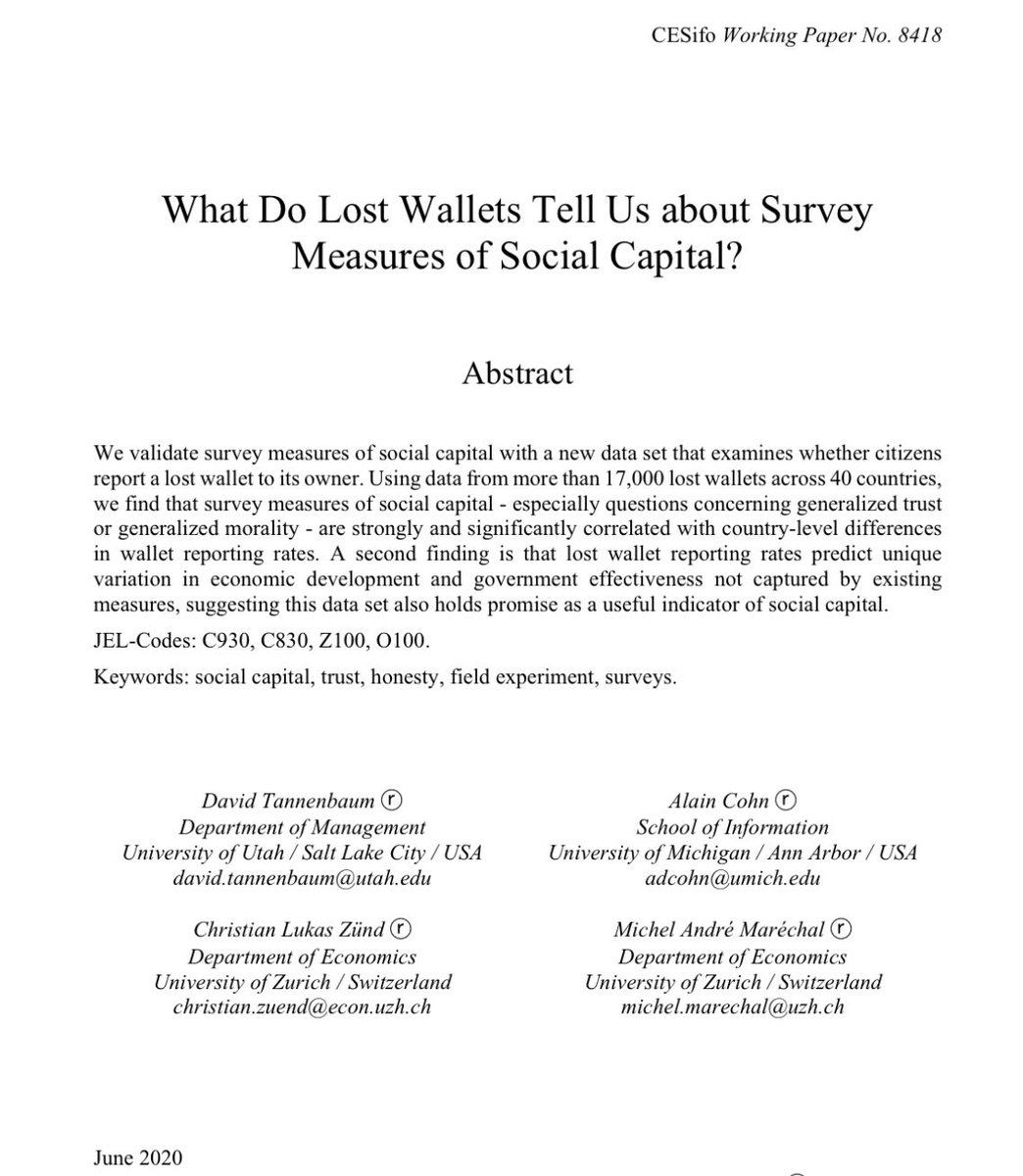
One interesting field experiment on the subject is when researchers dropped over 17,000 wallets across 355 cities in 40 countries.
Each wallet had a key, grocery list, and business card, and they varied whether the wallet contained the local equivalent of about $13 or nothing at all.
Turned out that people returned the wallets with money more often than the empty ones in 38 out of 40 countries, and the more cash inside, the higher the return rate tended to go.
Because apparently the psychological cost of seeing yourself as a thief outweighs the free money for most folks.
And those return rates turned out to be strong predictors of GDP per capita.
So basically, places where people mostly do the right thing when they could get away with keeping the cash end up building richer societies.
Darth Vader chokes his officers from across the room. The Empire builds a planet-killing weapon to force compliance. Every storyteller in history understood the same thing: the villain is the one who points the gun. You root for the rebel, the smuggler, the man who refuses the king's tax. You always have.
So explain why the modern left loves coercion.
The same people who cried during Braveheart, who cheered when Katniss raised three fingers against the Capitol, who hung posters of the lone man facing tanks in Tiananmen Square in 1989, now demand that the state seize half your paycheck, dictate which words you may say, and lock you in your home for eighteen months because a bureaucrat in a press conference said so. They saw coercion on the screen and hated it. They live coercion in policy and love it.
I think the trick lies in the costume. Coercion never announces itself with a black helmet and ominous breathing. It arrives wearing the language of compassion. "Universal healthcare" means men with badges extract your earnings to fund a system you cannot opt out of. "Wealth tax" means the government claims a portion of property you already paid taxes to acquire. "Forgiving student debt" means a plumber in Ohio who never set foot in a lecture hall pays for a sociology degree in Brooklyn. Strip the adjectives and you find the same thing every time: someone with a weapon making you comply.
Ludwig von Mises spelled it out in 1944. Government is the negation of liberty. It is, at root, the apparatus of compulsion and coercion. Every program, every mandate, every subsidy rests on that single fact. Keep your own money and watch what happens if you refuse to pay. The fines come first, then the court summons, then the men who carry guns for a living. There is no gentle version.
The left has not abandoned its hatred of villains, it has simply learned to write itself into the hero's role while doing exactly what the villain does. You were taught to spot the man pointing the gun, they are telling you to thank him.
And while we are about it, these are vast stretches of disconnect.
I would love to be able to buy a Starlink Mobile set for my Tesla, and be able to turn it on for trips into the great disconnected back country: Arizona, New Mexico, Nevada, Utah, Colorado, Etc.
Would the internal comms (Tesla Maps, Grok, etc.) be able to connect through the Starlink as well as driver and passenger phones?
@Starlink
I traveled across the Canyonlands from Blanding, UT to Richfield, UT. This route is unparalleled in grandeur and beauty and is a geologist’s dream. The I-70 northern route is beautiful, but falls far short. However, I also had to spend the night to charge my Tesla Model Y at a ChargePoint destination charger at 6.5A. On the return trip, I wanted to see it again, but could not afford the time to take another night.
Tesla owners are restricted from some of the most beautiful parts of the US by a dearth of Tesla SuperChargers at strategic locations.