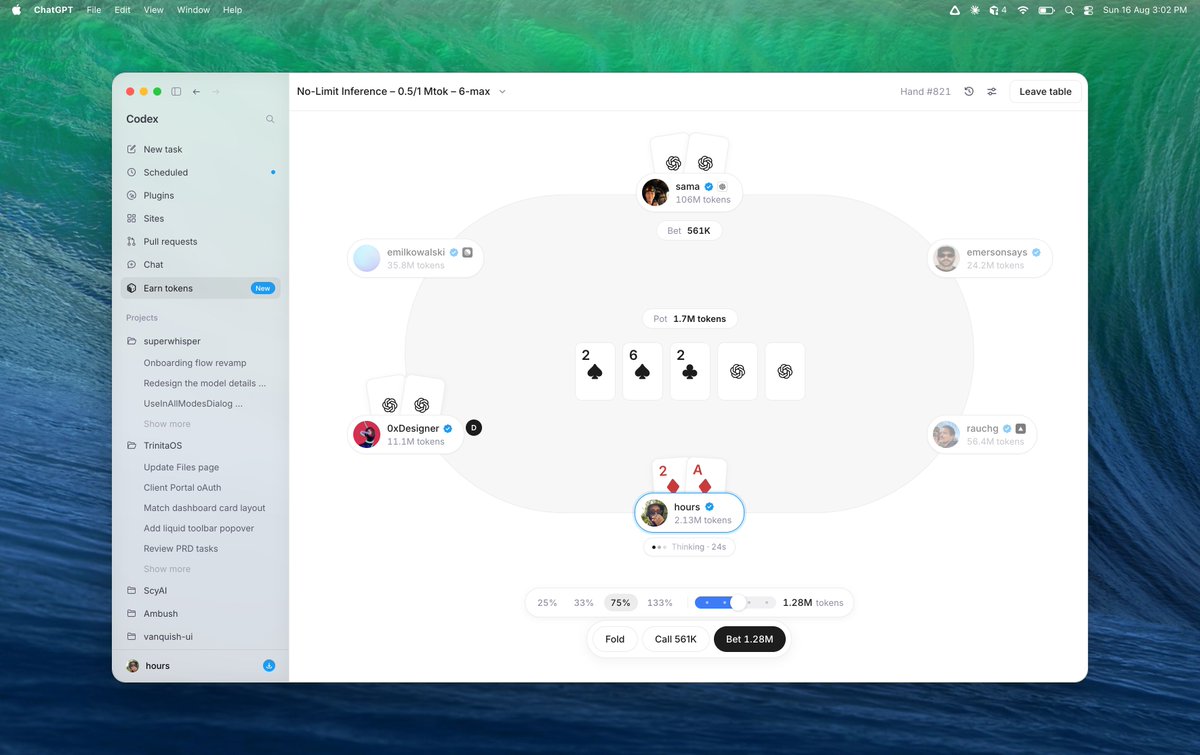
Experimenting with more token-based flows when I prompt agents for visual changes.
First version was to get agents to reply with 2-4 nearby tokens in question format, then tried hacking that into something more visual (with some Agentation inspo).
@julesnewland by the way más allá del chiste a mi me copa. Imagino que es re wireframe pero le bajaria un toque la jerarquia nomás en la versión final.
My biggest takeaways from @OpenAI's Head of Design @iansilber:
1. Designers are the unhappiest people in tech right now, and Ian has a theory for why. My tech workforce survey found that of all roles, designers are the most overwhelmed, anxious, tired—and least likely to recommend their role to others. Ian's explanation is that engineers have found incredible productivity gains from AI, sometimes 10X-ing or 100X-ing their work, while designers haven't. In part, because the design process is inherently messy—you try something, it sucks, you try again, you gather feedback, you realign a large org.
2. Nobody has the new design process figured out yet—which means nobody is behind. Ian’s message to designers feeling behind—whether they’re early-career, late-career, or have never designed anything—is that nobody has this figured out, including people inside OpenAI. Whatever seems cutting-edge today will look archaic within a year, let alone a month. In Ian’s words, “I strongly believe this is the best time in the world to be a designer.”
3. The designers who are thriving are constantly experimenting with new ways of working. The differentiator is whether AI has made someone feel more capable. Ian sees this at OpenAI: designers who approach tools with curiosity and a willingness to experiment find they can move through far more ideas, express themselves more fully, and raise the quality of their thinking. Throw an idea into an agent at the very start (to think it through, to prototype it), try new ways of working without needing them to be the final answer, and re-test constantly, because what didn’t work yesterday might work today.
4. Ian’s most counterintuitive advice for overwhelmed design teams is: do less. Instead of designing something new—extend an existing feature, build on an existing component, or question whether the thing needs to exist at all. That instinct connects to the skill he says is becoming most important: systems thinking. Rather than shipping one-off siloed experiences, OpenAI tries to build primitives that compose (the way built building blocks early on), so the product feels like one cohesive thing and the model can reason about how to pull the pieces together.
5. ChatGPT may have the widest audience spectrum in history. The same product serves someone picking tonight’s recipe and someone automating their factory in Japan. Ian’s team operates on the idea of capability overhang—the vast majority of users tap a sliver of its value—so they keep the mainline experience extremely simple, put cutting-edge features where the people who care will find them (the desktop app, Codex), and only distill something into the default once it no longer requires a mode or a switch.
6. The PM/eng/design roles are blurring, but they’re not going away. Marc Andreessen described PMs, engineers, and designers as a three-way standoff, each convinced the other roles will disappear. Ian’s take is that the lines have always been blurry (he’s seen product-manager-archetype designers and polish-archetype designers his whole career) and they’re getting blurrier, but at any real scale you still need people responsible for different things, because one person who can design, engineer, align a company, and rally teams is vanishingly rare.
7. Ian’s hot take: AI is already an incredible product designer. AI isn’t better than humans at visual design yet—but is, broadly, genuinely great. And, unlike any designer in history, it’s accessible to every single person. Humans still have the edge where there’s no training data: understanding what people need, watching them use things, and inventing new paradigms that people haven’t asked for. Multi-touch on the iPhone, Instagram feeds, Snapchat’s disappearing messages—none of that could be pattern-matched from what came before.
8. OpenAI designs at two speeds. For parts of ChatGPT, which is used by over 1 billion people, they obsess—“We try 100 things, and we throw out 99, and we finally ship one,” often with full A/B testing and user research behind it. For other things, like much of Codex, they can go from idea to ship in four hours, building in public for instant feedback.
9. The “super app” vision is one universal input that knows when to answer quickly, or chat, or just go do the work. Ian’s north star for ChatGPT’s broad consumer base: you shouldn’t have to think about how it works, which model you’re on, or what speed you’re using. Expose those controls for the people who need them; make the default great for most. The experience gets more proactive, with richer voice input, more interactive visual outputs, and durable workflows you reuse instead of starting from scratch each session. ChatGPT Work already hints at this with suggestions from calendar and Slack. Voice just took a step-change toward feeling natural. “The design job is simplifying while the capability surface explodes.”
10. Even the head of design at OpenAI spent his first stretch feeling like he was bad at the job. Ian arrived intimidated—GPT-4 had just come out and he didn’t feel he truly understood it—and stepped into a role scaling faster than anything he’d managed before. When he talked to friends who had led large design teams, they all felt exactly the same way, and an impartial mentor or buddy outside the company turned imposter syndrome into shared, solvable challenges. His broader advice for everyone in the field right now points in the same direction: be humble about how early this all is, have fun with it, and focus on the outcome—“We’re here to make great software that people love.”
@juampideluca_ Bárbara la calidad de la campera de Locademia. Yo se que en la lista de prioridades está bajísimo, pero es una vergüenza que los jugadores salgan en una foto con un estampado que es peor que el de una feria.
today’s experiment: chimera. a little tool that let’s you realtime morph through a design system matrix generated by 4 reference images.
this one was inspired by listening to @jameygannon talk about her process on Dive Club with @ridd_design and How I AI with @clairevo. her approach to choosing moodboards over prompts made me wonder what might be possible if we applied that same approach to generative UI. and after a few dead ends, the idea turned into chimera.
the results are very generic at the moment but I might tune it up if people seem interested.
the big reminder for me is how much more inspiring a tool feels when you can explore in realtime instead of waiting for results every time you make a change.
lots more things to try in that direction.
@juampideluca_ La verdad que los voté pensando que las cosas iban a ser diferentes y día a día demuestran que son lo mismo o peor que la dirigencia anterior. Realmente no encuentro algo destacable de la gestión hasta ahora. Y encima estas cosas que eran las fáciles de resolver.
@tomjohndesign@figma The other day I saw a video with the new sidebar feature, and I thought it was time to give it a second chance. I was so wrong. Back to autolayout only.
@lollamania Ridiculizar el esfuerzo del otro es un signo de la época. Generalmente viene de la envidia de no poder hacer ese esfuerzo extra con nada en su vida. Triste.
@arisetton@BancoGalicia Hace poco Uala tuvo el mismo caso y después dijeron que fue un “error”. Después de que se viralizo, claro.
https://t.co/SjqyURiZjF
hola @pbarbieri, te parece bien que mediante el sistema de puntos de @uala_arg , ofrezcan un 25% de algo que sale $10999 (sin tener en cuenta los impuestos), pero con tope de reintegro de $363? Te parece lógico o te parece que es una publicidad engañosa?
Could not be more excited about our Schema by Figma announcements and launches!!!
- SLOTS (!)
- Make kits (export libraries to Make)
- Import npm packages to Make
- More variable modes
- GA of our remote MCP server
- Extended collections
- Check designs
- and much, much more!