⚡️Success is mostly the compounding of a correctly matched nervous system under sustained reality feedback.
The biggest driver is not “hard work.” It is finding a game where your default traits become asymmetric advantages. Obsession becomes endurance. Low social dependence becomes independence. High pattern sensitivity becomes judgment. Restlessness becomes output. Then you stay in that game long enough for small advantages to compound into something that looks supernatural from the outside.
The real separator is adaptation speed.
A person who updates fast after failure, reallocates toward what is working, and can tolerate being wrong without ego collapse will eventually outrun someone more talented but slower to revise. Reality keeps grading everybody. The winner is usually the person whose internal model converges fastest while remaining in the arena.
Luck matters enormously, but mostly by determining which doors appear and when. Success comes from converting those openings better than others do.
So my deepest compression is:
Success = trait-game fit × adaptation speed × duration × opportunity.
And the part people miss is that almost all four are unevenly distributed before anyone starts “trying.”
For years, doctors noticed something strange about vaccines in India.
Vaccines that worked well in Europe and America worked less well in Indian children. Same vaccine, same dose, weaker protection.
Most people accepted it. One scientist in Vellore spent 30 years asking why.
Her name is Gagandeep Kang.
She trained as a doctor at Christian Medical College in Vellore, in Tamil Nadu, and then did something unusual for a physician. She went into the laboratory and stayed there.
Her subject was the gut.
Specifically, the guts of children in poor households. She studied what repeated diarrhoeal infection does to a child's intestine over the first years of life.
What she found matters enormously. Those repeated infections do not just make a child ill. They damage the lining of the gut, stunt growth, and interfere with how the body responds to oral vaccines.
That is why a vaccine developed in a clean environment abroad underperforms in a child who has had 10 infections before the age of 2. The problem was never the vaccine. It was what the child's gut had already been through.
Then she went further than diagnosis.
Rotavirus is the leading cause of severe diarrhoea in small children and it kills a very large number of them. India had access to imported rotavirus vaccines, but they were expensive and often out of reach for the families who needed them most.
Kang led the clinical trials for Rotavac, India's first indigenous rotavirus vaccine, made by an Indian company. She was also central to the work behind a second one, Rotasiil.
Both are now approved by the World Health Organisation. Rotavac went into India's national immunisation programme, which means it reaches children whose parents pay nothing for it.
In 2019 she became the first Indian woman scientist working in India to be elected a Fellow of the Royal Society, the scientific body founded in London in 1660. It took 359 years.
She has served on the World Health Organisation's global advisory committee on vaccine safety, and she now leads global health work at one of the largest health foundations in the world.
She built her career on a question most people did not think was worth asking.
Not how do we get vaccines to poor children. But why do they not work as well when they get there.
TOILETS.
Toilet of house - Bathroom
Toilet of office - Washroom
Toilet of mall - Restroom
Toilet of flight - Lavatory
Toilet of restaurant- Powder room
Toilet of stadium - Toilet cubicle
Toilet of swimming pool - Changing room
Did you know?
Steve Kerr says Roger Federer taught his Warriors team the secret to sustained success wasn’t outworking everyone, it was building a life around your craft you never want to escape from
“I’ll tell you a great story about Roger Federer. We were playing in China with the Warriors in 2017. Roger was in Shanghai for the Masters tournament, so we invited him to come speak to the team.”
“Draymond Green asked him, ‘How do you sustain success? How have you managed to win majors 20 years after you first won one?’ Everyone was expecting him to say, ‘I work harder than everybody,’ the will, all the clichés.”
“Roger Federer says, ‘I get up every morning and I make breakfast for my kids. Then I take them to school and drop them off. Then I go practice tennis for about two hours, and I’ve figured out a really good routine where I don’t destroy my body, but I can get all the work in I need.”
“‘Then I go have lunch with my wife. In the evening, we cook dinner together. The kids are all home from school. We ask them about school. There’s so much joy in the house. We put them to bed, and then I put my head on the pillow and go, “Man, that was just a great day.” And I’ve been doing that for 20 years.’”
“And it was like, yes. That’s it. That’s the formula. That’s what leads to sustained success. He loves tennis. He loves his family. He loves life. It’s not outworking everybody and banging your head against the wall, ‘I’m going to be better than everybody.’ It’s allowing your natural talent to shine through with a work ethic, with a great family life, with perspective, with peace, with mindfulness.”
“It’s perspective. It’s joy. It’s passion. It’s mindfulness. It’s an awareness that we are truly lucky. To get the most out of ourselves, it’s our daily rituals and experiences and love and joy.”
If you want to live peacefully in India
- Avoid roadrages
- Avoid teaching civic sense to strangers on road
- Avoid public transport
- Avoid discussing politics in public place
- Say sorry with folded hand and move on
People have became impatient and violent specially here.
This is the new epidemic which no one is talking about
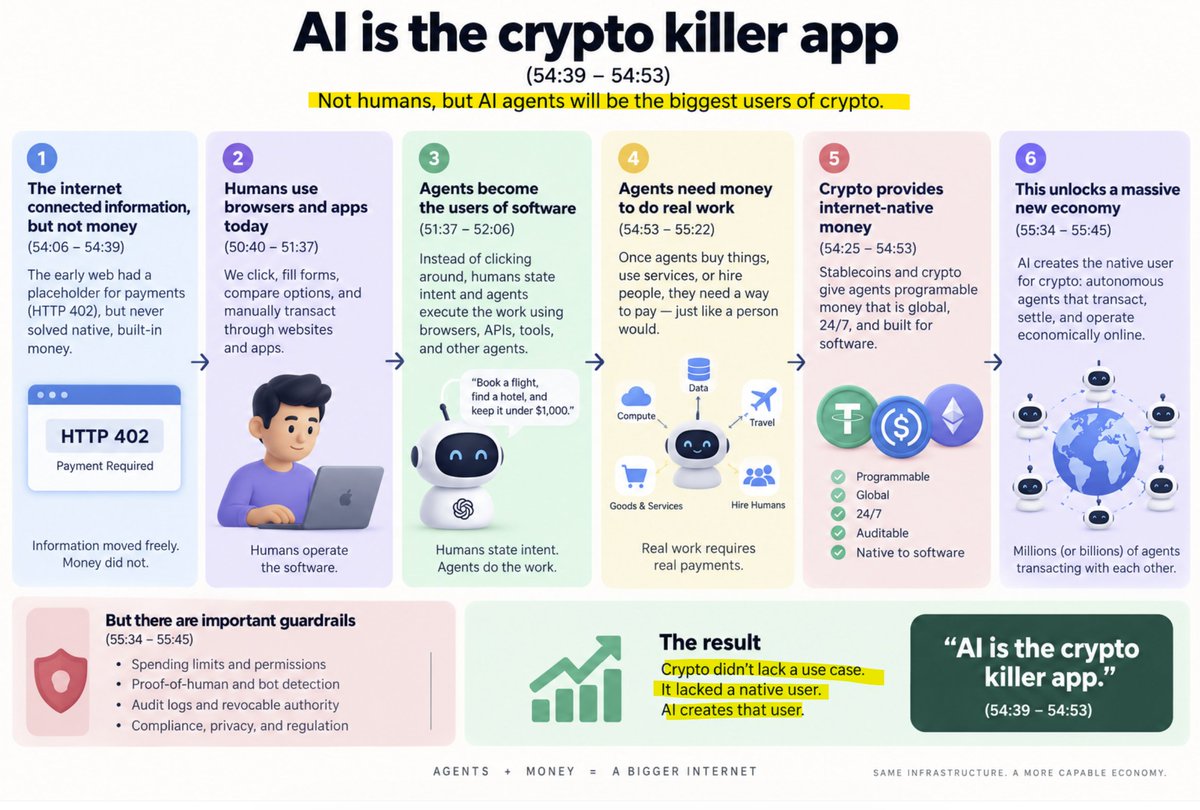
This is a visual I put together for this weekend's video. It is built from timestamps of an interview with Marc Andreessen from April on the importance of the collision of AI agents and crypto. I will go through in detail on Sunday morning but this intersection is the most important investment theme for the next year. Do your homework now.
Once in joe Rogan podcasts Chris Williamson said:
"This great line that the curse of discipline is that every day looks the same, and the curse of indiscipline is that every year looks the same."
⚡️There is going to be a brutal repricing of education.
A four-year degree at enormous cost makes much less sense when knowledge itself becomes abundant.
The university system will be forced to justify what the credential buys beyond information transfer.
Elite networks, regulated credentials, laboratories, medicine, physical training, genuine apprenticeship, those survive better.
Paying $150,000 to receive lectures and prove basic cognitive competence gets harder to defend when an AI tutor is better, personalized, available constantly, and nearly free.
There is a 48x27 cm carved rock in Burzahom, Kashmir.
A hunting scene from 4500 years ago. But, in this scene, there are 2 suns in background.
It was discovered in 1969. First archeologists ignored 2 suns as some cultural symbol.
But later, they interpreted it was intentional. The people 4500 years ago did notice something in sky that they wanted to paint in their memory.
These paintings were a way to teach things to younger gens in those times. So what were these two suns?
Archeologists interpreted that other sun can be HB9 Supernova which happened around the timeline & people must have observed it on earth.
If that is true, then it is world’s earliest known evidence of astronomy and star chart.
It is still debatable if this is a supernova but it is a fine piece of history about how humans were curious in those times.
Feels like a good time to revisit the 4chan posts that called the Oct 6th Crypto top.
More importantly, how the second post calls the rebound.
BTC: $190,000
ETH: $15,000
SOL: $1,000
QE is back under a different name and Crypto appears to have bottomed.
If that same math applies to other alts, here's what it looks like:
$HBAR: → $1.50–$2.00
$XRP: → $5–$7
$XLM: → $1.20–$1.60
$QNT: → $800–$1,000
$CC: → $2–$3
$ALGO: → $2–$3
Not predictions.
Not advice.
Just another fake 4chan conspiracy... right??
One of the greatest cheat codes in life is to never get offended. Train yourself to have thick skin. Don't take things personally. Let others disagree with you. Being easily offended means you're easily manipulated. If you value peace of mind, avoid getting offended.
A monk once said:
“Imagine being bitten by a snake, but instead of treating the poison, you chase the snake, trying to understand why it bit you and prove you didn’t deserve it.”
Many people get stuck in this question.
Why did this happen to me?
You replay the conversation.
Analyze their words.
Question their motives.
Search for what you did wrong.
Build a case for why you didn't deserve it.
You keep chasing the snake that bit you.
But the snake isn't the problem anymore.
The poison is.
Understanding can help. But endlessly searching for an explanation can keep the wound open.
You may never get an apology.
You may never understand their motives.
You may never get a satisfying answer.
And you don't need one to heal.
At some point, stop asking “Why did they hurt me?”
Start asking:
“What do I need to do to heal?”
Stop chasing the snake.
Treat the wound.
#wisdom
⚡️Bitcoin’s most profound breakthrough is this:
It created property that does not need a sovereign, bank, company, or custodian to exist as property.
That goes deeper than “digital gold,” deeper than scarcity, deeper than payments, deeper than Saylor’s “economic energy” metaphor.
For almost all of history, wealth ultimately depended on recognition by some external authority.
Land required law.
Bank deposits required banks.
Stocks required corporate registries.
Bonds required issuers.
Gold could escape some of that, but once you wanted to move it at scale, store it safely, or use it across borders, institutions came back into the picture.
Bitcoin did something historically strange.
It fused the asset, the ownership record, and the settlement system into one thing.
If you possess the keys, the network recognizes the claim because the claim is cryptographically valid. Nobody has to know who you are. Nobody has to approve the transfer. Nobody has to promise redemption. There is no issuer whose balance sheet sits underneath the asset.
That is the rupture.
And the 21 million cap makes it even deeper because now the monetary constitution travels with the property.
The future cannot casually decide that yesterday’s savings should be diluted because today has an emergency.
So the breakthrough is really two things welded together:
Ownership without permission, and scarcity without discretion.
That combination had never existed globally in a digitally native bearer asset.
And this is where Saylor’s “economic energy” language is reaching for something real.
Money is stored agency across time.
You work today.
You do not consume everything.
You carry that unused command over resources forward.
Bitcoin gives you a way to encode that deferred agency into a system whose monetary rules are extraordinarily difficult for any single actor to rewrite.
That is why the deepest description remains:
Bitcoin is incorruptible monetary memory.
It remembers that value was assigned here, transferred there, and remains under this key.
It remembers without needing the original owner.
It remembers without needing Satoshi.
It remembers without needing a bank.
It remembers without needing the government that happens to exist fifty years later.
That is almost mythic when you really sit with it.
Human civilization spent thousands of years asking:
Can we store sacrifice across time without trusting the future not to alter the terms?
Bitcoin is the first serious answer that says:
Make the promise survive the promisor.
And if it succeeds over generations, that will be its historical meaning.
Not that it made money digital.
That it made monetary ownership native to information itself, and gave the past cryptographic teeth against the future.